Pet Travel Crate Sizing Errors That Cost Time and Money
A dog can be under the manufacturer’s weight limit and still be denied at airline cargo check-in. Weight is not the controlling measurement.
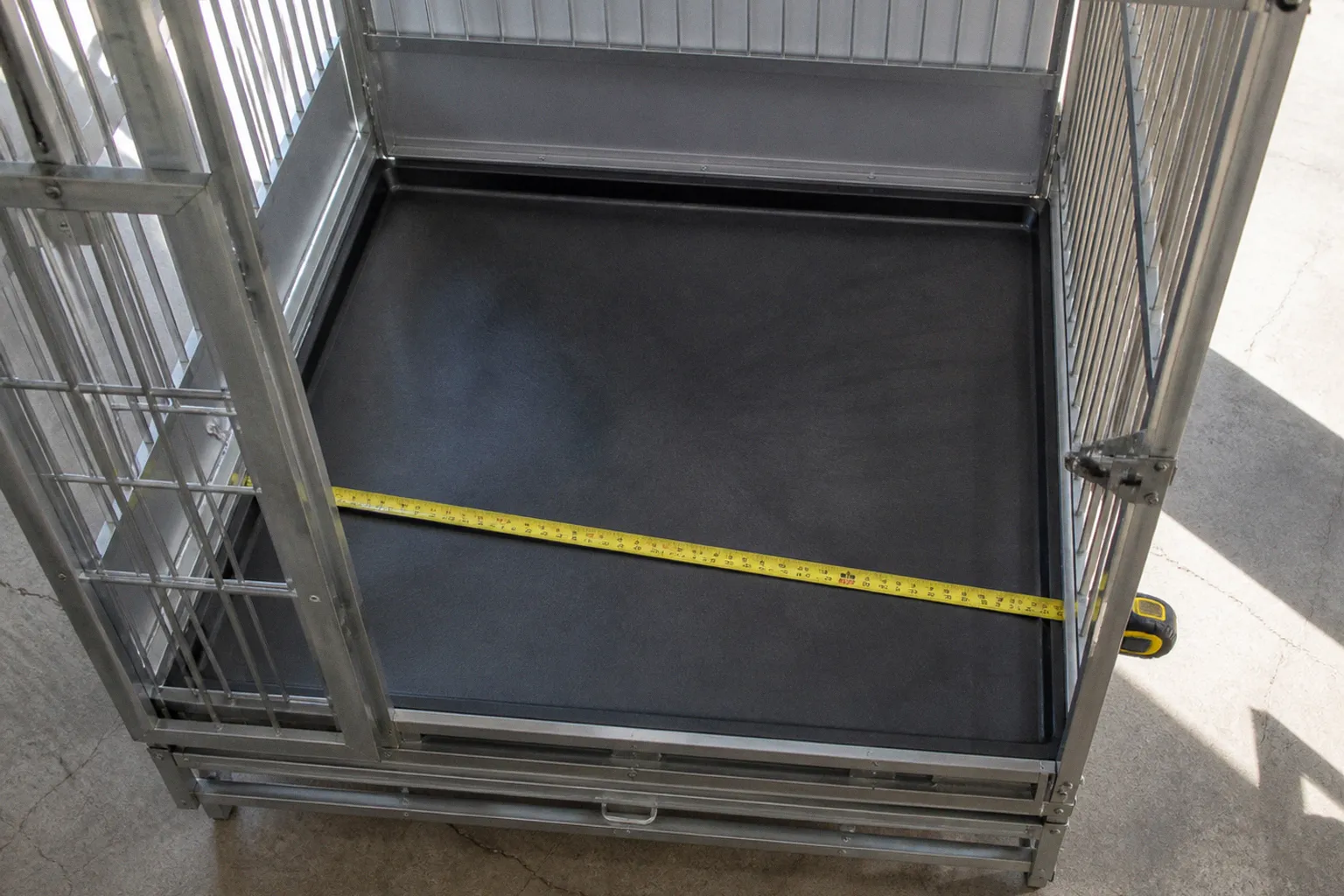
Internal length, width, height, ventilation, door security, and structural configuration determine whether a crate meets IATA Live Animals Regulations requirements.
The most expensive pet travel crate sizing mistakes occur before the trip begins: selecting by breed, trusting an “airline approved” retail label, measuring only the dog’s back, or ignoring bedding thickness. The result is predictable. The crate fails inspection, the booking is reworked, and the animal is exposed to unnecessary handling and delay.
For cargo travel, size the crate from the dog’s body measurements. Then inspect the crate as a transport system, not as a retail product.
The “airline approved” label is not a compliance test
Retail packaging uses “airline approved” as a broad commercial description. It does not confirm that a specific crate complies with the requirements applied by an individual airline or with the IATA-LAR Container Requirement 1 formula.
This distinction matters because two crates can carry the same listed weight while providing different internal dimensions. A 30-kilogram rating says little about whether the dog can stand without ear contact, turn around without compressing the shoulders, or lie down in a natural position.
The label also says nothing about several structural details that can trigger a cargo denial:
- The crate may use plastic side fasteners instead of metal nuts and bolts.
- The door may lack locking pins with sufficient extension above and below the frame.
- Ventilation openings may be too large for safe containment.
- The base may not be solid or leak-resistant.
- Wheels, removable handles, or top-loading doors may conflict with cargo requirements.
- The advertised dimensions may be external, while the usable internal space is significantly smaller.
A manufacturer’s weight rating is useful for load capacity. It is not a substitute for gait clearance, turning space, or vertical clearance.
An “airline approved” label is a marketing claim until the crate passes the measurement and hardware inspection.
Airlines can apply their own operational acceptance procedures. They may also reject a crate that does not match the booked animal, even if the product is sold for air travel. The relevant question is not whether the crate was advertised for airline use. The relevant question is whether its internal dimensions and construction satisfy the applicable transport standard.
Measure the dog before selecting the crate
Measuring a dog for an airline crate is a geometry task. Do not begin with the crate catalog. Begin with the animal.
Use a standing position on a level surface. The dog should be in a neutral posture, not sitting, crouching, stretching forward, or lowering the head. If the dog has a thick coat, measure the body position rather than the inflated coat outline. Record the measurements in centimeters.
The four measurements used in the IATA-LAR CR1 sizing formula are:
- A — body length: from the tip of the nose to the base of the tail.
- B — elbow height: from the floor to the elbow joint.
- C — shoulder width: the widest horizontal measurement across the shoulders or body.
- D — standing height: from the floor to the top of the head, or to the top of the ear tips when the ears are naturally erect.
The measurements must describe the dog’s actual transport posture. A dog that normally carries its head high can require more vertical clearance than a breed chart suggests. Ears are part of the height calculation. So is bedding.
The CR1 sizing formulas
The minimum internal dimensions are calculated as follows:
| Crate dimension | IATA-LAR CR1 formula | Practical measurement issue |
|---|---|---|
| Internal length | A + ½B | Nose-to-tail length does not include the additional elbow-height allowance |
| Internal width | C × 2 | Shoulder width must be measured at the widest point |
| Internal height | D + bedding height | Bedding reduces usable vertical clearance |
| Alternative height allowance | Height × 1.1 | A 10% increase may be applied where required by the sizing method or breed profile |
The formula is based on internal usable space. External crate dimensions do not qualify. Interior ribs, door frames, recessed walls, molded handles, and sloped panels can reduce the space available to the dog.
For example, a dog with a body length of 85 centimeters and an elbow height of 30 centimeters requires an internal length of:
85 + 15 = 100 centimeters
If the shoulder width is 32 centimeters, the internal width calculation is:
32 × 2 = 64 centimeters
If the dog’s standing height is 70 centimeters and the bedding is 5 centimeters thick, the internal height must accommodate at least:
70 + 5 = 75 centimeters
These calculations do not make a crate automatically acceptable. They establish the dimensional baseline. The crate must still pass the hardware, ventilation, door, base, and airline acceptance requirements.
Measure the crate’s usable interior
Manufacturers often list dimensions in a way that creates confusion. A crate may be described by its external length, while the interior is narrowed by the door assembly or sidewall shape. Measure the interior at the points the dog will occupy.
Check:
1. Length at floor level. Confirm that the dog has the calculated nose-to-tail space plus the elbow allowance.
2. Width across the usable interior. Do not measure only the widest external section.
3. Height above the bedding. Place the actual absorbent pad or bedding in the crate before measuring.
4. Door clearance. The opening must not create a lower or narrower passage than the crate interior.
5. Internal projections. Remove or account for bolts, wheel housings, handles, and molded structures that reduce movement.
The dog should be able to stand with the head and ears clear of the roof, turn around without shoulder compression, and lie down in a normal position. These are functional outcomes of correct sizing. They are not optional comfort features.
Why breed charts and weight limits fail
Breed averages are not individual measurements. A narrow, long-bodied dog and a compact dog can have the same weight with completely different crate requirements. A lean dog with long limbs may exceed the height of a heavier dog with a lower stance.
Weight-based selection also fails when the dog is near the upper size limit of the crate. The animal may fit the load rating while failing the width or height calculation. The crate can carry the mass but still restrict the kinetic chain during standing, turning, and lying.
This is particularly relevant for dogs with:
- Long backs relative to body height.
- Broad shoulders.
- Erect ears.
- Heavy neck and chest development.
- Large variations between male and female body dimensions.
- Recent growth or changing body condition.
- Orthopedic limitations that require more turning space.
A crate that fits today may fail after the dog gains muscle, coat volume, or body length. For puppies and adolescent dogs, use the expected transport size rather than the current measurement. Oversizing beyond the required dimensions is not automatically safer, however. Excessive empty space can increase movement during handling and turbulence. The target is compliant functional clearance, not maximum interior volume.
Structural failures that cause cargo denials
Sizing is only one part of airline acceptance. A crate can meet the CR1 dimensions and still fail because of its construction.
Fasteners and frame integrity
Cargo crates require secure assembly. Plastic side fasteners and plastic latching clips are common points of failure. For cargo travel, the crate should use metal nuts and bolts through the relevant connection points. The fasteners must hold the two shell sections together under handling loads.
Do not rely on friction-fit panels, snap closures, or a single central latch. A door that appears secure in a living room may not remain secure when the crate is lifted, tilted, or moved across a cargo facility.
Door locking pins
The cargo door must resist accidental opening. Locking pins should extend at least 1.6 centimeters above and below the door frame. The pin extension is a physical security feature. It prevents the door from disengaging when the frame flexes or the latch is disturbed.
Inspect the door in the closed position:
- Confirm that the pins fully engage.
- Confirm that the door frame is not cracked or distorted.
- Confirm that the latch cannot be released by pressure from inside.
- Confirm that no removable component can shift during handling.
- Confirm that the door does not bind against the crate shell.
A metal door is not enough by itself. The locking mechanism, frame, hinges, and shell connection must function as one load-bearing assembly.
Wheels, handles, and removable parts
Wheels can alter the stability of the crate and create projections that catch on conveyor systems or handling equipment. Top-loading doors create a second access point and can be incompatible with cargo acceptance. External handles can detach or interfere with stacking.
If a crate includes wheels or a removable platform, follow the airline’s instructions for removal. Do not assume that a detachable component is acceptable simply because the manufacturer includes it in the product design.
Solid base and absorbent bedding
The base should be solid and capable of containing moisture. Use bedding that provides absorption without raising the dog above the calculated internal height.
Thick cushions can create a sizing failure even when the empty crate appears compliant. Measure the height of the bedding after it is placed inside and compressed under normal weight. Loose blankets can also bunch against the door or cover ventilation openings.
The bedding should support the dog without creating a rolling surface. Stability affects load distribution and postural control during acceleration, deceleration, and handling.
Ventilation openings must contain the animal safely
Ventilation is a thermal regulation and containment problem. Air must circulate through the crate, but openings must not allow the dog’s nose, paw, or claw to become trapped.
For rigid plastic cargo crates, the maximum ventilation opening dimensions identified in the research are:
- Dogs: 25 by 25 millimeters, or 1 by 1 inch.
- Cats: 19 by 19 millimeters, or three-quarters by three-quarters of an inch.
Do not enlarge ventilation holes to compensate for a poorly designed crate. Larger openings can create entrapment points and may fail inspection. Do not cover openings with fabric, plastic film, or improvised mesh. Any modification can change airflow, structural integrity, and acceptance status.
Inspect all four sides. A crate may have adequate openings on the door but insufficient airflow on the rear or side panels. Ventilation pathways can also be obstructed by luggage, cargo wrapping, or positioning against a solid surface. The carrier should not be packed around the crate in a way that blocks the openings.
Thermal risk increases when the dog cannot dissipate heat through normal respiratory exchange. Brachycephalic dogs have additional airway and airflow limitations. Their crate selection requires more than a nominal fit.
Brachycephalic breeds need additional clearance
Short-nosed breeds such as Pugs and Bulldogs present a higher respiratory management problem during transport. The shortened muzzle changes airflow resistance. Restricted clearance around the head can further reduce effective ventilation.
For these dogs, the research indicates that the crate may require a full size increase or an additional 10% in each dimension. Apply the increase to the actual calculated dimensions, not merely to the manufacturer’s next product name.
If the calculated internal length is 90 centimeters, a 10% increase produces 99 centimeters. If the calculated width is 60 centimeters, the adjusted width becomes 66 centimeters. The same logic applies to height, with bedding included in the final clearance.
The crate should allow the dog to hold the head without pressing the muzzle against the door or sidewall. Avoid designs that taper sharply near the front. A crate can satisfy a rectangular measurement while restricting the respiratory space around the face.
Airline policies for brachycephalic breeds can also be more restrictive than the general crate standard. The crate calculation is therefore a minimum design control, not a guarantee of acceptance. Confirm the breed policy and routing restrictions before paying for transport.
For a short-nosed dog, internal clearance is an airflow parameter. Treat it as part of respiratory safety, not as spare room.
The difference between ground transport and cargo travel
Ground pet transport has more flexibility in crate selection, but the same biomechanical principles apply. A crate that is acceptable for a private vehicle may not be acceptable for aircraft cargo. Conversely, a crate designed for cargo may be unnecessarily large or difficult to secure in a car.
For ground transport, assess:
- Whether the crate can be anchored so it cannot slide or rotate.
- Whether the dog can maintain a stable stance during braking.
- Whether the crate allows adequate airflow inside the vehicle.
- Whether the doors remain accessible to the handler.
- Whether the crate blocks emergency exit routes.
- Whether temperature can be controlled throughout loading and transit.
A loose crate changes the dog’s load distribution during acceleration and cornering. The animal may brace continuously through the limbs and shoulders. That increases fatigue and can aggravate existing orthopedic limitations.
In a pet taxi or relocation vehicle, the crate must be compatible with the vehicle’s anchor points. Do not place a rigid crate where it can move laterally or where luggage can fall against the ventilation panels. The crate should remain level and stable.
For interstate relocation, air and ground segments should be treated as one transport chain. The dog may change vehicles, handlers, and environments. A crate that meets the airport requirement but cannot be safely secured in the ground vehicle is not a complete solution.
A troubleshooting sequence for crate selection
Use this sequence before booking the animal.
1. Identify the transport mode
Determine whether the dog will travel:
- In the aircraft cabin.
- As checked baggage, where permitted.
- In cargo.
- By private vehicle.
- With a professional ground transport provider.
- Through a mixed air-and-ground itinerary.
The IATA-LAR CR1 formulas are specifically relevant to cargo crate sizing. Cabin carriers follow different dimensional and airline-specific limits. Do not transfer cargo assumptions directly to an under-seat carrier.
2. Record the four body measurements
Measure A, B, C, and D in a neutral standing position. Repeat each measurement if the result is close to a crate’s listed internal dimension. Use the larger reliable measurement when anatomy or posture creates uncertainty.
3. Calculate the internal dimensions
Apply:
- Length = A + ½B.
- Width = C × 2.
- Height = D + bedding height.
For a brachycephalic breed, evaluate the additional 10% allowance or the next full crate size. Do not reduce the allowance because the dog’s weight appears low.
4. Compare against usable interior dimensions
Ignore the external product size. Measure the internal floor, interior width, and height above bedding. Check the door opening separately.
If any dimension is below the calculated requirement, the crate is undersized. A larger crate is required.
5. Inspect the hardware
Reject the configuration for cargo use if it depends on:
- Plastic side fasteners.
- Plastic latching clips.
- Wheels that cannot be removed when required.
- Top-loading doors.
- Unsecured removable panels.
- Door pins that do not extend at least 1.6 centimeters above and below the frame.
- A base that is not solid.
6. Inspect ventilation
Confirm that openings provide airflow without exceeding the relevant maximum opening size. For dogs, the maximum identified opening is 25 by 25 millimeters. Check the rear, sides, roof, and door.
7. Confirm the route and airline policy
A compliant crate does not eliminate route-specific restrictions. Verify acceptance conditions for the operating carrier, aircraft type, destination, season, and breed. Recheck the requirements if the itinerary changes.
8. Conduct a functional trial
Place the dog inside the assembled crate with the actual bedding. Observe standing, turning, lying, and head clearance. Do not use a short trial as proof that the airline will accept the crate. Use it to identify physical restrictions before the travel date.
Common pet travel crate sizing mistakes
The following errors occur repeatedly because they replace measurement with assumption.
1. Selecting by body weight alone.
Weight measures load, not internal clearance. A dog can meet the weight rating and fail length, width, or height requirements.
2. Using breed averages.
Breed averages cannot account for individual shoulder width, ear height, body length, or posture.
3. Measuring only from neck to tail.
The CR1 length formula begins at the tip of the nose and adds half of the elbow height.
4. Ignoring the ears.
D is measured to the top of the head or ear tips, depending on the dog’s natural ear position.
5. Measuring the empty crate.
Bedding reduces vertical clearance. Interior fittings reduce usable space.
6. Trusting the phrase “airline approved.”
Retail labeling does not establish compliance with IATA-LAR CR1 or a specific airline’s acceptance process.
7. Using plastic hardware for cargo.
Plastic fasteners and latching clips can fail under handling loads and are not compliant for cargo travel.
8. Accepting oversized ventilation openings.
Large openings can expose the nose and paws to injury or entrapment.
9. Failing to account for brachycephalic anatomy.
A nominal fit may not provide adequate airflow around a short muzzle.
10. Testing the crate only at home.
A stable crate on a floor may move in a vehicle, on a trolley, or during loading. Security must be evaluated across the transport chain.
Final safety parameters
Before the crate is presented for cargo travel, confirm every parameter below:
- Internal length meets A + ½B.
- Internal width meets C × 2.
- Internal height meets D + bedding height.
- The dog can stand without the head or ears contacting the roof.
- The dog can turn around without shoulder compression.
- The dog can lie down in a normal position.
- Brachycephalic breeds receive the required size increase or 10% dimensional allowance.
- Internal dimensions, not external product dimensions, were used.
- Bedding is installed before the final height assessment.
- The crate has a solid base.
- The crate uses metal nuts and bolts where required.
- Plastic side fasteners and plastic latching clips are not used for cargo.
- Door locking pins extend at least 1.6 centimeters above and below the frame.
- Dog ventilation openings do not exceed 25 by 25 millimeters.
- No wheel, handle, panel, or accessory can detach during handling.
- Ventilation openings remain unobstructed.
- The carrier’s current route and breed requirements have been confirmed.
- The crate is stable in the vehicle or transport system used for the ground segment.
The correct crate is not the one with the highest weight rating or the most convincing retail label. It is the crate that matches the dog’s measured anatomy, preserves functional clearance, maintains containment under load, and remains acceptable across the actual transport route. Size from the dog. Inspect the hardware. Validate the route before departure.