Can Two Dogs Share a Travel Crate?
The phrase "bonded pair" gets tossed around like it's a shipping label. Two dogs who curl up on the same couch, eat within a few feet of each other, and tolerate shared space at home become a…
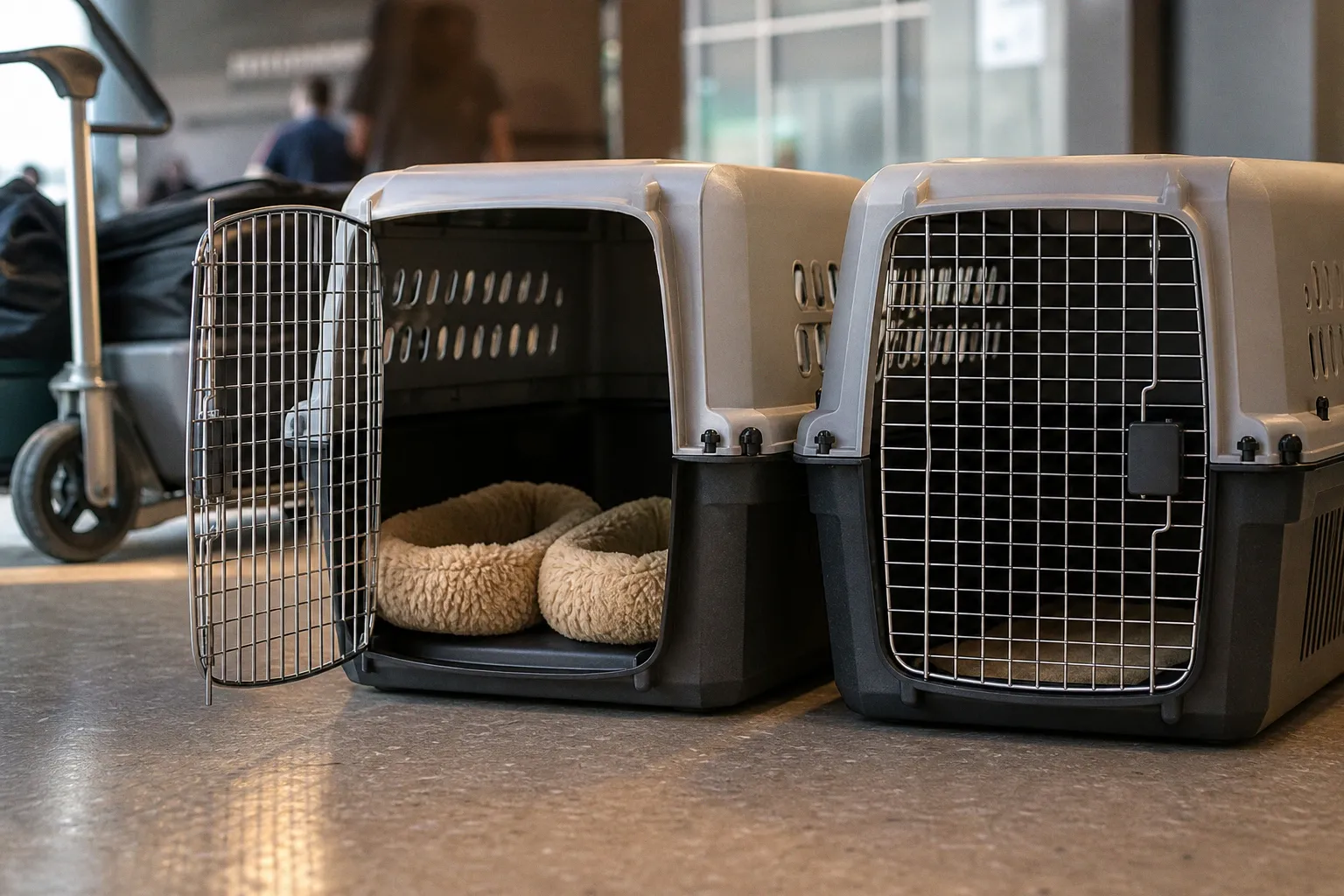
The phrase "bonded pair" gets tossed around like it's a shipping label. Two dogs who curl up on the same couch, eat within a few feet of each other, and tolerate shared space at home become a logistical unit that has to stay together — through airport cargo holds, ground transport vans, and multi-day relocations. Then someone Googles whether they can stack both dogs in one kennel to save on shipping fees, and the answer they want is yes.
The actual answer has three layers, and they don't agree with each other. The federal regulations technically allow shared crating in narrow circumstances. Most commercial airlines refuse it outright. And the behavior case against crating two dogs together — even bonded, even littermates — is stronger than most owners want to hear.
What the Rulebook Actually Says (USDA and IATA)
Two regulatory bodies govern how animals move under shared containment, and they read like they were written by different species of bureaucrat.
USDA rules, the ones domestic air transport inside the United States falls under, default to one dog per kennel. The exception is built for puppies, not adult dogs: two puppies between 8 weeks and 6 months old can share a crate if they are of comparable size, both weigh 20 pounds (9 kg) or less, and the crate is sized to accommodate both animals comfortably with the usual space and ventilation standards. Once a dog passes 6 months or tips over 20 pounds, the USDA position is one dog per kennel, full stop.
IATA Live Animal Regulations, which govern international shipping and most commercial pet relocation services, are slightly more permissive on paper. Two adult dogs of comparable size, each weighing no more than 14 kg (about 30 lbs), can share a crate if they are "compatible and accustomed to cohabiting." For puppies or kittens traveling together, the rules are tighter: same litter, no older than six months, each animal under 14 kg, and a maximum of three animals per container.
| Regulation | Who can share | Weight limit (per animal) | Age limit | Max animals per container |
|---|---|---|---|---|
| USDA APHIS | Two puppies | 20 lbs (9 kg) each | 8 weeks – 6 months | 2 |
| IATA (adults) | Two compatible, cohabiting dogs | 14 kg (≈30 lbs) each | No upper limit named, but compatibility required | 2 |
| IATA (littermates) | Puppies or kittens, same litter | 14 kg each | Under 6 months | 3 |
That's the baseline. None of these rules override the carrier.
The rulebook gives you permission. The airline gives you a bill of lading. They are not the same document.
Airlines Hold the Real Cards
This is where the romantic version of the rules collides with operations. The vast majority of U.S. carriers and a long list of international carriers prohibit shared crate travel for adult dogs outright, even when the dogs meet every IATA threshold on paper. Reasons cited: ventilation, weight distribution during flight, crew handling logistics, and liability if one animal injures the other in transit.
Pet relocation services follow the same trajectory. Companies that move animals across state lines or across oceans typically default to one dog per crate for any animal past the puppy stage. The agencies that will attempt shared crating for adult dogs usually require proof of long-term cohabitation, a behavioral assessment, and a signed liability waiver — and even then, the final call belongs to the operating airline at the connection point.
If you book two adult dogs into a single crate on a flight and the cargo team refuses the load at the tarmac, the dog that doesn't fly doesn't get a refund — they get rebooked into a kennel of their own at your cost, often at a worse routing. This is not a hypothetical; it's a Tuesday for relocation coordinators.
Airline policy is the only policy that matters when the crate hits the cargo hold.
The Behavior Fallout Nobody Wants to Talk About
Here's where the rescue rehab lens comes in, and where owners who have a stable multi-dog household at home often push back hard. They get along fine. They've never fought.
Home behavior doesn't predict travel behavior. Travel strips every coping mechanism a dog has. There is no escape route. No other room. No backyard. No place to put distance between themselves and a crate-mate when a baggage cart slams into a wall, when a turboprop engine winds up on the other side of the fuselage, when the crate next to them on the conveyor is occupied by a barking stranger.
Dog behaviorists are unanimous on this: crating two unfamiliar or loosely-bonded dogs together during transit is a recipe for redirected aggression. Stress hormones spike. External triggers — engine noise, barking from neighboring crates, sudden motion — flood the system. One dog startles, snaps, and the only thing within reach is the other dog. Resource guarding kicks in around water dishes, around favorite corners of the crate, around the handler's hand reaching in at the layover point.
Even bonded littermates, the strongest case for shared crating, are not safe from this. Littermate syndrome is its own documented phenomenon, and travel amplifies it. Two puppies who have never had to manage separation anxiety may come out of a 14-hour transit showing new aggression toward each other, new hyper-dependency, or both.
A bonded pair at home is not a bonded pair in a crate at 35,000 feet. The crate doesn't know they're siblings.
Cabin Carrier Exceptions (and Why They're Tiny)
In-cabin travel is the one place where shared carriers are still alive in practice. Some airlines permit two small, compatible pets in a single cabin carrier, provided their combined weight plus the carrier stays under the airline's limit. Egyptair publishes one of the clearer limits: 17 lbs (8 kg) total for two pets in one carrier.
The practical math here is brutal. A single cat can weigh 10 pounds. Two small dogs plus carrier can blow past the limit before you've factored in a water dish. The cabin exception exists for genuinely small pets — think two cats under 8 lbs each, or two toy-breed puppies — and even then, the airline's final word on compatibility comes down to the gate agent. Many U.S. carriers have quietly phased out cabin shared carriers altogether, and the trend line points toward fewer exceptions, not more.
If your plan depends on a shared cabin carrier, call the airline, get the answer in writing, and arrive at the airport with two carriers anyway. That's not paranoia; it's standard operating procedure.
What Actually Works for Two Dogs on the Move
The clean answer is also the least fun one: buy or rent two crates, sized to each dog individually, and accept the cost as part of the relocation budget. Everything else is a compromise that trades safety or sanity for savings.
For ground transport specifically:
- Two crates side-by-side in the vehicle, not stacked, not nested. Each dog has its own sight line, its own water, its own ventilation profile.
- If the dogs must travel loose in a vehicle, use a crash-tested harness on each, anchored to separate seat belt points. Never tether two dogs to the same anchor.
- For long-distance ground transport services (cross-state, cross-country van services), confirm the operator's policy on shared vs. individual crates before booking. Reputable operators default to individual crating and have no problem putting that in writing.
For air transport:
- Two individually-sized crates, each compliant with IATA or USDA standards for the dog inside it. The crate is sized to the animal, not the budget.
- Direct flights whenever possible. Connection points are where crates get mishandled, dogs get re-tagged, and shared-crate requests get rejected at the last minute.
- Pre-flight behavioral assessment is worth the cost if either dog has any history of resource guarding, fear-based reactivity, or travel anxiety. A vet or certified behavior consultant can flag the dogs who should never be crated near another animal, regardless of paperwork.
For the home stretch — decompression is the word that matters here. When the dogs arrive, give them parallel space, not immediate forced reunion. Two crates side-by-side in a quiet room, separate water, separate elimination walks, and a gradual reintroduction over 24 to 48 hours. Travel stress lingers longer than owners expect. The dogs don't need a family reunion; they need to land.
The Homework
This is the part most people skim, so it's the part I'll be direct about.
Before you book any multi-dog transport, do these four things, in order:
1. Call the operating airline (or the relocation agency's operating partner). Ask, in writing, whether shared crating is permitted for your specific dogs. Don't accept a generic "we follow IATA" — that's a sales line, not a permission slip.
2. Weigh each dog the day before travel, not the week before. Airlines and regulators measure on transit-day weight, and a dog that's put on 2 lbs since the last weigh-in can move you out of the shared-crate window overnight.
3. Watch both dogs together in a confined, mildly stressful situation — a small room with a vacuum running, or a car ride to an unfamiliar place. If either dog stiffens, whale-eyes, lip-licks, or guards resources in that context, shared crating is off the table regardless of what the regulations permit.
4. Budget for two crates and two fees. If the math doesn't work with two individual crates, the math doesn't work. Downsize the trip, postpone the move, or use ground transport instead of air. Don't compromise on containment to make a budget reconcile.
The hard truth of moving two dogs isn't a paperwork problem. It's a logistics problem with teeth. The owners who get it right plan for two crates, two fees, and two dogs arriving with their relationship intact. The ones who try to save on the crate learn what redirected aggression looks like on a baggage claim floor.
Pick the boring option. It's the one that still has a bonded pair on the other end.