USDA pet travel certificates: timing and cost traps
A USDA pet health certificate can fail even when every vaccination is current and the animal is clinically fit to travel. The failure point is usually chronology. A microchip placed after a rabies vaccine.
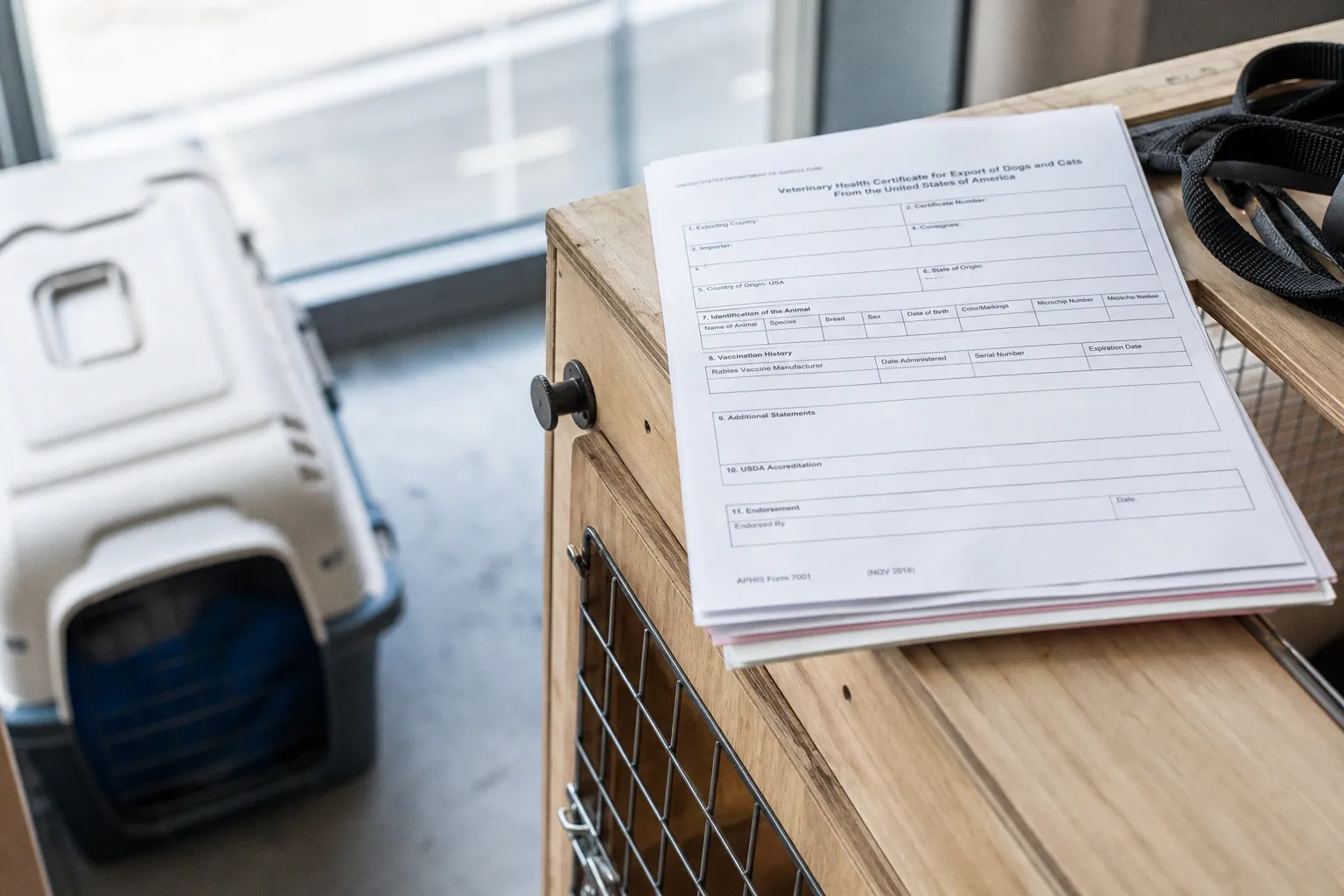
An endorsement date that falls outside the destination’s arrival window. A paper certificate still moving through overnight mail while the flight is already scheduled.
For international transport, the relevant variable is not “Does the dog have its records?” It is whether the records form a valid, destination-specific sequence on the date the animal arrives. That sequence determines both the USDA pet health certificate cost and timing.
The endorsement itself may start at $101. The operational cost of getting a usable certificate can reach $400 to $1,200 or more once veterinary examinations, laboratory work, administrative handling, digital submissions, and express return shipping are added. The higher number is not necessarily a sign of overcharging. It often reflects a late or poorly sequenced process.
The endorsement fee is only one component of the travel cost
USDA endorsement fees are tiered by the number of laboratory tests included in the certificate package. The base fee is not a universal price for international pet travel. It is the federal endorsement charge for a completed certificate with no laboratory tests.
| Certificate package | USDA endorsement fee |
|---|---|
| No laboratory tests | $101 |
| 1–2 laboratory tests | $160 |
| 3–6 laboratory tests | $206 |
| 7 or more laboratory tests | $275 |
Those figures do not include the veterinarian’s examination, certificate preparation, microchip implantation, rabies vaccination, titer testing, parasite treatment, or transport to and from appointments. They also do not include corrections. Corrections are where a routine file becomes expensive.
USDA-accredited vet fees vary by clinic and region. The fee structure also changes with the destination. A straightforward trip to a country requiring a microchip, rabies record, clinical examination, and endorsed certificate has a different workload from a move involving rabies antibody testing, import permits, treatment windows, or multiple animals.
The practical budget should separate four cost groups:
- Clinical preparation. Examination, microchip scan, vaccinations, blood draws, treatment administration, and any recheck required by the destination protocol.
- Document preparation. The accredited veterinarian’s time to review records, complete destination forms, correct identifiers, and submit the file.
- USDA endorsement. The federal fee, determined in part by the laboratory-test count.
- Document movement. Courier service, overnight return shipping, and replacement costs if the endorsed original is delayed or damaged.
A paper original can add roughly $110 to $120 in overnight return shipping. That charge becomes unavoidable where the destination or carrier requires the physical endorsed certificate in hand before departure. It should be treated as a planned transport expense, not an emergency upgrade.
The certificate fee is predictable. The cost trap is paying for speed after the document sequence has already failed.
The 10-day window is measured against arrival, not the veterinary exam
For non-commercial travel to the European Union and the United Kingdom, USDA endorsement must occur within 10 days of the animal’s arrival at the destination. This is the timing rule that produces the most avoidable failures.
The error pattern is consistent. An owner books a veterinary appointment ten days before departure. That seems logical. It may not be. Departure is not arrival. A late flight, a connection, a weather diversion, or a next-day landing can shift the actual arrival beyond the valid window.
Use the destination arrival time as the anchor. Work backward from there.
1. Set the scheduled arrival date and time. Use the first point at which the animal legally enters the destination jurisdiction, not the time it leaves the U.S. airport.
2. Confirm the certificate type. EU, UK, and other destinations use different forms and supporting-record requirements. Do not assume that a prior trip’s paperwork remains valid.
3. Reserve the accredited veterinary examination. The veterinarian must have enough time to examine the animal, review original vaccination records, complete the form, and submit it.
4. Allow for USDA processing. Digital submission through VEHCS commonly reduces the endorsement turnaround to one to three business days. Mail-in processing commonly requires seven to ten business days.
5. Add document-delivery time. If an original endorsed copy is required, the document still needs to reach the traveler before check-in.
6. Build a disruption margin. The legal window may be ten days. Your operating window should be shorter.
The distinction matters because the certificate can be perfectly completed and still be invalid at the border. An endorsement dated within ten days of departure is not automatically compliant if the destination arrival occurs later than expected.
This is also why weekend and holiday scheduling causes disproportionate trouble. A certificate appointment on Friday may look efficient. It is inefficient if the file cannot be reviewed, endorsed, returned, and physically delivered before a Monday or Tuesday flight. The calendar needs to include business days, not just calendar days.
Do not confuse the rabies waiting period with the certificate window
A primary rabies vaccination generally requires a waiting period of 21 to 30 days before travel is permitted, depending on the applicable destination rules. That waiting period is separate from the USDA endorsement window.
The two timelines run at different speeds:
| Timing event | What it controls | Typical planning consequence |
|---|---|---|
| Microchip implantation | Animal identity for the international record | Must occur before or on the same date as valid rabies vaccination |
| Primary rabies vaccination | Immunization eligibility | May trigger a 21–30 day wait before travel |
| Veterinary certificate examination | Current clinical status and paperwork completion | Must align with destination form requirements |
| USDA endorsement | Federal validation of the export certificate | For EU/UK non-commercial travel, must fall within 10 days of arrival |
| Airline check-in | Carrier acceptance | May impose separate document and timing requirements |
Do not treat an airline’s acceptance as proof that border documents are valid. Airlines can have stricter or different administrative rules. Their policies also change independently of USDA procedures.
Commercial status changes the clock from days to hours
The term “commercial” is often misunderstood because it does not simply mean that money changes hands for the flight. Under common USDA travel classifications, a trip can be treated as commercial when the owner travels more than five days apart from the pet or when six or more pets travel. Other circumstances can also affect the classification.
For commercial travel, the health certificate must be issued and endorsed within 48 hours of departure. This is a compressed operating window. It eliminates casual scheduling.
A 48-hour requirement creates a specific transport sequence:
- The travel classification must be determined before the veterinary appointment is booked.
- The accredited veterinarian must be available close enough to departure to issue the correct certificate.
- The USDA submission path must be confirmed in advance.
- The carrier’s acceptance deadline must be checked separately.
- Any missing laboratory result, identifier mismatch, or form revision can terminate the trip.
The wrong classification is one of the most expensive international pet travel document errors because it is often discovered late. A traveler may prepare a non-commercial certificate, then learn that a delayed owner itinerary changes the status of the animal’s movement. The document may no longer meet the applicable timing rule.
A 48-hour certificate is not a tighter version of a 10-day certificate. It is a different operational category.
Pet transport providers should not classify a movement from a verbal summary alone. The exact owner itinerary, number of animals, destination, purpose of transport, and handoff arrangements determine the documentation path. If an owner and dog are traveling separately, the date gap must be calculated precisely.
VEHCS reduces transit time, not planning requirements
The Veterinary Export Health Certification System, or VEHCS, allows accredited veterinarians to submit export health certificates digitally for USDA endorsement. In many cases, digital submission reduces the endorsement turnaround to one to three business days. Traditional mail-in processing commonly takes seven to ten business days.
That difference is operationally significant. It does not make last-minute travel safe.
VEHCS removes one delay: the movement of documents to and from a USDA office. It does not remove:
- the need for a destination-correct certificate;
- the veterinarian’s examination and record review;
- laboratory turnaround times;
- destination-required treatments;
- the need to resolve a mismatch in microchip numbers;
- physical delivery time when the destination requires an original hard copy;
- airline cargo or cabin booking deadlines.
A digital submission is only as reliable as the record set attached to it. A scan of a handwritten rabies certificate with an unclear date is not a minor formatting issue. It can stop endorsement or create a border challenge. The same applies to inconsistent owner names, incomplete addresses, missing microchip digits, and dates entered in an ambiguous format.
The correct use of VEHCS is procedural:
1. Ask the accredited veterinarian early whether the destination certificate can be submitted through VEHCS.
2. Confirm whether the destination requires an original endorsed document or accepts a digital copy for the relevant stage of travel.
3. Provide complete vaccination and microchip records before the examination, not during the submission window.
4. Review every field before submission: species, breed description, sex, date of birth, microchip number, owner details, routing, and destination.
5. Keep a realistic buffer for correction and delivery.
Mail-in endorsement can still be workable for travel planned well in advance. It is structurally unsuitable for a short timeline, particularly where an EU or UK arrival window is controlling.
Microchip and rabies records must follow the correct order
The most damaging chronological error is simple: rabies vaccination administered before microchip implantation.
For international travel, the rabies vaccination must be given on or after the date the microchip is implanted to be valid for the travel record. The microchip is not merely an identification accessory. It binds the animal to the vaccination and certificate history.
If the dog received a rabies vaccine before microchipping, the usual response is not to argue that the dog was already protected. Immunity is not the only issue. The document chain must identify the animal at the time the vaccination was recorded.
The correction can require:
1. implanting a compliant microchip;
2. administering a new rabies vaccination on or after the implantation date;
3. waiting through any destination-required post-vaccination interval;
4. completing additional testing if the destination requires it;
5. restarting the certificate timeline.
For many destinations, the microchip should be ISO 11784/11785 compliant and use a 15-digit number. The scanner must read it reliably. A chip that exists but cannot be scanned at the appointment is a transport risk. A chip number transcribed incorrectly onto a certificate is equally serious.
Treat the microchip number as a controlled identifier
In transport work, identifiers fail most often through copying, not through technology. The dog may be microchipped correctly, but the number appears differently on the rabies certificate, laboratory report, veterinary record, and export form.
Use one source record. Scan the chip at each clinical event. Compare the full number character by character before the file is submitted. Do not rely on a photograph of a prior certificate or a number copied from an owner’s note.
Other common pet travel health certificate mistakes follow the same pattern:
- A rabies vaccine is recorded without stating whether it was a primary or booster dose.
- The vaccination product, manufacturer, or validity period is missing from the supporting record.
- The certificate uses a destination form that has been replaced or revised.
- The owner’s name does not match the itinerary or import documentation.
- A required treatment is administered outside its allowed time band.
- A laboratory test is ordered too late to support the travel date.
- A departure date is used as the compliance anchor when the rule is based on destination arrival.
- The physical certificate is assumed to be available because the digital endorsement has been approved.
None of these errors is mechanical in isolation. They compound. A one-day delay in a laboratory result can force a new veterinary appointment. That appointment can move the USDA endorsement outside the arrival window. The resulting courier request can add cost without solving the underlying validity problem.
Build the file before booking the final transport segment
International pet transport should begin with the document path, not the flight search. This applies whether the animal travels in cabin, as checked baggage where permitted, or through an air cargo program. Transport mode changes handling conditions and carrier rules. It does not remove import requirements.
A stable planning sequence looks like this:
- Identify the destination country and any transit countries.
- Determine whether travel is commercial or non-commercial.
- Read the destination’s current certificate and import conditions through the appropriate official channels.
- Scan the microchip and verify the full identifier.
- Audit rabies chronology against the chip date.
- Determine whether laboratory testing or timed treatments apply.
- Calculate the earliest lawful travel date.
- Calculate the latest safe veterinary and USDA endorsement dates from arrival, not departure.
- Choose VEHCS or mail-in submission based on the actual calendar.
- Confirm whether an original endorsed certificate must be returned before travel.
- Only then lock the flight or ground-transport handoff.
This order is not bureaucracy for its own sake. It prevents the transport booking from becoming the controlling deadline. Once a nonrefundable flight is fixed, owners tend to force the documentation process to fit it. Border requirements do not compress because a ticket was purchased.
Release parameters before travel
A dog should not be cleared for international movement until all of the following are true:
- The microchip is readable and its full number matches every supporting record.
- The rabies vaccine was administered on or after the microchip implantation date.
- Any mandatory post-vaccination waiting period has expired.
- The correct destination certificate has been used.
- The travel classification is confirmed as commercial or non-commercial.
- The USDA endorsement date falls within the destination’s applicable window.
- For EU and UK non-commercial travel, endorsement is within 10 days of destination arrival.
- For commercial movement, certificate issuance and endorsement are within 48 hours of departure where that rule applies.
- VEHCS processing time or mail-in processing time has been built into the schedule.
- A physical endorsed original is in hand if the destination requires one.
- Airline documentation deadlines have been checked separately from government entry rules.
The governing principle is narrow: valid records are not enough. The records must be valid in sequence, valid for the destination, and valid on the arrival date. That is the difference between a certificate packet and a travel-ready dog.