Airline pet travel: cabin, cargo, or flight nanny?
The first phone call is rarely about the dog. It is about the confusion. A family planning a cross-country relocation calls in the middle of choosing movers, school districts, and a new veterinarian…
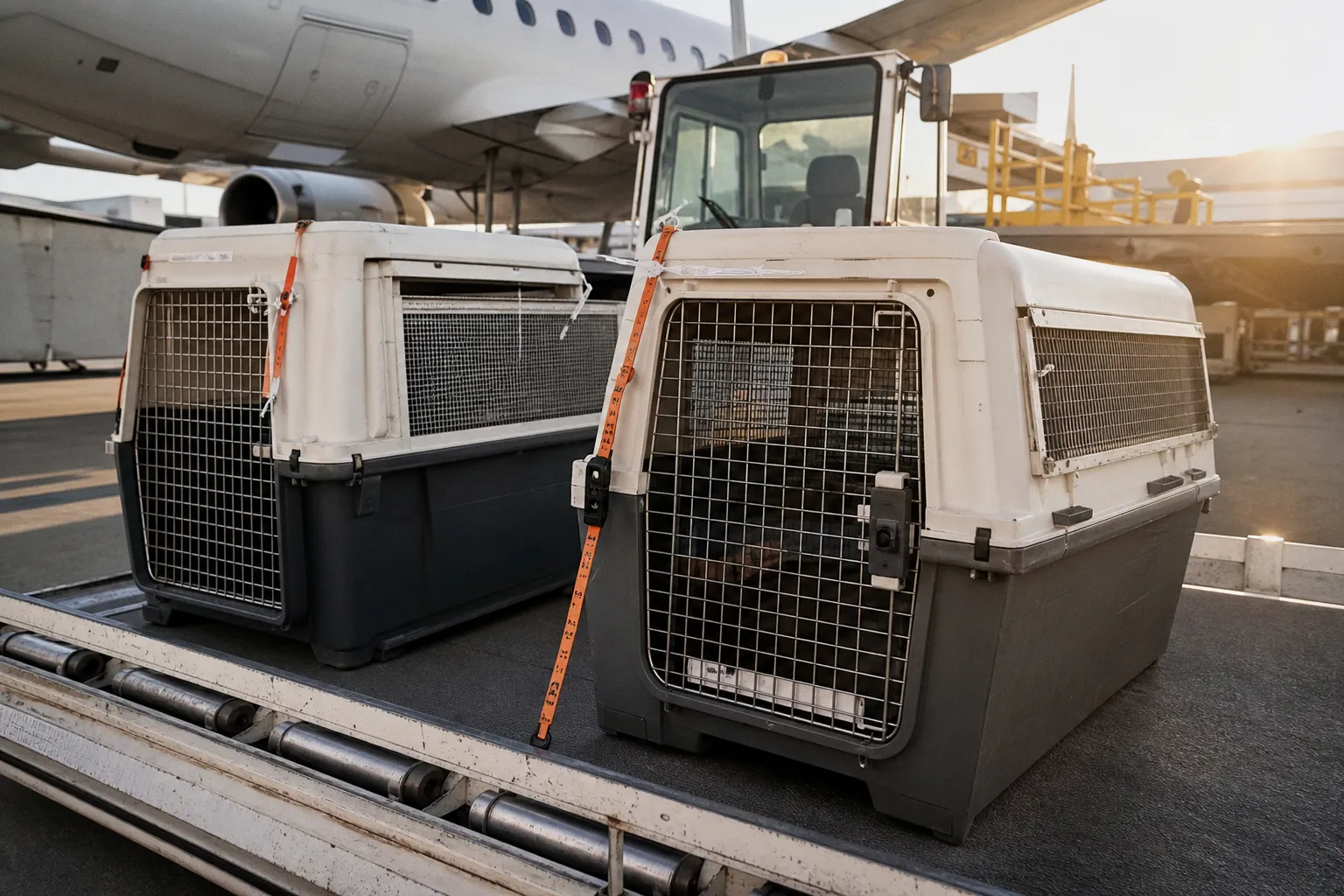
The first phone call is rarely about the dog. It is about the confusion. A family planning a cross-country relocation calls in the middle of choosing movers, school districts, and a new veterinarian, and they already have three competing stories from three friends: one flew her cat under the seat in a soft-sided carrier, another shipped her Labrador through the cargo terminal, and a third paid a professional escort to carry a Pomeranian in a tote bag onto a regional jet. All three trips worked. None of them followed the same rules, because airline pet transport is not a single service with a single fee and a single set of criteria. It is a stack of decisions, and the stack changes the moment you swap an aircraft, a route, a breed, or a destination country.
Compare car rental deals in United Kingdom
See available offersPartner link — DiscoverCars comparisonThat is the practical problem this guide is built to resolve. We will walk through the three realistic options for getting a dog or cat on a commercial flight in the United States — under-seat cabin travel, transport in the pressurized cargo hold, and a flight nanny escort — and we will map the eligibility, sizing, paperwork, and welfare considerations that decide which one actually fits your situation. The goal is not to crown a winner. The goal is for you to leave this page knowing which questions to ask your airline, your veterinarian, and yourself, and in what order to ask them.
The three labels — cabin, cargo, flight nanny — describe how the animal travels, not what is allowed. Eligibility is set by the airline, the aircraft, the route, and the destination, in that order.
The three systems you are actually choosing between
It helps to separate the modes from the rules. A mode is the physical arrangement: the pet is in the cabin with you, the pet is in the cargo hold, or the pet is in the cabin with a hired escort. The rules are layered on top: the airline's own acceptance policy, the Federal Aviation Administration's standards for in-cabin carriers, the cargo-handling protocols of the carrier and airport, the destination country's import requirements, and where applicable, USDA APHIS endorsement of the documentation.
Under U.S. federal aviation rules, the FAA does not mandate that any airline accept pets in the cabin. Each carrier decides its own policy within the framework of safety rules that apply to live animals carried on board. When a carrier does accept a cabin pet, the animal is treated as carry-on baggage: the carrier must fit under the seat in front of you, must not block the aisle or any exit, and must be stowed before the aircraft leaves the gate and remain stowed through taxi, takeoff, and landing. That is the regulatory floor. Everything else — maximum dimensions, fee, number of pets per flight, breed restrictions — is set by the airline.
Cabin is not the only airline-managed option. IATA's published position is that only small dogs and cats can travel in the cabin, while other accepted animals may be transported as special baggage in a heated and ventilated hold or as air freight, subject to the airline's own rules. In the United States, the APHIS-aligned standard for commercial air transport of dogs and cats is that the animal cargo space must be pressurized during flight. Pressurization is a baseline, not a guarantee of acceptance — airlines still impose seasonal embargoes, breed restrictions, and route-specific limits that can take a route off the table for your specific animal.
The flight nanny is the third label you will hear. It is an industry term for a paid escort who buys a ticket, brings an eligible pet into the passenger cabin, and hands the animal over at the destination. A flight nanny does not remove the need to meet the airline's cabin-pet rules, carrier limits, or destination entry requirements. The escort is essentially filling the seat that you would have filled — the pet still has to be small enough, the carrier still has to fit, and the route still has to accept pets.
| Mode | Where the pet travels | Who decides eligibility | Typical fee reference | Key constraint |
|---|---|---|---|---|
| Cabin (with you) | Under-seat carry-on | The airline, within FAA carry-on rules | Operator-set; American Airlines lists $150 per kennel on eligible routes | Combined pet-and-carrier dimensions, aircraft type, route |
| Cargo / hold | Pressurized, heated, ventilated belly | The airline, with route and seasonal limits | Quoted per shipment; varies by weight, route, and carrier | Crate compliance, breed restrictions, weather embargoes |
| Flight nanny | Cabin with a hired escort | The airline, the same way as any cabin booking | Nanny fee + ticket cost; varies by broker | Does not bypass airline, route, or destination rules |
Carrier dimensions and the cabin acceptance window
Cabin travel is the most restrictive in absolute terms, because the limiting surface is the floor space under a specific seat on a specific aircraft. Most U.S. carriers that accept cabin pets give a soft-sided carrier size that is roughly 18 x 11 x 11 inches (46 x 28 x 28 cm), with American Airlines listing that exact recommendation as a working example. Two things to notice about that figure: it is a recommended size on a recommended route, not a federal standard, and it is bound to the seat geometry of the aircraft operating your flight. A smaller regional jet may have a smaller under-seat volume. A widebody with a deeper seat base may technically accommodate more, but the airline's published cap still governs.
The FAA's carry-on framework adds three operational rules that often surprise first-time flyers. The carrier must fit under the seat in front of you, it must not block the aisle or any exit row, and it must remain stowed from the moment the aircraft leaves the gate until it returns to the gate at the destination. That last point is why airlines ask you to count the pet's weight together with the carrier against your normal carry-on allowance, and why carriers are usually asked to be soft-sided — a rigid crate is harder to maneuver into a confined seat base.
The practical consequence is that cabin travel is a window, not a category. There is a maximum size the airline will accept, a maximum weight the animal can be when the carrier is added, and a maximum number of pets allowed per cabin on each flight. If any of those three variables close the window, you are not choosing a slightly bigger cabin option — you are moving to a different mode entirely.
What "pressurized cargo" actually means for your dog
Cargo carries a stigma that the engineering has, in most cases, already addressed. For commercial air transportation of dogs and cats, APHIS training states that the animal cargo space must be pressurized during flight. The hold where your pet rides is not a separate unpressurized compartment; it is part of the same pressure-controlled fuselage as the cabin, just temperature-managed to a separate, often narrower band. The animal area is also heated and ventilated.
The honest version of the cargo picture has four caveats that you should treat as part of the decision, not as footnotes:
1. Airlines reserve the right to refuse specific animals, breeds, and routes. Snub-nosed dogs and cats are commonly restricted because their airway anatomy makes them more vulnerable to respiratory stress at altitude and in heat. You will see this in the airline's own acceptance policy, not in any federal rule.
2. The Animal Welfare Act transport standard for commercial carriage generally bars a carrier from accepting a dog or cat more than 4 hours before the scheduled departure. This is intended to limit ground-time stress before the flight, and it is one of the reasons that early-morning departures are easier on the animal than late-night ones.
3. Seasonal embargoes are real. In the United States, most major carriers embargo brachycephalic breeds and certain other categories during summer heat waves, and some embargo all live animals on specific routes when connecting ground temperatures are unsafe.
4. You are dependent on a chain of handlers. The pet is checked in at the cargo terminal, handled by airline staff, loaded by ground crew, and met by you or a designated receiver at the destination. That chain is professionalized on regulated carriers, but it is still a chain.
A responsible plan for cargo transport treats each of these as a planning variable rather than a worry. The animal is dropped off as close to departure as the airline allows, the crate is built to IATA standards (which we will get to), and the flight is chosen for a time of day and time of year that minimize temperature exposure.
The flight nanny, and what it actually buys you
A flight nanny is hired because the family cannot fly with the pet, not because the airline will be more flexible. The escort boards a regular passenger flight, carries the pet in the cabin under the airline's standard cabin-pet rules, and delivers the animal at the destination airport. From the airline's perspective, the flight is no different from yours taking the same trip with the same pet.
The model is genuinely useful for specific transitions — a senior dog whose owner has already relocated for work, a kitten moving to a new family before the family has finished closing on a house, a pet traveling between two cities where the owner cannot take time off. In those cases, the value the nanny provides is time, not regulatory relief. Because the booking is still subject to the airline's cabin acceptance, carrier dimensions, and the destination's import rules, the same paperwork architecture applies.
Where people get into trouble is treating the flight nanny as a workaround. If the animal is over the airline's cabin weight, the nanny cannot fly with it in the cabin. If the destination country requires a USDA-endorsed health certificate, the nanny cannot endorse that document. If the route has a seasonal embargo on the breed, the nanny cannot lift it. Vetting a flight nanny therefore means asking the same questions you would ask the airline, because the nanny is the airline's customer, not a separate channel.
IATA crate sizing — the calculation that decides everything
Whether you end up in cargo or in cabin, the crate is the single most consequential purchase in the entire process. IATA's container-sizing guidance for one animal is built on four body measurements and a simple formula, and getting it wrong is the most common reason a pet is refused at the airport.
For a single animal, the minimum internal dimensions are:
- Length: nose-to-tail-base length (A) plus one-half of ground-to-elbow height (B). The animal must be able to lie down without its nose or tail touching the ends of the container.
- Width: width across the shoulders or widest point (C) multiplied by 2. The animal must be able to turn around and lie down without curvature or pressure on the sides.
- Height: natural standing height to the top of the head or ear tip (D), plus enough headroom for bedding under IATA's comfort allowance.
The two important exceptions to memorize:
- Snub-nosed breeds require a container 10 percent larger under IATA's guidance. The reason is the same as the cargo restriction — reduced airway clearance makes thermal regulation harder, and a larger container helps the animal dissipate heat.
- Up to two compatible adult animals of comparable size may share a primary enclosure only when each weighs no more than 14 kg. Above that threshold, the animals must be crated separately. Up to three weaned puppies or kittens from the same litter may share a primary enclosure when they are under six months old and meet the same weight threshold.
The reason this matters beyond the obvious welfare argument is that the crate is also the airline's safety surface. A crate that is too small is a refusal at check-in. A crate that is too large is a projectile risk in turbulence, because the animal can be thrown against the walls. The IATA formula is the only widely accepted sizing framework, and most airlines will not board a pet in a crate that does not meet it.
Build the crate to the formula, not to the dog as it stands today. Adjustments for a younger animal, a thicker winter coat, or a post-surgical harness all belong in the headroom and length calculations.
Veterinary documentation, destination windows, and the paper trail
The paperwork is the part families underestimate most often, because the medical visit feels like a routine appointment even when the trip is not. The structure of the requirements depends on whether the pet is crossing state lines or international borders.
For international travel from the United States, USDA APHIS is clear that the destination country sets the entry requirements. These can include a health certificate, vaccinations, laboratory tests, treatments, and — where required — USDA endorsement by a USDA-accredited veterinarian. The original signed or endorsed paperwork must travel with the pet when required. Some destination countries operate on a tight window between when the veterinarian signs the health certificate and when the pet arrives; USDA APHIS notes that some countries allow only a limited window, with 30 days given as an example. The validity window is not a number to memorize; it is a number to look up for the specific destination, because the wrong assumption here is what gets a pet held at the airport on arrival.
For interstate U.S. travel, the receiving state or territory sets the rules, not USDA APHIS. Depending on the destination, requirements may include a health certificate, vaccination updates, diagnostic testing, or parasite treatments. Hawaii, for example, has a well-known rabies quarantine program that is far more involved than a typical mainland move. The honest version of the interstate advice is to check the destination state's department of agriculture page before booking the flight, not after.
There is one welfare-side documentation note that belongs in this section even though it is not a form. IATA advises against sedatives and tranquilizers for animals transported in either the cabin or cargo hold because of possible adverse effects at altitude. American Airlines also states that it does not accept sedated or tranquilized pets, citing increased respiratory and cardiovascular risk. This is the one place where the airline, the regulator, and the international industry body agree, and it is the place where a family's instinct to "take the edge off" for the animal should be redirected toward crate familiarity, a short pre-flight fast, and a calm drop-off routine rather than a pharmaceutical.
The decision framework, in the order it actually works
Once the three modes and the supporting rules are on the table, the choice collapses into a small number of questions, and the order of the questions matters as much as the answers.
Start with the animal. What is the combined weight of the pet and its carrier, and what is the breed profile? If the combined weight is within the airline's cabin cap and the breed is not restricted, cabin is on the table. If the animal is too large, cargo is the airline-managed option. If the family cannot fly with the animal, a flight nanny becomes the delivery mechanism for whichever of the two physically works.
Then check the route. Confirm the aircraft operating the flight, the number of cabin-pets already booked, and any seasonal or breed-specific embargo on the date. If the route is open, you are selecting between cabin and cargo based on size. If the route is closed, you are changing the route, not the mode.
Then check the destination. Pull the entry requirements for the destination country or state, including the documentation window. If the timeline allows for a USDA-accredited veterinarian visit, USDA endorsement where required, and enough buffer for the health certificate to remain valid on arrival, you are clear. If not, you are moving the flight, not skipping the paperwork.
Then build the crate to IATA standards, including the 10 percent snub-nosed adjustment where applicable, and confirm the carrier's hardware — locking pins, ventilation openings, water bowl attachment — meets the airline's checklist.
The expected outcome of running through this list, in this order, is a trip plan where the animal is sized correctly, the route is open, the paperwork is current, and the family is not relying on a workaround to solve a sizing problem. Airline pet transport becomes a logistics project once you stop treating it as a product, and the project has a real and achievable plan.