Long-distance ground pet transport: key travel milestones
A long-distance ground pet transport timeline fails when it is treated as a single booking. It is a sequence of controlled handoffs: veterinary clearance, carrier conditioning, route design, nutrition timing, vehicle loading, and welfare monitoring.
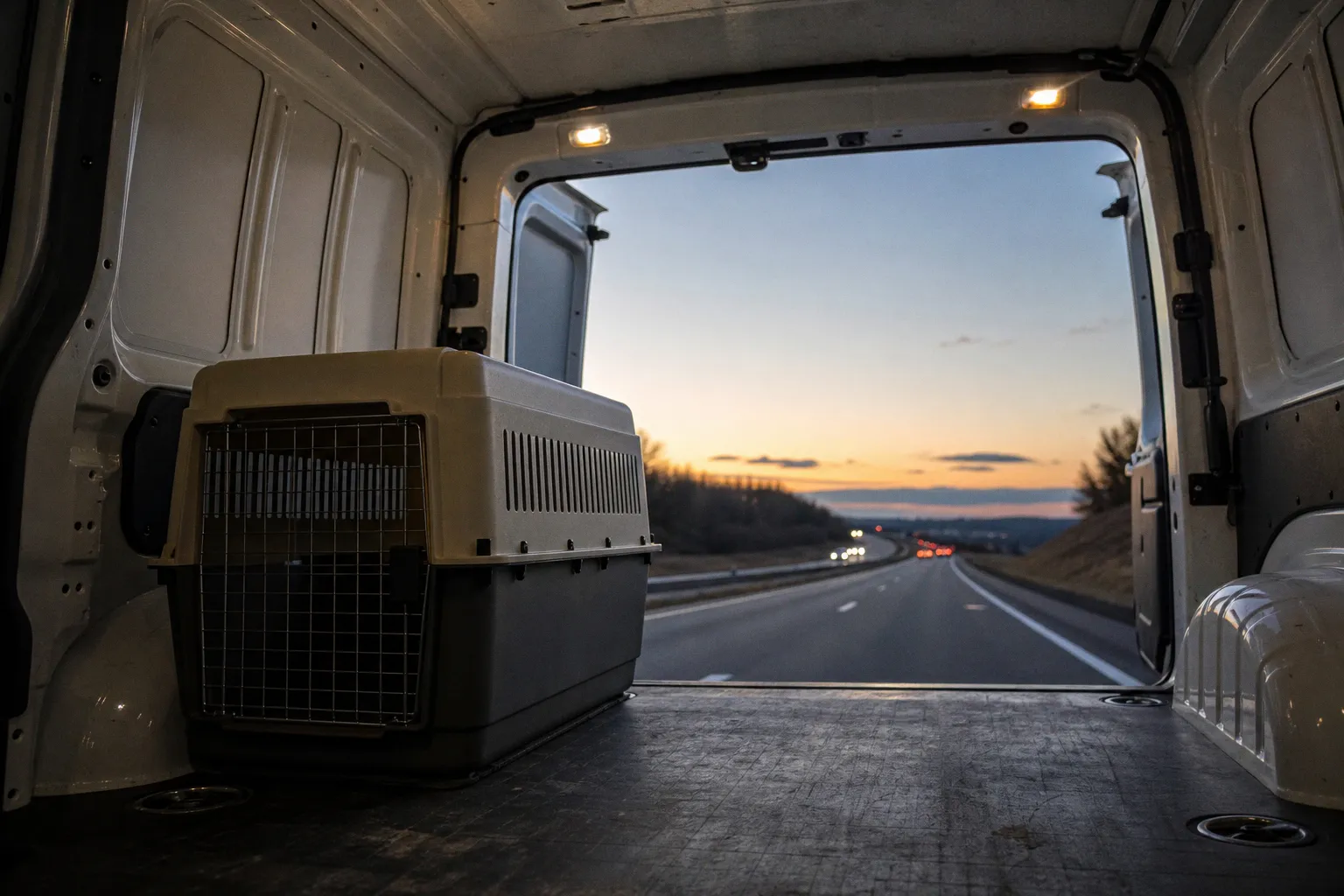
Miss one handoff and the fault propagates through the trip.
For an interstate move, the workable planning window is usually three to four weeks. That is enough time to secure a qualified transporter, obtain current health documentation, identify state-entry requirements, and determine whether the animal can travel safely in a confined transport environment. It is not excess lead time. It is the minimum buffer that prevents last-minute substitutions.
Cross-country ground pet transport commonly takes two to five days. The distance matters, but so do pickup sequencing, shared versus private service, weather exposure, traffic, overnight stops, and the animal’s tolerance for motion and confinement. A quoted arrival date without these variables is not a schedule. It is a guess.
The three-week pre-departure logistics window
Start the process three to four weeks before pickup. This is the period where safe pet taxi logistics are built, not improvised.
The first task is to define the transport model. A private ride, shared ride, and owner-driven relocation have different control points.
| Parameter | Private ground transport | Shared ground transport | Owner-driven trip |
|---|---|---|---|
| Pickup timing | Usually fixed or narrowly scheduled | Depends on route consolidation | Controlled by owner |
| Transit duration | Often shorter | May extend due to other pickups and deliveries | Depends on driving plan |
| Animal handling | Dedicated vehicle space and handler attention | Multiple animals may be onboard | Depends on owner skill and vehicle setup |
| Route flexibility | Higher | Limited by other commitments | High, within safe driving limits |
| Cost structure | Higher per animal | Lower than private service in many cases | Vehicle, lodging, fuel, and time remain costs |
| Main operational risk | Overconfidence in fast delivery | Inadequate updates or poor route planning | Fatigue and inconsistent welfare stops |
A transporter should be selected before the veterinary appointment. The carrier’s requested documentation may vary by destination state, route, animal species, and operational policy. Do not obtain a health certificate first and assume it will satisfy every leg of the trip.
For commercial interstate transport in the United States, ask whether the provider holds current USDA Class T carrier registration. This is not decorative paperwork. It identifies a commercial transporter operating under the Animal Welfare Act framework. Registration alone does not prove good handling, but the absence of it is a material defect when a business is moving animals across state lines.
The booking conversation should establish the operating conditions in writing:
- Pickup and delivery windows, not merely calendar dates. A shared route can shift by hours as traffic, loading delays, and animal-care stops accumulate.
- The maximum number of animals carried in the vehicle and whether unrelated animals are housed in separate enclosures.
- Crate dimensions, ventilation design, tie-down method, and whether crates are secured against lateral movement under braking or cornering.
- Water delivery protocol. A bowl that spills inside a moving crate is not hydration management.
- Overnight protocol, including whether animals remain in the vehicle, move into climate-controlled lodging, or stay in a monitored facility.
- Update frequency and the method used if the handler cannot safely answer while driving.
- Escalation authority. The handler needs clear instructions on who can authorize veterinary assessment if the animal develops vomiting, diarrhea, respiratory distress, overheating, or marked lethargy.
A transport plan is sound only when the animal’s crate, documents, route, and emergency authority are defined before the vehicle moves.
Crate training belongs in this same window. The crate is not luggage. It is the animal’s restraint system, rest area, and thermal microenvironment for the duration of the journey.
A dog that only enters a crate under force begins the trip with elevated arousal. Elevated arousal changes breathing rate, water use, gastrointestinal motility, and pressure behavior. It also affects the kinetic chain: a braced, tense dog shifts weight through the forelimbs and spine differently than a resting dog. Over hours, that matters.
Condition the dog in short sessions. Feed meals near or inside the crate. Close the door briefly while the dog remains calm. Introduce vehicle motion in controlled increments if possible. The goal is not enthusiasm. The goal is stable behavior under confinement.
Navigating USDA requirements and health documentation
For interstate ground travel, a Certificate of Veterinary Inspection, often called a CVI or Interstate Health Certificate, is generally required. It should be issued by a USDA-accredited veterinarian within 30 days of travel.
This 30-day window is often misunderstood because airline travel frequently uses a shorter document window. Ground transport is not airline cargo. Do not apply aviation timelines to a road relocation without confirming the actual requirements of the destination and transport provider.
The CVI is one component of the transport file. It does not replace destination-specific entry rules, vaccination records, medication instructions, microchip information, or proof of ownership where requested.
The document packet should include:
1. Current CVI or Interstate Health Certificate. Confirm that the examination date and travel date fall within the applicable validity period. If a shared route is delayed, the certificate still needs to remain valid at delivery, not only at pickup.
2. Rabies vaccination record. The document should show the animal’s identity, vaccine date, and expiration date. Some jurisdictions and carriers may request this independently of the CVI.
3. Microchip record and collar identification. A microchip is a recovery tool, not a restraint system. Pair it with a durable collar tag containing a reachable phone number. Do not attach a leash to a crate door as a substitute for identification.
4. Medication instructions. Use the original container and written dosing directions. The transporter should know the medication name, dose, timing, and prescribing veterinarian. Do not send unlabelled tablets in a plastic bag.
5. Emergency veterinary authorization. List a primary contact, backup contact, regular veterinarian, and spending authorization threshold if immediate treatment becomes necessary.
6. Feeding and behavior notes. State normal meal size, known triggers, bite history where relevant, handling restrictions, and signs that indicate distress for that individual animal.
Documentation should travel in two forms: a physical packet secured with the transport records and a digital copy accessible to the owner and handler. Paper fails when it gets wet, misplaced, or separated from the vehicle. Digital files fail when there is no signal, dead battery, or inaccessible account. Redundancy is the appropriate control.
The veterinarian’s examination is also the point to identify animals that need a modified plan. Dogs with brachycephalic airway anatomy, active gastrointestinal disease, seizure disorders, severe orthopedic limitation, or unstable cardiac and respiratory conditions may not tolerate ordinary road transport protocols. This is not a question for a booking agent. It is a medical suitability question.
Managing pre-trip nutrition and motion acclimation
Feeding errors are one of the most avoidable causes of poor travel performance.
A light meal three to four hours before departure is the usual operating target. It allows partial gastric emptying before motion begins while avoiding the stress response associated with an empty, hungry animal. A full meal immediately before loading increases the likelihood of nausea, regurgitation, and gastrointestinal upset.
During peak travel hours, food is generally withheld while water remains available. This is a practical balance. Digestion and vehicle motion are a poor combination for many dogs. Hydration cannot be treated the same way.
The pre-departure sequence should be simple:
1. Exercise before feeding, not immediately after it. Allow a controlled walk and elimination opportunity. Avoid high-intensity activity that raises body temperature before loading.
2. Provide a light, familiar meal three to four hours before pickup. Do not introduce new food, treats, supplements, or rich table scraps on travel day.
3. Offer water in measured opportunities. The objective is normal hydration, not forced intake. Excessive drinking immediately before loading can produce discomfort and urgent stops.
4. Complete the final elimination break immediately before crate loading. This reduces contamination risk and prevents the first stop from becoming an emergency stop.
5. Load the animal into the prepared crate without a prolonged farewell routine. Prolonged handling can raise arousal. The handler needs the dog settled, secured, and ventilated before the vehicle enters traffic.
Most animals begin to settle once steady vehicle motion starts. A typical adjustment period is roughly 30 to 60 minutes. That does not mean every dog sleeps. It means initial vigilance often declines after the vehicle reaches a stable travel rhythm.
Motion acclimation should not be confused with sedation. Sedation for ground transport is generally discouraged because it can alter cardiovascular response, respiratory function, balance, and thermal regulation. A sedated animal may appear quiet while becoming harder to assess. The transporter needs to observe posture, breathing, responsiveness, and water intake accurately.
If a veterinarian prescribes medication for a specific condition, follow that clinician’s instructions. But do not turn travel medication into an unmonitored experiment on departure day. A first dose should not be administered in a moving vehicle where adverse effects are difficult to separate from ordinary travel stress.
Professional transit standards: driving limits and comfort stops
The vehicle’s route should follow the animal’s recovery capacity, not only the navigation app.
Professional long-distance transport commonly limits daily driving to roughly eight to 12 hours. Some operators aim for closer to seven active driving hours when route conditions allow. This is not a federally fixed pet-specific maximum that can be applied to every carrier and every route. It is an operational welfare standard. Driver fatigue degrades every downstream task: loading, leash control, sanitation, observation, vehicle handling, and emergency response.
A credible cross-country ground pet transport schedule distinguishes between driving time and total duty time. Fueling, crate checks, cleaning, feeding, unloading, lodging, traffic delays, and weather detours all add time. A route advertised as “10 hours away” can become a 14-hour animal-care day if those factors are omitted.
For dogs, comfort stops are generally scheduled every two to four hours. The range is deliberate. A young, healthy dog in cool conditions may tolerate a longer interval than an older dog, a dog on medication, or a dog traveling in high heat. Schedule design should account for the individual animal rather than imposing a rigid clock.
At each dog stop, the handler should assess more than elimination:
- Respiratory pattern: normal resting panting versus persistent, labored, noisy, or shallow breathing.
- Oral tissues: gum color and moisture can indicate perfusion or dehydration concerns.
- Posture and gait: stiffness, non-weight-bearing steps, persistent crouching, or reluctance to turn can indicate discomfort.
- Crate condition: spilled water, vomit, urine, feces, damaged latches, chewed bedding, or signs of escape attempts.
- Thermal state: excessive panting, hot ears, drooling, shivering, or abnormal lethargy require action before the next driving segment.
- Behavior change: a previously responsive dog that becomes withdrawn, disoriented, or unusually reactive needs closer evaluation.
Cats require a different protocol. They should receive visual checks inside their carriers, with handling minimized. A roadside “break” for a cat creates a high escape risk and usually increases stress rather than reducing it. Confirm secure latches, airflow, posture, and visible water access without removing the cat from containment.
Comfort stops are welfare inspections with an elimination opportunity attached. Treating them as quick fuel breaks misses the point.
Crate placement affects safety as much as the stop schedule. The crate must remain stable under acceleration, braking, and lateral loading. A crate that slides across a cargo floor transfers force directly into the animal’s body. That changes load distribution through the shoulders, hips, spine, and neck. It also causes repeated startle responses, which prevent rest.
Bedding should be absorbent, low-slip, and easy to replace. Thick loose bedding can trap heat. Thin material can provide insufficient cushioning for a dog with orthopedic sensitivity. The correct setup depends on the dog’s coat, age, joint condition, and ambient temperature. There is no universal “comfort blanket” solution.
Thermal regulation needs active management. Ventilation, sun exposure, crate position, outside temperature, vehicle insulation, and the number of animals onboard all change the internal environment. Do not accept a provider’s vague statement that the vehicle is “climate controlled.” Ask how temperatures are monitored, where sensors are placed, what happens during fuel stops, and how the operator responds to HVAC failure.
Setting realistic expectations for cross-country transit times
Most long-distance ground relocations across the United States take two to five days. A private direct trip may fall toward the shorter end. A shared service with multiple pickups and deliveries may take longer, even when the total distance looks straightforward on a map.
The correct question is not, “How fast can the vehicle get there?” The correct question is, “What travel duration allows the animal to arrive hydrated, ambulatory, documented, and physiologically stable?”
The main variables are predictable:
- Route density. Shared transport schedules are built around multiple addresses. A dog may travel past its destination region before final delivery if the route sequence requires it.
- Weather. Heat, snow, flooding, and high winds can force slower driving, additional stops, or route changes. These are not inconveniences when animals are onboard. They are thermal and handling variables.
- Animal mix. A vehicle carrying several dogs may require more frequent sanitation and comfort intervals. A transport carrying cats may need quieter handling and reduced unloading.
- Pickup readiness. Missing paperwork, an unprepared crate, an inaccessible pickup location, or a dog that cannot be safely loaded can delay every later milestone.
- Vehicle and lodging protocol. Overnight care is part of the trip, not dead time between driving days. The animal still requires secure containment, water, sanitation, temperature control, and observation.
Owners should also define the handoff condition at delivery. The receiving person needs to be present within the agreed window, carry photo identification if requested, have a leash and secure home entry ready, and understand that the dog may need a quiet decompression period before normal feeding or activity resumes.
Do not schedule a grooming appointment, dog park visit, long hike, or house full of visitors for the arrival day. The animal has spent multiple days adapting to motion, confinement, handler changes, road noise, and altered sleep cycles. A controlled transition is more useful than a celebratory one.
A final safety review should be completed before the pickup vehicle is released:
- CVI remains valid through the planned delivery date.
- The carrier has confirmed interstate authority and current USDA Class T registration where applicable.
- Crate size permits normal standing, turning, and resting without unstable excess space.
- Crate latches, ventilation openings, and vehicle tie-down points have been inspected.
- Feeding is set for a light meal three to four hours before departure.
- Water access, comfort-stop frequency, and overnight protocol are specified.
- Sedation is not being used as a routine transport control.
- Emergency veterinary authority and contact numbers are in the transport file.
- The delivery window accounts for normal route variation rather than promising an artificial exact hour.
Long-distance ground pet transport is not a test of endurance. It is a controlled welfare operation. The route is only one part of it. The useful timeline begins weeks before pickup and ends only when the animal is safely transferred, assessed, and allowed to recover in a stable environment.