Pet taxi vetting: what to verify before your dog's first ride
“Pet-safe transport” is not a safety standard. It is a phrase people put on a booking page because it sounds reassuring.
Pet taxi vetting: what to verify before your dog’s first ride
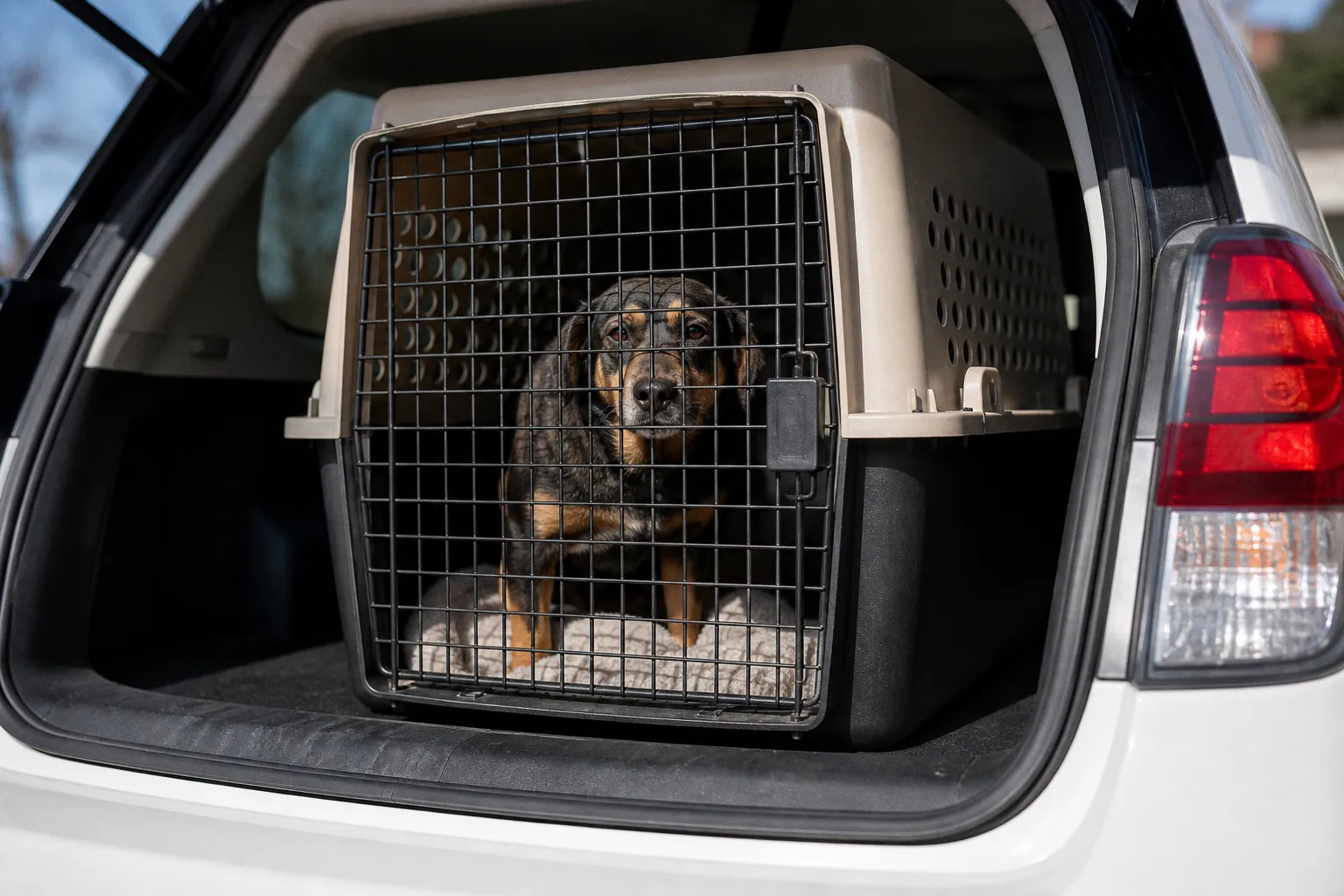
The hard truth is that a dog in a moving vehicle is dealing with confinement, vibration, unfamiliar smells, traffic noise, temperature swings, and separation from the person who usually manages their behavior. A dog who is perfectly civilized in your back seat can become nauseated, frantic, shut down, or defensive in a stranger’s van. Add a poorly secured crate or a driver with no plan beyond “we’ll get there,” and the behavioral fallout can last longer than the ride.
A real pet taxi service vetting checklist is not about finding the company with the cutest paw-print logo. It is about determining who has custody of your dog, how the dog will be physically secured, what happens if the vehicle stalls in summer traffic, and whether the operator can answer plain questions without performing a sales routine.
Start with the custody question, not the USDA badge
A lot of pet transport companies advertise themselves as “USDA certified” or “USDA approved.” That wording can be meaningless, misleading, or simply imprecise.
Under the federal Animal Welfare Act framework, a business that takes custody of an animal and transports it for hire may need to register with USDA APHIS and follow applicable transport standards. A hired driver transporting your dog while you are not physically present is the kind of arrangement that can trigger federal oversight.
But there is a distinction owners routinely miss: if your dog rides in a hired taxi while you remain in custody, that specific arrangement is not federally regulated under the Animal Welfare Act. That does not mean the ride is automatically safe. It means USDA registration is not a universal pass/fail test for every local pet taxi.
Ask the company directly:
1. Who has legal and practical custody from pickup through handoff?
“The driver is just helping” is not an answer. If you are not in the vehicle and the company accepts the dog, loads the dog, and decides how to handle a delay or medical problem, they are operating as the responsible custodian in real life.
2. Does the company hold USDA registration for the services it actually provides?
If the answer is yes, ask for the registration details. Claimed registration can be checked through the USDA Animal Care Public Search Tool, including available inspection and compliance records. Do not settle for a screenshot of a logo or a vague “we work with USDA standards.”
3. Is this a local ride, a multi-state transport, or a relocation service?
The answer changes the paperwork, the route planning, the handoff risks, and sometimes the applicable rules. A 20-minute veterinary appointment shuttle and a two-day interstate move are not cousins. They are different operations.
4. What state and local requirements apply at pickup and destination?
There is no single nationwide rulebook covering every business license, commercial insurance arrangement, health document, or driver qualification. If a company acts as though all this is simple, they may be simple. That is not praise.
A registration claim is worth checking. A polished website is not a substitute for checking it.
The point is not to turn every owner into a regulator. The point is to stop accepting labels in place of facts. A provider should be able to describe its custody model and regulatory status in ordinary language.
The vehicle matters more than the app
Many dogs are transported in vehicles designed for people, then retrofitted with a crate, a seatbelt clip, and some optimistic marketing. That can work for a calm dog on a short ride. It is not automatically an appropriate setup for every dog, every season, or every route.
When booking a pet taxi for dogs, ask what vehicle will actually arrive. Not the vehicle shown in the promotional video. The actual one.
A sound vehicle setup should address four things at once:
- Secure containment: The dog cannot roam the cabin, climb into the front seat, interfere with the driver, or become a projectile during hard braking.
- Stable restraint: A crate or harness cannot slide, tip, or shift when the vehicle turns or stops.
- Air quality and temperature: The dog is not riding in a stagnant cargo area, next to engine heat, or in a compartment exposed to exhaust.
- Practical access: The driver can reach and remove the dog quickly if there is a crash, mechanical issue, vomiting episode, panic response, or heat problem.
For dogs traveling on a vehicle seat rather than in a crate, the safer baseline is the back seat with a properly fitted harness attached to the vehicle’s seat-belt system. That is not the same as clipping a leash to a headrest and calling it restraint. A leash can tangle, load the neck during a collision, or give a stressed dog just enough slack to scramble into the front.
Crating is usually the more controlled option for a dog with travel anxiety, resource guarding, escape behavior, or an unreliable response to handling. But “crate transport” can also mean a cheap plastic box sliding across a cargo floor. Ask how the crate is anchored. If the company cannot explain that in one or two clear sentences, assume it is not anchored well.
Heat is not a minor inconvenience
Temperature trouble is one of the bluntest risks in pet transport because dogs cannot open windows, adjust vents, or tell a distracted driver that the cargo area is getting hot.
For federally regulated surface transport, auxiliary ventilation such as fans, blowers, or air conditioning is required when the animal cargo space reaches 85°F (29.5°C). Under those standards, the cargo area cannot remain above 85°F or below 45°F (7.2°C) for more than four hours.
Those numbers are not universal pet-taxi rules for every local trip. They are not permission to let a dog sit in a hot vehicle for three hours and fifty-nine minutes, either. They are a reminder that temperature management must be active, not aspirational.
| Question to ask | Reassuring answer | Answer that should stop the booking |
|---|---|---|
| Where does the dog ride? | “In a secured crate behind a barrier,” or “In the rear seat in a crash-tested harness.” | “Usually wherever they’re comfortable.” |
| How is the temperature monitored? | “The driver can monitor the animal area, and climate control reaches that space.” | “The van has AC up front.” |
| What happens during a breakdown? | “We move the dog to a safe, temperature-controlled location and contact you immediately.” | “That has never happened.” |
| Can the crate move during braking? | “It is tied down or fixed to dedicated anchor points.” | “It is heavy enough not to move.” |
| Is the dog ever left alone in the vehicle? | “No,” or a narrow, clearly explained operational exception with active safety controls. | “Only for a minute.” |
That last phrase — “only for a minute” — has covered a lot of bad decisions in animal care.
Look at the crate like the dog will have to live in it
For a short, routine ride, owners often focus on whether the crate looks clean. Clean matters. It is not enough.
A transport enclosure has to contain the dog without creating its own hazards. Under Animal Welfare Act standards for regulated transport, crates must have no sharp points or protrusions, allow rapid removal of the animal in an emergency, and have a solid leak-proof bottom or a leak-proof waste tray. They must also be cleaned and sanitized before each use.
The ventilation requirements are specific for non-permanently affixed enclosures: openings must exist on two opposing walls, with openings equal to at least 16% of each of those walls’ surface area and at least 14% of the combined wall area overall. Again, those are regulatory standards for covered transport, not a universal formula for every suburban pet taxi. But they expose the kind of detail that separates actual transport planning from vibes.
For your dog, the practical crate test is simpler:
- Your dog can stand, sit, lie down, and turn around without folding themselves into a shape they would not choose.
- The crate has real airflow on opposing sides, not decorative slits blocked by luggage, blankets, or another crate.
- The floor is dry, stable, and non-slip. A soaked pad under a frightened dog is a fast track to distress and contamination.
- The door hardware is secure but can be opened quickly by a trained person.
- Your dog’s identification is attached to the crate as well as to the dog. Collars can come off. Tags can tear away. Layers matter.
- The company does not stack equipment, bags, or other animals against the crate’s ventilation panels.
Do not assume a larger crate is always better. Too much empty room can let a dog slam into the sides during sudden stops. The appropriate space is enough room for normal posture and repositioning, with enough stability to prevent a dog from being thrown around.
The dog’s behavior changes the correct setup
A cheerful Labrador who naps in the car may do fine in a secured rear-seat harness for a direct vet trip. A dog with motion sickness, kennel stress, panic around strangers, or a bite history needs a more controlled plan.
Tell the transport provider about behavior before the ride, not after something goes wrong. This includes:
- guarding of food, bedding, crates, or the owner’s belongings;
- escape attempts, door-darting, and chewing through soft carriers;
- fear responses to men, uniforms, hats, handling, or other dogs;
- car sickness, drooling, vomiting, or stress diarrhea;
- a history of redirecting onto a leash, harness, or person when frightened;
- medication needs and the dog’s response to previous travel medication.
This is not “making your dog look bad.” Shelter staff deal with the consequences of withheld information all the time. The owner says, “He’s never done that before,” while the dog is pressed against the back of a kennel, overloaded and out of options. Honesty gives the driver a chance to use the right equipment and avoid forcing contact.
A transport plan that depends on your dog behaving unlike themselves is not a plan.
Driver protocols are where good intentions get tested
There is no nationwide rule requiring every pet taxi driver to hold a particular first-aid certificate, pass a universal background check, carry GPS tracking, or maintain live video monitoring. Those may be excellent company practices. They are not automatically guaranteed because someone charges a premium.
So ask what the company actually does.
A capable provider should have a concrete answer for each of these:
Pickup and handoff
Who places the dog into the vehicle? Is the driver comfortable receiving a dog at the door, or do they expect the dog to walk loose through a parking lot? Will they verify the dog’s identity before loading? What happens if the receiving veterinary clinic, groomer, boarding facility, or airport contact is unavailable?
The driver should know the dog’s name, destination, owner contact, emergency contact, medication instructions, and any handling warning before the wheels move.
Delays and route changes
Traffic happens. A closed road happens. A vehicle issue happens. What matters is whether the driver has a communication protocol and enough judgment to change course without improvising around an anxious dog.
Ask how quickly you will be contacted if there is a substantial delay, route change, health concern, or behavior incident. “We will let you know if needed” is soft language. Ask for the threshold.
Veterinary emergencies
There should be a named emergency veterinary clinic or a process for locating the nearest appropriate clinic en route. The company should know whether it has authorization to seek emergency treatment, what spending limit you authorize, and how it will contact you.
Do not hand a driver a vague note saying “do whatever is necessary.” Give clear written instructions: your veterinarian, preferred emergency clinic if local, allergies, current medications, known conditions, and the person authorized to make decisions if you cannot be reached.
Dog-to-dog separation
If the service transports more than one dog at a time, ask whether animals share space, sightlines, pickup routes, or handling equipment. Dogs do not need to physically fight to have a bad transport experience. A reactive dog staring at another dog through a crate for 45 minutes can arrive already over threshold.
A company that transports multiple animals should be able to explain separation, crate placement, sanitation between passengers, and how it prevents one dog’s bodily fluids, loose items, or agitation from becoming everybody else’s problem.
Insurance is worth asking about, but do not pretend it answers everything
Owners often ask, “Are you insured?” Then they hear yes and stop thinking. That is understandable. It is also incomplete.
There is no universal nationwide minimum insurance package for every local pet taxi. Commercial auto coverage, general liability, care-custody-and-control coverage, exclusions, and state requirements can vary. A company may be insured for its vehicle while having limits or exclusions that matter when an animal is in its care.
Your pet transport insurance check should be a conversation, not a demand for a magic phrase. Ask:
1. What coverage applies while my dog is in your custody?
The company should distinguish vehicle coverage from coverage related to animals in its care.
2. Are there exclusions for breed, behavior history, medical conditions, or transport distance?
A driver may accept a dog operationally while the policy has limitations the owner never hears about.
3. What is your incident-report process?
If a dog is injured, escapes, vomits repeatedly, damages a crate, or bites during handling, you need more than a promise to “sort it out.”
4. Can you provide your written service agreement before payment?
Read the cancellation, delay, emergency treatment, injury, and transfer-of-custody language. The fine print is where the company tells you what it will do when the cheerful booking experience ends.
Insurance does not make a driver skilled. It does not cool a hot cargo compartment. It does not prevent a scared dog from rehearsing panic. It is a backstop, not a safety system.
Do the unglamorous prep work before the first ride
The driver cannot compensate for an owner who sends a dog out the door with an outdated microchip record, no behavior notes, an unfamiliar harness, and a stomach full of breakfast.
Here is the owner homework that actually changes the ride:
1. Update identification before booking.
Confirm that your dog’s microchip information and contact details are current. Use a secure collar with readable identification, but do not rely on a collar alone.
2. Run a short practice session.
Let the dog enter and exit the crate or vehicle setup without the pressure of departure. Pay attention to body language. Freezing, frantic scanning, refusal to approach, hard panting in mild weather, and escape attempts are data, not stubbornness.
3. Feed with travel in mind.
The CDC suggests feeding pets roughly three to four hours before road travel to help reduce car sickness or vomiting. Your dog’s medical needs come first, of course. If your dog has diabetes, GI disease, or a medication schedule tied to meals, get advice from your veterinarian instead of freelancing.
4. Pack only what the driver can use.
Bring medications in original labeled containers, travel documents, rabies-vaccination proof where relevant, concise feeding instructions for longer trips, and a familiar item only if it will not create guarding or choking risks. Do not send a suitcase of loose toys into a moving vehicle.
5. Check the destination rules for interstate or international travel.
Domestic requirements can vary by destination and purpose of travel. International return or entry requirements are a separate issue entirely. For dogs entering or returning to the United States, CDC requirements depend in part on vaccination status and the countries where the dog has been during the previous six months. A dog that has been in a high-risk dog-rabies country during that period and is not vaccinated against rabies will not be allowed to enter the country.
6. Tell the truth about medication and anxiety.
Never surprise a driver with a sedated dog, a dog who has just started a new medication, or a dog prone to panic. Medication can be appropriate, but that decision belongs with your veterinarian. Sedation is not a substitute for crate training, route planning, or skilled handling.
The right pet taxi should make scrutiny easy
A competent transport provider will not act offended because you asked about crates, custody, insurance, climate control, or emergency handling. Those questions are the job.
The wrong provider may answer every question with a slogan: “We treat every pet like family.” Fine. Families also leave dogs loose in cars, underestimate heat, and call a frightened dog “dramatic.” Sentiment is not a protocol.
Before the first ride, get the vehicle setup, custody arrangement, driver plan, emergency contact process, and paperwork expectations clear in writing. Then give your dog one low-stakes trial ride before relying on the service for an airport run, surgery pickup, interstate relocation, or a stressful veterinary appointment.
That is the demanding part of responsible transport: do the boring work before your dog has no control over the situation.