Airline pet cargo: your booking and drop-off roadmap
Airline pet cargo is a separate freight operation, not an extension of passenger check-in.
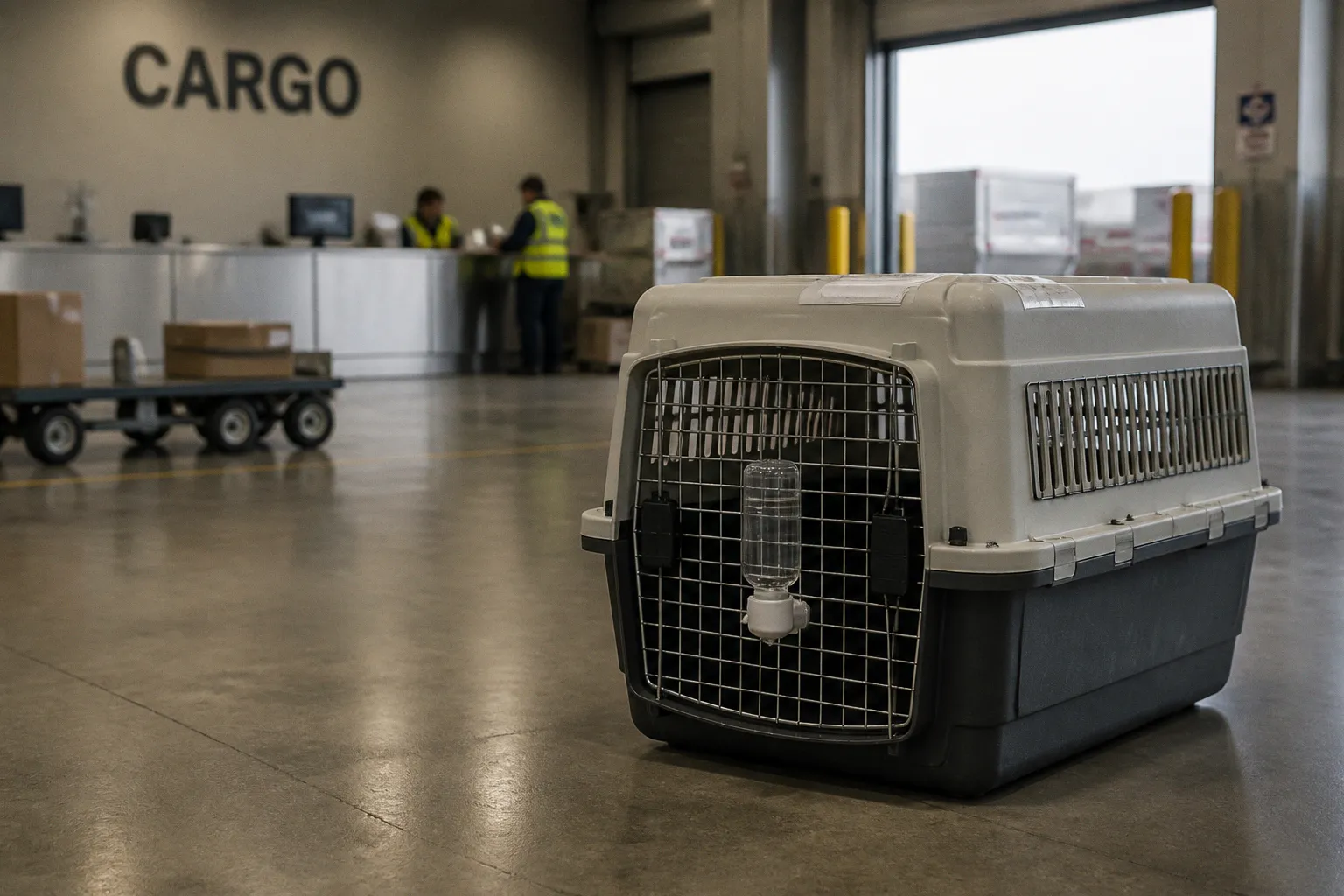
The animal is accepted at a dedicated cargo facility, processed against airline and animal-welfare rules, and transferred through a handling chain that may differ from the passenger route.
The airline pet cargo shipping process fails most often at the interfaces: an unsuitable crate, a health certificate outside its validity window, a late cargo arrival, or a temperature restriction that blocks acceptance. The booking is only one part of the transport. The physical preparation determines whether the shipment is accepted and whether the dog can maintain stable posture, ventilation, hydration, and thermal regulation during handling.
Start with the route, not the airline
The correct transport method depends on the dog’s size, breed structure, medical status, route length, season, and destination rules. Cargo may be the only available option for a large dog, but it is not automatically the safest option for every animal.
Before contacting an airline, define the transport profile:
- Origin and destination airports.
- Domestic or international routing.
- Total travel time, including ground transfers and connection handling.
- Dog’s age, weight, breed, body dimensions, and respiratory status.
- Required arrival date.
- Temperature at origin, connection points, and destination.
- Availability of a person authorized to deliver and collect the dog.
A direct route reduces handling events and limits the time spent in uncontrolled environments. A connection adds transfer risk, additional loading activity, and another point where weather or staffing can affect the schedule. If a direct cargo route does not exist, compare the full itinerary rather than the flight time alone.
The same distinction applies to airline selection. Some carriers accept pets through their cargo division. Others require a licensed pet shipper or freight forwarder for particular international routes. The booking channel must be confirmed before the crate is purchased or the veterinary appointment is scheduled.
Cargo against other transport options
| Transport method | Primary control point | Main limitation | Best use case |
|---|---|---|---|
| Airline cargo | Airline cargo facility and live-animal handling system | Strict documentation, crate, age, route, and temperature rules | Long-distance relocation when ground transport is impractical |
| In-cabin travel | Passenger terminal and cabin carrier limits | Size and weight restrictions; not available on every route | Small dogs that meet the airline’s cabin rules |
| Ground pet transport | Driver, vehicle, rest schedule, and handoff controls | Longer duration over interstate distances | Routes where continuous supervision is preferred |
| Pet taxi to an airport | Local driver and transfer timing | Does not replace airline cargo acceptance requirements | Transport between home, veterinary clinic, and cargo terminal |
The practical question is not whether cargo is technically available. It is whether the dog can complete the entire chain without a preventable failure in load distribution, ventilation, temperature control, or documentation.
Cargo acceptance is a timed safety procedure. Treat the airport handoff as a regulated appointment, not as ordinary check-in.
Build the booking timeline backward
The pet cargo booking timeline should be calculated from the flight departure, the veterinary certificate window, crate preparation, and cargo facility cutoff. Working forward from the day of travel creates avoidable compression.
A functional sequence has five stages.
1. Confirm eligibility before purchasing the ticket
Ask the airline cargo department or authorized shipper to confirm:
- Whether the route accepts live dogs as cargo.
- Whether the booking can be made directly or requires a freight forwarder.
- The cargo facility address and operating hours.
- The required arrival time before departure.
- Breed, age, weight, and crate restrictions.
- Seasonal temperature limits at every airport on the itinerary.
- Required health and vaccination documentation.
- Whether the aircraft type or connection point changes the acceptance rules.
The cargo facility is not necessarily located in the passenger terminal. Its address may be several miles away, and navigation to the wrong terminal can consume the entire acceptance window.
For domestic air transport in the United States, dogs generally must be at least 8 weeks old. International flights can impose higher thresholds; some carriers require dogs to be at least 6 months old. Destination-country rules may add vaccination, import permit, microchip, quarantine, or entry requirements. The airline’s acceptance rule and the destination’s legal rule both apply.
2. Reserve the shipment
A cargo reservation normally requires more than the dog’s name. The airline or shipper may need the animal’s species, breed, age, weight, crate dimensions, and routing details. Crate volume affects the shipment profile even when the dog’s body weight is moderate.
Do not provide estimated crate dimensions if the crate has not been selected. A change in external dimensions can alter the freight classification, handling plan, and available aircraft space.
The booking record should show:
- Shipment confirmation or air waybill information.
- Flight number and departure date.
- Cargo facility for drop-off.
- Cargo facility for collection.
- Acceptance cutoff.
- Contact number for the cargo desk or shipper.
- Any temperature or aircraft restrictions attached to the reservation.
Airline schedules can change. Reconfirm the shipment before the travel date, especially when the itinerary includes a connection or a seasonal temperature constraint. A passenger reservation does not guarantee live-animal cargo acceptance on the same flight.
3. Schedule the veterinary examination
A veterinary health certificate for cargo travel generally must be issued by a licensed veterinarian within 10 days of travel or arrival, depending on the applicable rule. The certificate should identify the dog and document the animal’s age, breed, and weight, along with confirmation that the dog is free from contagious disease.
The timing has two failure points:
1. The certificate may be issued too early and expire before arrival.
2. The certificate may be issued too late to satisfy airline or destination processing.
International routes can require additional endorsements and destination-specific paperwork. The veterinarian may need the final itinerary, airline requirements, destination regulations, and identification details before completing the examination.
Do not treat a general wellness note as a universal cargo certificate. The document must match the route and the accepting carrier. A certificate that satisfies one domestic shipment may not satisfy an international entry requirement.
4. Prepare the crate before the certificate window
The dog should be accustomed to the travel crate well before the flight. This is not a behavioral luxury. Familiarity affects movement, posture, panting, and kinetic load distribution during confinement.
The crate must meet IATA Live Animals Regulations Container Requirement 1. The dog must be able to:
- Stand without touching the top.
- Sit upright without forced neck flexion.
- Lie down in a natural position.
- Turn around normally.
- Maintain clearance from the sides and roof during ordinary posture changes.
A crate that is too small restricts gait transitions and increases contact pressure. A crate that is excessively large can allow uncontrolled sliding during handling. The target is functional space, not maximum internal volume.
Crate construction also matters. Ventilation openings must support airflow without creating points where paws, collars, or other equipment can become trapped. The locking system must resist accidental opening. Do not assume that any standard plastic kennel is IATA-compliant. Ventilation, fasteners, door design, dimensions, and structural condition all require verification.
The physical preparation: crate, hydration, and thermal load
The crate is the dog’s immediate environment for loading, transfer, flight, and collection. Its design controls posture and part of the thermal environment. It does not eliminate the effects of airport heat, cold, delay, or aircraft handling.
Fit the crate using body measurements
Measure the dog in standing posture and during normal sitting. Record:
- Nose-to-tail-base length.
- Floor-to-elbow height.
- Floor-to-top-of-head height while standing.
- Widest body measurement.
- Weight.
Use these measurements to select a container that permits the required postures. A dog with a long back or tall head may need a larger crate than its body weight suggests. Short-muzzled breeds may face additional airline or veterinary restrictions because panting is less efficient and heat dissipation is impaired.
Inspect the crate from the dog’s position, not from the outside. Check whether the door hardware creates a protrusion, whether the floor remains stable under load, and whether the ventilation openings are clear on all sides. Absorbent material should provide traction without becoming a loose obstruction.
Attach food and water equipment correctly
Cargo drop-off documentation generally includes food and water dishes that are accessible from outside the crate. The shipper may also require a completed food and water certification label.
The bowls must be secured so that handlers can refill them without opening the primary container. Loose bowls placed inside the crate can move during handling and create a trip or impact hazard. The food and water plan should correspond to the expected transport duration and the airline’s instructions. Do not improvise a feeding schedule that increases regurgitation risk immediately before loading.
The crate should carry clear identification, but labels must not obstruct ventilation or conceal required documentation. Keep copies of all documents separately from the crate in case a label is damaged during handling.
Control thermal exposure
Airlines commonly apply ambient temperature limits near 85°F and 20°F (-6°C), but the exact rule can vary by carrier, aircraft, airport, and route. The relevant temperature is not only the forecast at departure. Origin, connection, destination, ramp exposure, and local handling conditions all affect acceptance.
The risk assessment changes with the dog:
- Dense coat increases insulation but may impair heat release.
- Short muzzle reduces respiratory reserve.
- Obesity increases thermal load.
- Cardiac or respiratory disease reduces tolerance to stress.
- Very young and older dogs have less reliable thermal regulation.
- Wet fur increases evaporative and conductive heat loss in cold conditions.
Do not use sedatives to compensate for travel stress or crate resistance. Sedation can impair protective responses and thermal regulation, and airlines or veterinarians may restrict it. A dog that cannot safely tolerate a crate should be reassessed for a different transport method or a veterinary behavior plan before booking.
A calm appearance is not the safety metric. Airway function, thermal tolerance, hydration, and unrestricted posture are the relevant variables.
The cargo drop-off procedure
The dog flight cargo drop-off steps are operationally different from passenger travel. Allow time to locate the correct facility, complete paperwork, and resolve any discrepancy before the cutoff.
Cargo check-in typically occurs 2.5 to 6 hours before departure. The exact window depends on the airline and whether the shipment is domestic or international. Arriving outside the window can result in refusal even when the passenger flight is still open for boarding.
Use this sequence at the airport
1. Go to the dedicated cargo facility.
Do not start at passenger check-in unless the airline explicitly directs you there. Cargo buildings may be separate from the terminal and may use a different entrance, parking area, or security process.
2. Present identification and shipment records.
Bring valid government-issued photo identification, the booking confirmation, and any air waybill or shipper documentation. Keep digital and paper copies.
3. Submit the health certificate and destination documents.
The cargo agent checks whether the documents identify the correct animal, route, and travel date. Missing signatures, expired certificates, inconsistent weight, or incorrect destination information can stop acceptance.
4. Present the crate for inspection.
The agent may verify dimensions, ventilation, locking hardware, condition, and access to food and water containers. The dog must fit the crate under the required posture standard.
5. Complete the food and water certification.
Follow the airline’s form and attachment instructions. The label must be visible and the dishes must be accessible from outside the crate.
6. Confirm the collection procedure.
Ask where the receiving party goes, which documents are required, and whether the destination cargo office will call when the shipment is ready. The person collecting the dog may need government-issued identification.
7. Leave only after the cargo agent accepts the shipment.
A crate placed at the facility is not proof of acceptance. Obtain confirmation that the shipment has entered the cargo system.
The final pre-handoff inspection should be quiet and controlled. Remove collars, harnesses, or other loose items if the airline or veterinarian directs this. Loose equipment can catch on crate components or handling equipment. Follow the carrier’s instructions rather than adding personal accessories to the crate.
Troubleshooting the common failure points
The most useful troubleshooting method is to classify the problem by its controlling variable.
If the airline rejects the crate
Determine whether the issue is size, structure, ventilation, door security, damaged components, or noncompliant water access. Do not solve a dimensional problem with a temporary extension or improvised hardware. A replacement crate may require a new cargo measurement and reservation update.
If the dog cannot stand, turn, or lie naturally, the crate is not acceptable. If the crate is oversized but the airline identifies an aircraft or handling restriction, ask whether a different approved container or route is available.
If the health certificate is questioned
Compare the certificate against four fields:
- Dog identification.
- Issuing veterinarian credentials.
- Date of issue.
- Destination and carrier requirements.
A certificate can be medically accurate and still operationally unusable if it falls outside the permitted validity period or lacks a required destination document. Contact the veterinarian and cargo desk before traveling to the airport.
If the weather blocks acceptance
Check every airport on the itinerary. A safe temperature at the origin does not resolve a heat restriction at a connection point. Options may include an earlier or later flight, a different route, a cooler season, or ground transport.
Do not place ice packs, heating devices, or thick insulation inside the crate without carrier approval. These can reduce usable space, obstruct airflow, leak, or create a contact hazard. Thermal control must preserve ventilation and normal posture.
If the dog shows severe travel intolerance
Persistent respiratory distress, collapse, uncontrolled vomiting, extreme weakness, or inability to recover from mild exertion changes the transport decision. Cargo travel is not an appropriate behavioral test. Obtain veterinary assessment before shipment.
Travel anxiety alone does not establish a medical diagnosis, but the physical signs require interpretation. Evaluate gait, respiratory rate and effort, mucous membrane color, hydration, and recovery after exertion. The goal is not to make the dog motionless. The goal is to preserve functional physiology during confinement and handling.
If a connection is unavoidable
Use the fewest transfers available. Confirm who handles the animal between aircraft and whether the shipment remains in a controlled environment. Ask the cargo department how delays are managed and how the receiving party is notified.
Do not build an itinerary with a passenger connection time and assume it applies to the animal shipment. Cargo handling has separate cutoffs and transfer procedures. The dog may need to be accepted hours before passenger boarding, and the destination collection process may not begin immediately after landing.
When ground transport is the better route
Ground pet transport can provide continuous supervision and a more controllable rest schedule. It may be preferable for dogs that are medically stable but poorly suited to aircraft cargo, for routes with severe seasonal temperature exposure, or when airline cargo connections introduce excessive handling.
That does not make ground travel automatically low risk. The vehicle needs secure crate placement, adequate ventilation, temperature monitoring, scheduled water and elimination breaks, and a documented handoff plan. A dog should not be allowed to move freely in a vehicle during transit. Load distribution changes during braking and cornering; unsecured movement increases impact risk.
For interstate relocation, compare the total duration rather than the number of miles. A long ground route can create cumulative dehydration, fatigue, and thermal exposure. An airline route can reduce travel time but increase handling intensity. The safer choice is the one with the lower combined physiological and operational load for that specific dog.
Final safety parameters
Before leaving for the cargo facility, verify the following:
- The route is confirmed for live-animal cargo.
- The shipment is booked through the correct airline cargo channel or authorized shipper.
- The cargo facility address is recorded separately from the passenger terminal.
- The acceptance window is known. Typical cargo drop-off occurs 2.5 to 6 hours before departure.
- The dog meets the applicable minimum age. Domestic travel generally requires at least 8 weeks; international rules may require at least 6 months.
- The veterinary health certificate is issued within the permitted 10-day window and matches the itinerary.
- Destination documents are complete for the specific country or state.
- The crate satisfies IATA Container Requirement 1.
- The dog can stand, sit upright, lie down, and turn around without contact restriction.
- Ventilation openings are clear and the locking mechanism is secure.
- Food and water dishes are accessible from outside the crate.
- The food and water certification label is completed and attached.
- Government-issued photo identification is available.
- Weather limits have been checked at origin, connections, and destination.
- No sedative has been used unless specifically prescribed and accepted under the carrier’s rules.
- The receiving person knows the collection facility, timing, and identification requirements.
- The cargo agent has confirmed acceptance before departure from the facility.
The airline pet cargo shipping process is controlled by interfaces: veterinary clearance, container geometry, cargo timing, weather, and handoff logistics. Treat each interface as a separate safety parameter. If one fails, do not compensate with optimism or a rushed airport decision. Change the route, timing, crate, documentation, or transport method before the dog enters the cargo system.