One World Observatory Tickets: Pre-Booking Pet Checklist
If you're planning to buy tickets One World Observatory for a New York trip with a dog in tow, stop before you click purchase. One World Observatory does not allow personal pets inside the building or on the surrounding West Plaza.
That applies during regular public hours and private events alike. The dog in your purse is still a pet. So is the cat in the carrier over your shoulder, and so is an emotional support animal whose owner insists that the label should be enough.
Tickets and prices
One World Observatory
New York
01 · GetYourGuide
Skip-the-line ticket — choice of 3 options or VIP tour
USD30.33
02 · Official
Official ticket — standard general admission
USD44
The policy is firm, security enforcement is not discretionary, and tickets are non-refundable. This is not the sort of venue where you can arrive with a dog, explain the situation, and hope someone makes an exception. If your animal is not legally permitted to enter, the practical answer is simple: arrange care elsewhere before you buy.
A non-refundable ticket and an unauthorized pet can turn a bucket-list visit into a very expensive security-checkpoint mistake.
Most visitors who run into trouble do so at the worst possible moment: at the entrance, with children, bags, timed tickets, and a dog that still needs somewhere to go. The venue can deny entry or remove an unauthorized animal from the premises. Your ticket does not become refundable because the pet policy was overlooked, and a persuasive argument about your dog’s temperament will not change the access rules.
That makes the pet-care decision part of the ticket decision. Before booking One World Observatory tickets, establish whether the animal is staying at the hotel with a sitter, going to a boarding facility, remaining with a traveling companion, or qualifying for lawful access as a service or official assistance animal.
Strict Pet Prohibition and Venue Access Rules
One World Observatory occupies floors 100 through 102 of One World Trade Center. The building itself rises 1,776 feet, but that figure describes the tower’s total height, not the distance an elevator travels to the observatory. The relevant point for visitors with animals is less architectural: the observatory is a controlled attraction with security procedures that apply before you reach the elevators.
The pet prohibition extends beyond the observation deck. The venue’s rules cover the observatory complex and the West Plaza property surrounding the building. The plaza may feel like ordinary public space in Lower Manhattan, but it is part of the arrival and security environment for the attraction. Walking a dog to the entrance and hoping to take the animal inside for only a few minutes is not a workable plan.
The restrictions cover:
- Personal pets of every ordinary household type. Dogs, cats, birds, reptiles, and other companion animals are not admitted simply because they are small, calm, or used to traveling.
- Animals in carriers, slings, backpacks, and strollers. A carrier changes how an animal is transported; it does not change the animal’s status as a personal pet.
- Emotional support animals. An ESA is not automatically a service animal and does not receive the same general public-access rights. A letter, registration card, online certificate, or vest does not by itself create access rights at the observatory.
- Animals brought for convenience. A traveler cannot describe a pet as a working animal because the animal provides comfort, helps with routine anxiety, or has been trained informally to behave well in public.
- Animals left just outside the entrance while the group goes up. One person cannot solve the access problem by tying a dog near the plaza or expecting security staff to supervise it.
The permitted categories are narrow. They include legitimate service animals accompanied by a qualified handler, service animals in training that meet the venue’s stated age requirement, and police or certified assistance animals on official business. The distinction matters because a checklist that mentions only service dogs leaves out animals that may be present for official duties.
A personal pet does not become eligible because its owner has purchased a premium ticket, booked a private event, or arrived during a quieter period. There is no ticket tier that includes an animal-holding arrangement, a pet-relief area, or a temporary exception to the ban. The practical decision is made before arrival, not at the security desk.
What “service animal” means in practice
A service animal is not defined by a vest, a harness, a website registration, or the owner’s preference for the term. The relevant question is whether the dog is individually trained to perform work or tasks for a person with a disability. Emotional support and companionship, while meaningful, are different categories.
The venue also does not treat every species as an access animal under the ordinary service-animal rules. A miniature horse, for example, should not be assumed to have the same access status as a trained service dog. Police animals and certified assistance animals on official business belong to a separate permitted category and should not be collapsed into the personal-pet question.
This is where travelers often make a preventable mistake: they search for a broad pet policy, find a general statement about service animals, and assume that any animal with documentation will qualify. Documentation is not a substitute for the animal’s actual function, training, and behavior. If there is any uncertainty, resolve it with the venue before the day of the visit rather than treating the entrance as a place to negotiate.
Service Animal Requirements and Age Restrictions
Service animals are permitted, but access is not unconditional. The dog must be with the person it serves, must be under control, and must meet the venue’s requirements for service animals in training. A traveler should plan around those details rather than relying on a general assumption that all dogs working in some capacity will be admitted.
Three points deserve particular attention.
1. Service animals in training have an age restriction. The venue requires a service animal in training to be at least 12 months old. A younger puppy wearing a program vest, attending socialization outings, or enrolled with a reputable trainer does not meet that specific threshold for entry.
2. The handler must be present. A service dog cannot be dropped off with a friend while the person it assists visits the observatory. The animal’s role is connected to its handler, and the handler must accompany it.
3. Behavior standards still apply. A permitted service animal must remain under control and be housebroken. Barking, lunging, uncontrolled movement, or disruptive conduct can lead to removal. Public-access rights do not eliminate ordinary requirements for safe behavior in a crowded attraction.
The age rule is especially important for visitors traveling with a young working dog. Training status and future working status are not enough; the animal has to meet the venue’s stated requirement on the date of the visit. That should be checked before booking a timed entry slot, particularly if the trip is being planned months ahead and the dog will cross the age threshold during the journey.
For official animals, the category is different. Police or certified assistance animals performing official duties may be permitted under the venue’s rules even though they are not personal pets and do not fit the ordinary service-dog framework. That is not a loophole for private travelers. It is a reminder to classify the animal accurately instead of forcing every situation into a simple pet-versus-service-dog binary.
Access depends on the animal’s legal role, training, handler, and behavior—not on a vest, a letter, or a confident explanation at security.
If your dog is a genuine service animal, prepare for a normal security process and keep control of the animal throughout the visit. If the animal is a personal pet, stop looking for a way to reclassify it and arrange care off-site. That decision is kinder to the dog and much less stressful for the group.
Logistics for Non-Refundable Ticket Purchases
One World Observatory tickets are sold on a final-sale basis. Standard admission, combination options, and all-inclusive upgrades may differ in what they include, but none of them solves the pet problem. Higher-tier products may offer benefits such as priority security access, a digital iPad guide, or food, beverage, and retail vouchers. Those features affect the visitor experience, not the venue’s animal-access rules.
The common failure pattern is predictable. Travelers book several weeks ahead, assume they will sort out the dog later, and then discover that the sitter is unavailable on the only day that fits their itinerary. The boarding facility is full. The hotel will not allow the dog to remain unattended. The traveling companion has arranged a separate activity. By the time the problem becomes visible, the tickets have already been purchased.
That is backwards. Pet care is not a minor detail to fill in after the attractions are booked. In New York, it can determine whether a particular sightseeing day is possible at all.
Book the sitter before you book the ticket. If the pet-care problem is unresolved, the sightseeing plan is unresolved too.
A useful way to think about the ticket choices is to separate what you are purchasing from what you are not purchasing:
| Ticket option | What it may provide | What it does not provide |
|---|---|---|
| Standard admission | Entry to floors 100–102 and the standard observatory experience | Permission for a personal pet or an animal-holding service |
| Combination pass | Standard admission plus an additional experience, depending on the package | A pet exception, relief area, or supervised waiting arrangement |
| All-inclusive option | Added conveniences such as priority security, a digital guide, or food, beverage, or retail value | Any change to the animal policy |
A faster security lane can reduce waiting time for the people in your group. It does not help if the dog is still with you on the West Plaza. Likewise, a flexible sightseeing schedule cannot compensate for a non-refundable reservation when no one is available to care for the animal.
Before paying, confirm four things:
- the date and entry time work with the sitter or boarding booking;
- the care provider can handle the animal’s feeding, walks, medication, and sleep routine;
- the hotel’s rules permit the intended arrangement;
- every adult in the group understands that the pet cannot be brought along as a backup plan.
The final point sounds obvious until a family is standing in a security queue with a dog that one person assumed would be allowed. Put the decision in writing in the trip plan. “We’ll figure it out” is not a pet-care arrangement.
Essential Visitor Guidelines for Smooth Entry
Once the animal issue is settled, the rest of the entry plan becomes much easier. Lower Manhattan is not a forgiving place for improvised logistics. Groups are moving between transit, security, timed admission, food stops, and other attractions. A small misunderstanding about bags or supervision can cost more time than the elevator ride itself.
Bags and personal equipment
The venue applies a maximum bag size of 25 inches high by 17 inches wide by 9 inches deep. Measure the backpack, camera bag, or family daypack rather than estimating by eye. A soft bag that looks compact when empty may exceed the limit once it is filled with jackets, snacks, chargers, and children’s supplies.
Do not assume that an oversized bag will be stored at the venue. The policy confirms the size limit, but it does not establish a paid bag-check service that visitors can rely on. The safest plan is to leave oversized luggage at the hotel or another confirmed storage location before heading to the observatory.
That matters for pet travelers because a dog carrier, travel crate, or large animal-supply bag can become part of the access problem even when the animal itself is staying elsewhere. Pack only what the group needs for the attraction and verify the dimensions in advance.
Children and youth groups
Children aged five and under are admitted without a ticket, but they still count as members of the visiting group. Free admission does not mean no supervision, no space, or no time spent getting through security. Families should account for younger children when choosing the entry time and building a buffer around the reservation.
Visitors aged 16 and younger require a chaperone. For groups of children or students, the stated ratio is one adult for every ten youth or students. This applies to school groups, scout groups, birthday parties, and similar outings. A family arriving with several children should also decide in advance which adult is responsible for which child during security, the elevator queue, and the observation-floor visit.
The pet-care plan should be coordinated with that supervision plan. A group should not discover at the entrance that one adult has to leave with an unauthorized dog while the remaining adults are suddenly responsible for more children than expected.
The elevator and the visit itself
The elevator takes about 47 seconds to reach floors 100 through 102. The frequently repeated figure of 1,776 feet refers to One World Trade Center’s total building height, not the elevator’s vertical travel to the observatory. It should not be used to describe the length of the ride.
The ride is still an important part of the experience, particularly for children or visitors who are uneasy in elevators. A quick explanation before entering can prevent a nervous reaction in a crowded car. Once on the observatory floors, visitors should follow staff directions, keep personal items secure, and avoid treating the attraction like an open public plaza where a group can stop wherever it wants.
Higher-tier tickets may shorten part of the security process, but no ticket eliminates the need to arrive prepared. Build time for transit, finding the correct entrance, bag screening, group coordination, and the inevitable pause when someone needs a restroom or realizes they left a jacket behind.
The smoothest entry is usually the least dramatic one: appropriately sized bags, the correct ticket information, a supervised group, and no pet-policy dispute waiting at the front door.
Arranging Reliable Pet Care in New York City
The observatory will not arrange care for a personal pet, so this is where the real planning begins. New York offers in-room sitters, boarding facilities, daycare programs, and private arrangements, but availability and quality vary. A service that looks convenient online may not be suitable for an animal that is anxious, elderly, reactive, medication-dependent, or unfamiliar with city noise.
Start with the dog or cat rather than with the attraction. A social, energetic dog may do well in a properly supervised daycare or boarding setting. A cat, senior animal, or dog that becomes distressed in unfamiliar group environments may be better off with a sitter in the hotel or another permitted private space. The right choice is the one that fits the animal’s routine, not the one that sounds most impressive in a booking app.
In-room sitting
An in-room sitter can be a practical option for cats, older dogs, low-energy animals, and pets that do not tolerate boarding well. The sitter may handle feeding, walks, medication, litter, and companionship at the hotel or other approved accommodation.
Confirm the hotel’s policy before relying on this arrangement. Some properties limit unattended pets, require a guest to be present, or have separate rules about outside caregivers. The sitter also needs clear instructions for accessing the room, handling keys, contacting the front desk, and responding if the animal becomes ill or distressed.
Look for:
- verifiable reviews that describe the same type of care you need;
- a clear cancellation and backup policy;
- evidence of insurance or professional operating standards where applicable;
- experience with medication, senior animals, anxious pets, or reactive dogs if relevant;
- a defined emergency procedure and permission to contact your veterinarian.
A sitter who is excellent with midday walks may not be the right person to manage insulin, separation anxiety, or a dog that cannot remain alone in a hotel room.
Boarding and daycare
Boarding or daycare can suit a confident, social dog that is comfortable around other animals and unfamiliar handlers. It may be a poor match for a dog that has just endured a long flight, struggles with noise, or becomes overwhelmed in group play.
Ask about the facility’s daily structure, rest periods, supervision, overnight arrangements, and separation procedures. Confirm vaccination requirements before making a booking; rabies, distemper, and bordetella are commonly requested, but the facility’s actual rules control. Make sure records are available in the format the provider accepts.
Do not schedule the most demanding care arrangement immediately after a stressful travel day without considering how your animal responds to disruption. Some dogs arrive in New York already tired, dehydrated, or overstimulated. A quiet, low-arousal setup may be safer than a busy playroom, even if the dog normally enjoys daycare at home.
Friends, family, and traveling companions
A friend or relative can be the best option when that person already knows the animal and is genuinely available. It is not a plan if the person has not agreed to the dates, cannot manage the animal independently, or is assuming that someone else will cover walks and meals.
The same applies to a companion traveling with you. That person should know exactly how long the observatory visit will take, where the dog can be walked, what happens if the group is delayed, and whether the hotel permits the animal to remain with them. A vague promise to stay behind is easy to make during itinerary planning and easy to break once the trip begins.
What to leave with the caregiver
Whatever care option you choose, prepare a concise care packet. Include:
- feeding amounts and timing;
- medication instructions, if any;
- walk and bathroom habits;
- behavior triggers and calming routines;
- your hotel information and local contact number;
- your veterinarian’s contact details;
- an emergency contact who can authorize decisions if you are unreachable;
- vaccination and identification records when the provider requires them;
- written permission for emergency veterinary care if appropriate.
Confirm the booking in writing and make sure the caregiver has a backup contact. If the primary sitter cancels, the problem should not first become visible while you are standing in the observatory security line.
The best pet-care plan is the one your animal barely notices because the routine continues without a crisis.
Before You Commit to the Purchase
Run through the practical decisions before paying for non-refundable admission:
- Classify the animal accurately. Is it a personal pet staying outside the attraction, a service animal entering with its handler, a service animal in training that meets the 12-month minimum, or a police or certified assistance animal on official business? If it is none of these permitted categories, it does not enter.
- Confirm the care arrangement. The sitter, boarder, or companion should have agreed to the date and time, not merely expressed general willingness to help.
- Check the accommodation rules. A hotel’s pet-friendly label does not automatically mean the animal can be left unattended or that an outside sitter can enter the room.
- Share the information the caregiver needs. Feeding, medication, emergency contacts, veterinary details, and access instructions should be ready before the day of the visit.
- Create a backup. New York plans change quickly. Assign a local person who can step in if the primary caregiver is delayed or unavailable.
- Review the ticket terms. Treat the purchase as non-refundable unless the applicable terms clearly say otherwise.
- Measure every large bag. Keep luggage and daypacks within the 25-by-17-by-9-inch limit. Do not assume the venue will provide paid storage for an oversized item.
- Confirm the group’s supervision plan. Visitors aged 16 and younger need chaperones, and groups must meet the stated one-adult-per-ten-youth ratio.
- Add a time buffer. Allow for transit, security, the elevator queue, children’s needs, and delays at the hotel before the timed entry.
If one of those decisions is unresolved, the trip is not ready to book. The observatory is not going to bend its pet policy because the sitter canceled, and a dog does not become comfortable with a long hotel stay simply because the tickets were expensive.
One World Observatory can be a memorable New York visit: the elevator ascent, the view across Manhattan, and the city opening up below the glass are all good reasons to go. None of that requires gambling with an animal’s care or arguing with security about a classification that was never valid.
Sort the animal first. Confirm the care. Then buy the ticket and enjoy the view.
FAQ
Can I bring my dog or cat into One World Observatory?
Are emotional support animals allowed at One World Observatory?
What are the requirements for a service animal at One World Observatory?
Are One World Observatory tickets refundable if my pet cannot enter?
What bag size is allowed at One World Observatory?
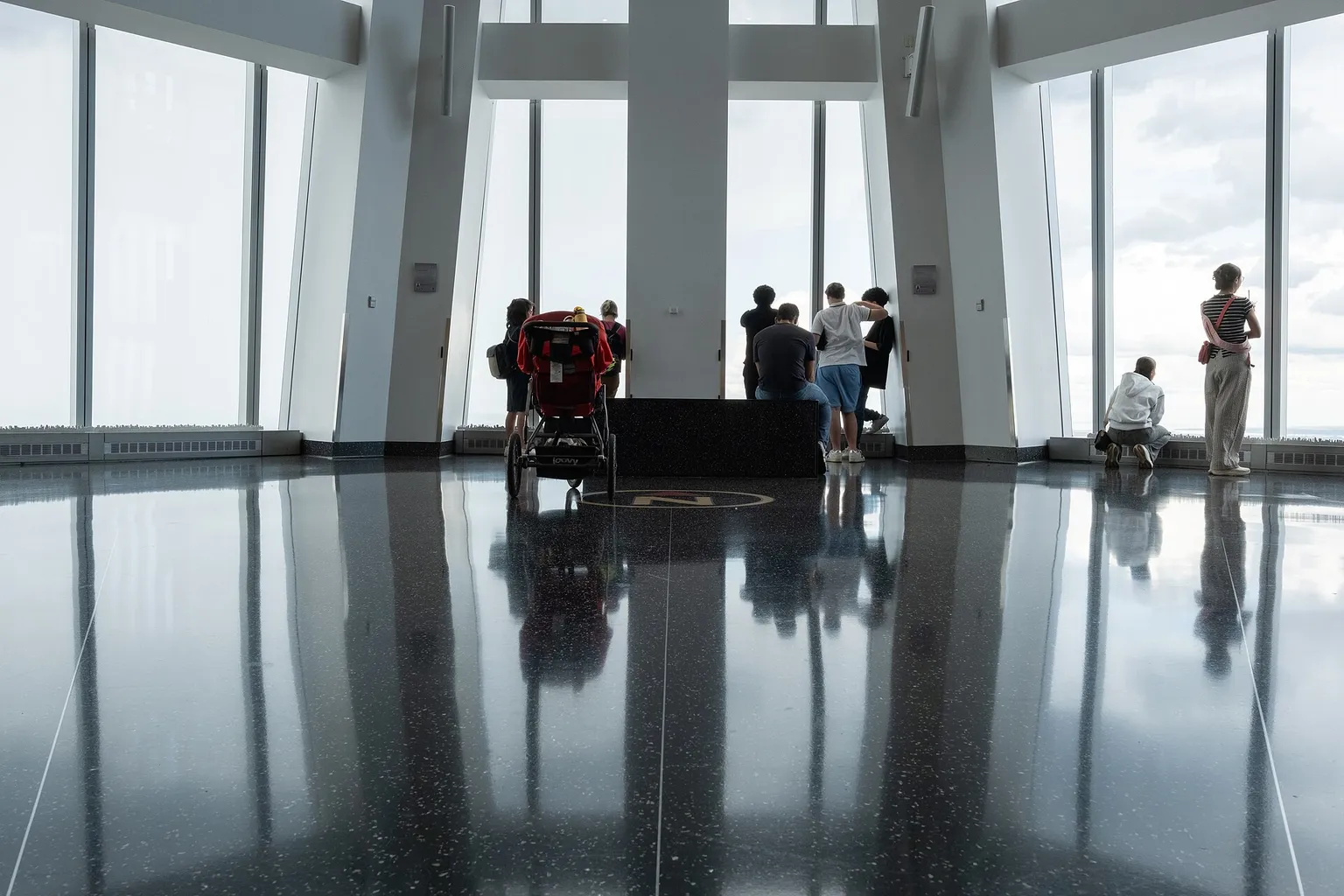
Photo: Christian David / CC BY-SA 4.0 — Wikimedia Commons