Pet first aid: does your sitter need certification?
No, a pet sitter in the United States does not need first aid certification to legally call themselves a professional.
There is no federal license, no universal qualification gate, and no agency stopping an untrained person from taking a client’s keys, leash, and dog.
That is the legal answer. It is also the bare minimum answer, which is why it is not enough.
The real question behind pet sitter first aid certification necessity is simpler: if your dog collapses, tears a nail to the quick, gets into a fight at daycare, chokes on a treat, or starts bleeding while you are three states away, is the person holding the leash trained to act for the first few minutes—or are they scrolling for advice while your animal gets worse?
A certificate does not turn a sitter into a veterinarian. It does not make emergencies routine. CPR is needed in a very small slice of veterinary emergencies—one hospital study put it at 0.12% of canine and feline emergency cases. But emergencies are not judged by frequency when they happen in your living room at 11:40 p.m. The hard truth is that a sitter’s response in the gap before veterinary care can matter enormously. The American Animal Hospital Association reports that 25% more pets could survive if even one first-aid technique were used before emergency veterinary treatment.
That is not a sales pitch for a laminated certificate. It is a reason to stop treating first aid training as a cute bonus.
Is pet first aid certification legally mandatory for sitters?
In the U.S., generally no. Professional pet sitter certification requirements vary wildly because the industry is largely unregulated. A person can build a dog-walking or overnight pet-sitting business without formal animal-care training, a business license in some places, or any demonstrated emergency skills.
Local rules may still apply. Cities, counties, landlords, insurers, and commercial facilities can impose their own requirements. A boarding facility may face different oversight from a solo sitter providing in-home care. But there is no federal rule that says every American pet sitter must complete pet first aid training.
The picture is different in the United Kingdom. Many local councils require pet first aid credentials for licensing or insurance purposes, particularly for dog walkers, sitters, and animal businesses. Manchester and several London boroughs have explicitly incorporated first aid certificates into licensing expectations. Industry groups also draw firmer lines: the National Association of Pet Sitters & Dog Walkers in the UK requires first aid training for membership and expects it to be renewed every three years.
So, do pet sitters need CPR training? The legal answer depends on where they work. The practical answer is that any sitter who markets themselves as a professional should have it.
There is a gap between “allowed to operate” and “prepared to care for an animal under stress.” Too much of the pet-care industry lives comfortably in that gap.
A sitter does not need to be a vet. They do need to know what to do before the vet takes over.
Why first aid matters when the pet is not yours
In shelter work, we see a version of this constantly: people underestimate how quickly a familiar animal can become an unfamiliar patient. Pain changes behavior. Fear changes behavior. A normally soft dog can bite when you try to inspect an injured paw. A food-motivated dog can guard a dropped medication bottle. A cat that tolerates handling at home can become a flying set of claws when transported in distress.
That is why decent first aid training is not just a CPR demonstration with plush animals on a folding table. It should prepare a sitter to recognize the problem, avoid creating behavioral fallout, stabilize what can be stabilized, and get the animal to veterinary care without turning the event into a second emergency.
A competent sitter should be able to deal with the first layer of common problems:
- Bleeding and wound control. Applying pressure, using appropriate temporary bandaging, recognizing when a wound is beyond home management, and preventing the dog from licking or escalating the damage.
- Choking response. Knowing the signs of true airway obstruction versus coughing, gagging, reverse sneezing, or panic. A sitter who “does something” to every coughing dog can cause real injury.
- Heat distress and dehydration. Stopping activity, moving the dog out of heat, using safe cooling measures, and heading for veterinary help rather than tossing the dog into an ice bath and hoping for a miracle.
- Seizures and collapse. Protecting the animal from further injury, timing the event, reducing stimulation, and understanding that fingers do not belong near the mouth of a seizing dog.
- Toxin exposure. Removing access, preserving packaging or taking a photo of it, calling the veterinary team or poison resource, and not improvising home remedies.
- Safe transport. Getting an injured, painful, or panicked animal into a vehicle without losing them, getting bitten, or worsening a possible spinal or orthopedic injury.
Notice what is missing: diagnosis. A trained sitter is not there to announce that a dog has bloat, poisoning, a broken leg, or a neurological event. They are there to see that something is seriously wrong, keep the situation from becoming worse, notify the owner and veterinarian, and move with purpose.
That distinction matters. Overconfident pet care is often more dangerous than plain inexperience because it delays the call that should have been made ten minutes earlier.
Certification is not the same thing as competence
Here is the uncomfortable part for owners shopping by badges: a certificate alone proves attendance or course completion, not judgment.
Some pet first aid courses are online and take roughly 35 minutes to an hour. They can be useful. A sitter who has never learned the basic sequence for bleeding control, choking response, or CPR is better off completing a solid module than doing nothing. Online material is also easy to revisit, which matters after the details get fuzzy.
But a four-hour in-person practical class does something a quick online course cannot: it forces the person to put hands on the process. They practice positioning, bandaging, muzzle considerations, assessment order, restraint decisions, and the awkward reality of trying to work around a scared animal. No class fully reproduces a 70-pound dog thrashing because its paw hurts. Still, physical practice is closer to the job.
| Training format | What it does well | Where it falls short | Best use |
|---|---|---|---|
| Short online course | Covers basic recognition, response steps, and emergency planning; easy to renew or review | Limited hands-on practice; easy to click through without retaining much | Baseline knowledge and refreshers |
| Live practical class | Teaches handling, technique, body positioning, and real-time decision-making | Takes more time and may not be locally available | Core training for active sitters and walkers |
| Veterinary-led or advanced workshop | Can add depth around triage, transport, and scenario work | Quality varies; still does not authorize veterinary treatment | Experienced professionals managing higher-risk cases |
The best professional setup is not mysterious: practical training, periodic refreshers, written emergency protocols, and a relationship with local veterinary clinics. If a sitter offers overnight boarding, handles multiple dogs, takes large breeds, works with seniors, or accepts animals with known medical issues, the case for hands-on training gets stronger.
A pet sitter walking one healthy adult dog at a time has a different risk profile from a person supervising six dogs in a private home. Pretending those jobs carry the same emergency burden is industry nonsense.
The shelter reality: emergencies come with behavior attached
Owners often evaluate sitters through soft signals: cheerful social-media posts, a nice meet-and-greet, a clean vehicle, lots of photos. None of that is bad. But it can obscure the questions that actually matter under pressure.
Ask what the sitter does when a dog refuses a harness because its shoulder hurts. Ask how they separate dogs after a scuffle without putting hands between heads. Ask how they manage a cat who has hidden for 24 hours and will not eat. Ask whether they know the nearest emergency clinic, how they transport a reactive dog, and what happens if your regular vet is closed.
These questions are not paranoid. They are normal. A pet sitter is being paid to enter your animal’s territory when you are absent. That means they inherit the animal’s routines, anxieties, resource guarding patterns, medication schedules, and triggers—often with incomplete information from the owner.
The owner expectation is usually: “My dog loves people, so there should be no problem.”
The shelter reality is: pain, confinement, unfamiliar handling, disrupted routine, and separation can remake behavior quickly. A dog who has never snapped at home may snap when a stranger reaches under a sore belly. A dog who is fine with other dogs at the park may guard a food bowl in a boarding environment. A cat who merely hides during a normal visit may become dangerously stressed if forcefully removed from a closet.
First aid training should include this behavioral piece. Not academic vocabulary for the sake of sounding smart. Just basic survival sense:
1. Do not corner a distressed animal. Create space, lower stimulation, and assess whether immediate hands-on intervention is truly needed.
2. Do not promise an owner you can “handle any dog.” That is how sitters get bitten and dogs get mishandled. The right response may be calling the owner, veterinarian, emergency contact, or animal control support.
3. Do not turn restraint into a contest. A muzzle can be an appropriate safety tool when a dog is painful and needs transport, but only if the dog can breathe normally and is not vomiting, overheating, or struggling to breathe.
4. Do not ignore the quiet animal. A dog who suddenly stops engaging, a cat who stays hidden and skips meals, or a normally noisy bird who goes still may be giving you the only early warning you get.
5. Do not delay escalation because you fear “overreacting.” Owners may complain about an unnecessary vet visit. They will not forgive a sitter who waited through an obvious emergency to avoid inconvenience.
The goal is not heroic intervention. The goal is fewer bad decisions before the animal reaches proper care.
What a first-aid-trained sitter should have besides a certificate
A certificate without systems is wall décor.
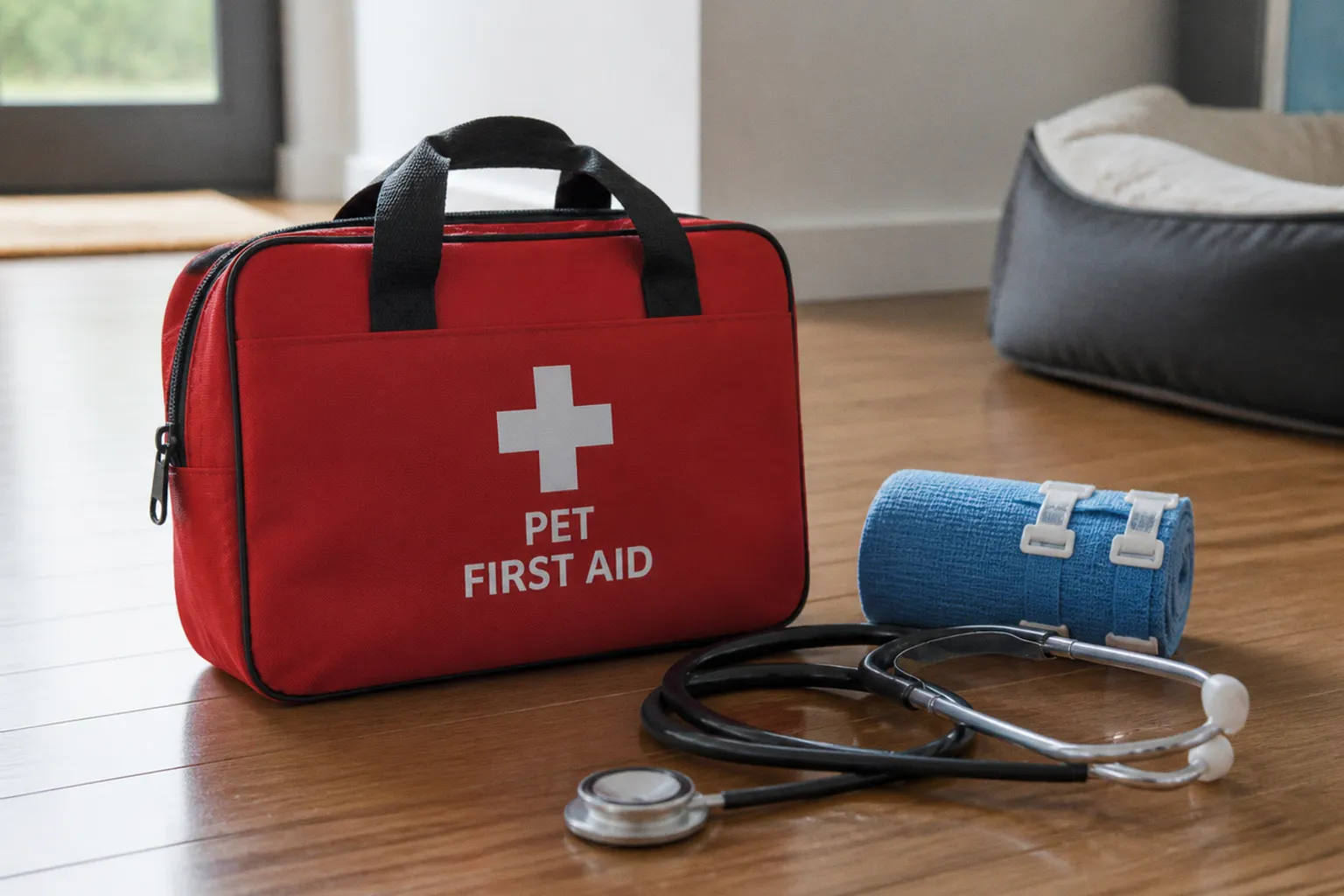
A serious pet sitter should carry a current first aid kit, but more importantly, they should know what is in it and why. The kit should be checked before supplies expire, get wet, disappear into another bag, or become contaminated. A random pouch filled with old gauze and one lonely bandage is not preparedness.
For in-home pet care and overnight boarding, the operational side matters just as much as the training:
- A signed veterinary release and spending authorization. The sitter needs clear permission to seek emergency care, plus a realistic financial limit or payment arrangement. “Call me first” is not a workable plan if the owner is on a plane.
- Primary and backup veterinary contacts. Include the regular clinic, after-hours emergency hospital, poison resource if relevant, and an authorized local contact who can make decisions if the owner cannot be reached.
- Current medical information. Medications, allergies, chronic conditions, prior seizure history, mobility limitations, bite history, feeding restrictions, and known triggers should be documented before the booking begins.
- A transport plan. Which vehicle is available? Where is the carrier? Can the dog be safely lifted? Does the cat have an escape-proof carrier? Is there an extra leash? These boring details are the details that fail at midnight.
- Clear communication thresholds. Owners and sitters should agree on what warrants an immediate call, what warrants a text update, and what means the sitter goes directly to emergency care.
- A record of the incident. Time, symptoms observed, photos when appropriate, what was given or done, veterinary instructions, and the animal’s response. This is useful to the owner and the veterinary team. It also keeps panic from rewriting the timeline.
For multi-pet households, add separation plans. If one dog is injured or sick, who manages the others? If a cat needs urgent transport, where are the doors closed? A sitter trying to load one panicked animal while three others rush the open front door is not dealing with a medical incident anymore. They are dealing with an escape risk too.
How long is certification valid, and does renewal matter?
Most pet first aid certificates are valid for two to three years, depending on the provider. Three years is a common renewal cycle. That may sound excessive for skills that seem straightforward, but knowledge decays fast when it is not used.
That is good news, in a grim way. You do not want a sitter “getting practice” on emergencies. You want them refreshing the steps before they need them.
Renewal is also a small test of professional seriousness. Pet care practices change, course content improves, and local licensing or insurance expectations can shift. A sitter who took one class eight years ago and has never revisited it is not current. They are relying on memory, confidence, and luck—a terrible trio.
Ask directly:
- When did you last complete pet first aid training?
- Was it online, hands-on, or both?
- Does your certificate have an expiration date?
- What would you do first if my pet became unresponsive, started bleeding, or showed signs of heat distress?
- Which emergency clinic would you use if my regular vet is unavailable?
- Are you insured, and does your policy require or recognize first aid credentials?
A capable sitter should not act offended by these questions. They should answer them without theater. If the response is “I’ve had dogs my whole life,” keep looking. Living with animals is not the same as being responsible for someone else’s animal in a crisis.
First aid ends where veterinary medicine begins
Pet first aid training for sitters is about immediate, temporary support. It is not a shortcut around veterinary care.
In the UK, the Veterinary Surgeons Act 1966 permits anyone to administer first aid in an emergency to save an animal’s life or relieve pain and suffering, as an interim measure until a veterinary surgeon can be reached. The principle is sensible anywhere: stabilize, communicate, transport, hand off.
A sitter should not diagnose illness, prescribe medication, perform surgery, decide that a serious symptom is “probably nothing,” or substitute a first aid kit for a clinic. They should also not give medications outside explicit owner and veterinary instructions. Human painkillers, leftover antibiotics, internet remedies, and improvised dosing are where otherwise manageable cases go sideways.
This boundary protects the animal, the owner, and the sitter. It also clarifies what professionalism actually looks like. Professionals know their lane. They do not pretend the lane is wider because they bought a course.
So, should you hire only certified sitters?
For routine cat sitting with a healthy, low-risk cat, a sitter without formal certification may still be attentive, capable, and perfectly suitable. For a senior dog, a brachycephalic breed, a pet with epilepsy or diabetes, a dog with separation distress, a boarding situation, group walks, or any household where multiple animals create extra variables, certification should be close to non-negotiable.
But do not stop at the badge. Look for the whole package: recent training, sane emergency protocols, written consent forms, veterinary contacts, safe transport, calm communication, and the humility to call for help early.
The industry has spent years selling “pet lovers” as the qualification. Pet lovers are everywhere. What your animal needs when something goes wrong is a person who can recognize a crisis, manage the first minutes without panic, and get out of their depth fast enough.
Do your homework before you hand over the keys. Ask to see the current certificate. Read the emergency policy. Fill out the medical and behavior history honestly, including the parts that make your pet harder to manage. Put the emergency clinic address in writing. Name a local backup contact. Then make sure the sitter knows exactly when you expect them to act without waiting for permission.
That is not distrust. That is the job.