Pet sitter certification vs experience: which matters more?
You've handled every curveball the job can throw — the diabetic cat who needs insulin at 6:15 a.m.
Pet Sitter Certification vs Experience: What Clients Actually Value
sharp, the German shepherd whose thunderstorm plan involves three rooms and a specific blanket, the client who texts you from a layover in Reykjavík because she's worried about her conure's appetite. Your calendar is full of repeat bookings, your reviews are warm, and you've never once wished you had a certificate on your wall. Then a newer sitter down the street prints "CPPS-certified" on her business card and suddenly you're wondering whether the paperwork you skipped is quietly costing you clients.
Compare car rental deals in United Kingdom
See available offersPartner link — DiscoverCars comparisonOr maybe you're approaching this from the other chair entirely. You're hiring overnight care for an aging dog with a heart murmur, and two sitters look equally solid on paper — one with a wall of five-star reviews and seven years in the field, the other with a polished certification but a shorter track record. How do you choose?
Both questions land on the same fundamental tension. In an industry where no state or provincial regulator requires a single credential, what does a certification actually buy you — and where does hands-on experience quietly outperform any exam score?
The Role of Formal Credentials in an Unregulated Industry
Pet sitting operates in a regulatory grey zone that catches most newcomers off guard. Neither pet sitters nor dog walkers in the United States or Canada are legally required to hold a certification to operate, which means anyone with a reliable set of house keys and a friendly demeanor can technically launch a business on Monday morning. That absence of formal regulatory compliance doesn't erase professional standards, though — it just shifts the entire burden of proof onto the sitter and onto the materials they choose to put in front of prospective clients.
For a pet owner, that absence creates a particular kind of anxiety. There is no licensing board to check, no public registry of disciplinary actions, no standard curriculum every sitter has completed. You're effectively evaluating a caregiver for a member of your family using whatever signals you can find — a website, an interview, a reference call, and yes, any credential that sitter has chosen to pursue on their own. A certification doesn't guarantee competence, but it does offer something tangible to evaluate when the rest of the field is informally trained.
For the sitter, that same gap means credentials function as voluntary differentiators. In a saturated local market, two professionals offering comparable rates and services can be nearly indistinguishable on a Google listing — until one of them lists a CPPS designation, a NAPPS certificate, or a PACCC credential under their name. That line of text won't win you every job, but it does shift the conversation away from "why should I trust you" and toward "tell me more about your approach."
Certification is a differentiator, not a magic key. It tells a careful client that you've voluntarily submitted to an external standard — but the standard only matters if it's paired with real, demonstrable care.
Comparing Certification Pathways: PSI, NAPPS, and PACCC
Once you've decided to pursue a credential, the next logistical hurdle is figuring out which one actually fits your work. Three organizations anchor the U.S. and Canadian landscape, and each takes a meaningfully different approach to what a "certified" pet sitter actually means.
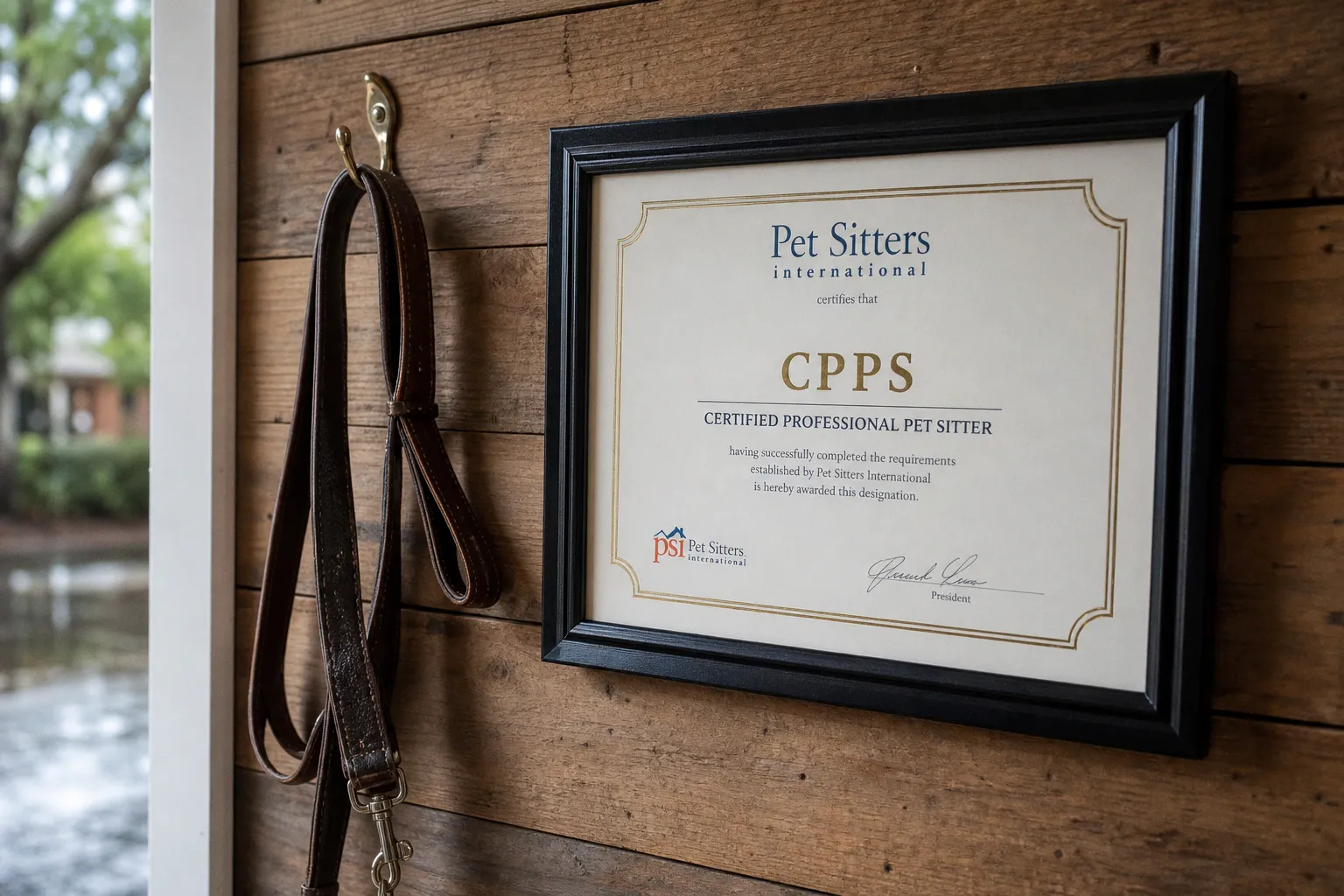
Pet Sitters International (PSI), founded in 1994, administers the Certified Professional Pet Sitter (CPPS) designation. It's a knowledge-assessed exam with no mandatory coursework, so candidates can sit for it once they feel ready. The application fee runs $275, and you'll need to score 80% or higher to pass.
The National Association of Professional Pet Sitters (NAPPS), founded in 1989, takes a more structured approach. Their certification is a course covering pet care, health, nutrition, behavior, and business management — material you must complete within six months of enrollment. The course costs $245 for NAPPS members and $395 for non-members, with a passing score of 75% or higher.
The Professional Animal Care Certification Council (PACCC), which opened its exam window in 2016, treats certification as an advanced step rather than an entry point. To sit for the Certified Professional Animal Care Provider (CPACP) exam, you'll need a minimum of 90 days or 500 hours of hands-on experience, plus two recommendation letters. The exam itself costs $385.
| Credential | Best for | Cost | Experience prerequisite | Format |
|---|---|---|---|---|
| CPPS (PSI) | New sitters who want a quick, knowledge-based credential | $275 | None | Exam only, 80% to pass |
| NAPPS Certification | Sitters who want a guided course across care and business | $245 member / $395 non-member | None | 6-month course, 75% to pass |
| CPACP (PACCC) | Experienced sitters ready for an industry-recognized advanced credential | $385 | 500 hours or 90 days + 2 references | Exam only |
The differences aren't cosmetic. CPPS rewards independent study and is the fastest path to having letters after your name. NAPPS functions as a mini-curriculum — useful if you'd rather be walked through the material than self-teach. PACCC is the credential that signals you've already paid your dues in real homes with real animals, and the experience prerequisite is part of what gives it weight with seasoned clients.
The Financial and Operational Edge of Being Certified
Beyond the marketing bump, there are concrete operational benefits that quietly add up over a calendar year. The most documented is an insurance discount: earning a CPPS or NAPPS certification qualifies you for a 15% reduction on liability insurance and bonding premiums through Business Insurers of the Carolinas. For a solo operator paying several hundred dollars a year in coverage, that's a meaningful recurring line item — and a useful piece of information to mention when a client asks why your rates sit where they do.
The other operational reality is maintenance. Both CPPS and NAPPS require 30 hours of continuing education units (CEUs) every three years to keep your active status. That's roughly ten hours a year — not nothing, but a manageable baseline for someone already doing the work. The CEU requirement is, in practice, a built-in refresher loop: it forces you to stay current on topics like vaccine schedules, feline environmental enrichment, separation anxiety protocols, and the business side of client communication, all of which drift in their own quiet ways over time.
What certification does not do is guarantee income or a flood of new bookings. That part still belongs to your reputation, your responsiveness, your referrals, and the way you handle the unusual cases. The credential opens a door; your portfolio and your people skills are what walk you through it.
The 15% insurance discount and the recurring CEU cycle aren't glamorous selling points, but they're exactly the kind of operational scaffolding that turns a side gig into a sustainable business over five years.
Why Hands-On Experience Remains the Gold Standard for Clients
Walk through any local pet sitting Facebook group and you'll see the same question posted over and over: "Would you hire a certified sitter with two years of experience or an uncertified sitter with seven years and glowing reviews?" The answer, almost universally, is the second one — and that tells you something important about how clients actually evaluate trust.
Practical experience, personal referrals, and accumulated reviews carry enormous weight in this industry, and for understandable reasons. A sitter who has managed a multi-pet household through a real medical emergency, who has navigated a client's last-minute travel change without drama, and who has earned the kind of repeat business that only comes from showing up consistently is signaling competence in a way no exam can replicate. That signal is exactly what an anxious pet owner is looking for.
That said, one specific credential does cut through the experience conversation: Red Cross Cat & Dog First Aid. It's not a pet-sitting certification per se, but it is widely recognized, frequently requested by clients, and covers the kind of acute scenarios — choking, heatstroke, toxin exposure, basic CPR — that pet owners desperately hope their sitter has rehearsed at least once. Many experienced sitters hold this certification alongside their years of work, and that's not a coincidence. It plugs a specific gap in the lived-experience story: clients want to know that if something goes medically sideways at 11 p.m. on a Sunday, you have a protocol beyond "call the owner."
The honest framing is this. Experience tells a client you can manage the predictable parts of the job — feeding schedules, litter box etiquette, walks, light medication, key handling, the texture of a calm household. Certifications, particularly in first aid and in the higher-tier programs like PACCC, tell a client you have rehearsed the unpredictable parts. The most trusted sitters in any market tend to carry both, and the familiarity anchors each one provides compounds over time.
Balancing Continuous Education with Real-World Pet Care
If you're standing at the decision point right now — certified and inexperienced, or experienced and uncertified — the cleanest sequencing is rarely either/or. It's a layered combination, and the layering matters.
For the new sitter, the logical transition phase looks like this: pursue a CPPS or NAPPS credential within your first year to anchor your professional identity, complete a Red Cross Cat & Dog First Aid course as a baseline safety measure, and stack your early bookings deliberately to build toward PACCC eligibility. Once you've cleared the 500-hour threshold, the CPACP exam becomes a natural next step that converts your logged experience into a credential clients can actually see.
For the established sitter who skipped certification early on, the same sequence applies in reverse. Your experience is already your primary asset — and a Red Cross First Aid card adds immediate, visible value to your existing reputation. From there, the CPPS exam is genuinely fast to prepare for if you already live this work, and it costs less than a single lost booking to recoup. NAPPS and PACCC remain available if you want a more formal external validation of what you already know.
Either path benefits from the same operating habit: treat the CEU requirement not as a checkbox but as a planning anchor. Thirty hours over three years is roughly one focused weekend of reading, a couple of webinars, and a conference day each year. Spread that across the calendar and your baseline comfort with current standards stays high without ever competing with your actual job.
Pet sitting will likely remain unregulated for the foreseeable future, which means the question of credentials versus experience will keep getting asked in forums and Facebook groups and kitchen-table conversations. The honest answer, drawn from years of watching this industry mature, is that neither one wins the argument on its own. Certifications build the floor. Experience fills the room. The sitters who combine both — and who treat both as ongoing practices rather than one-time achievements — are the ones whose client rosters grow quietly, year after year.