Ground transport safety for snub-nosed dogs
Most major airlines have quietly stopped accepting snub-nosed breeds in cargo. That's not cruelty toward your French Bulldog. It's a liability calculation built on a decade of necropsy reports.
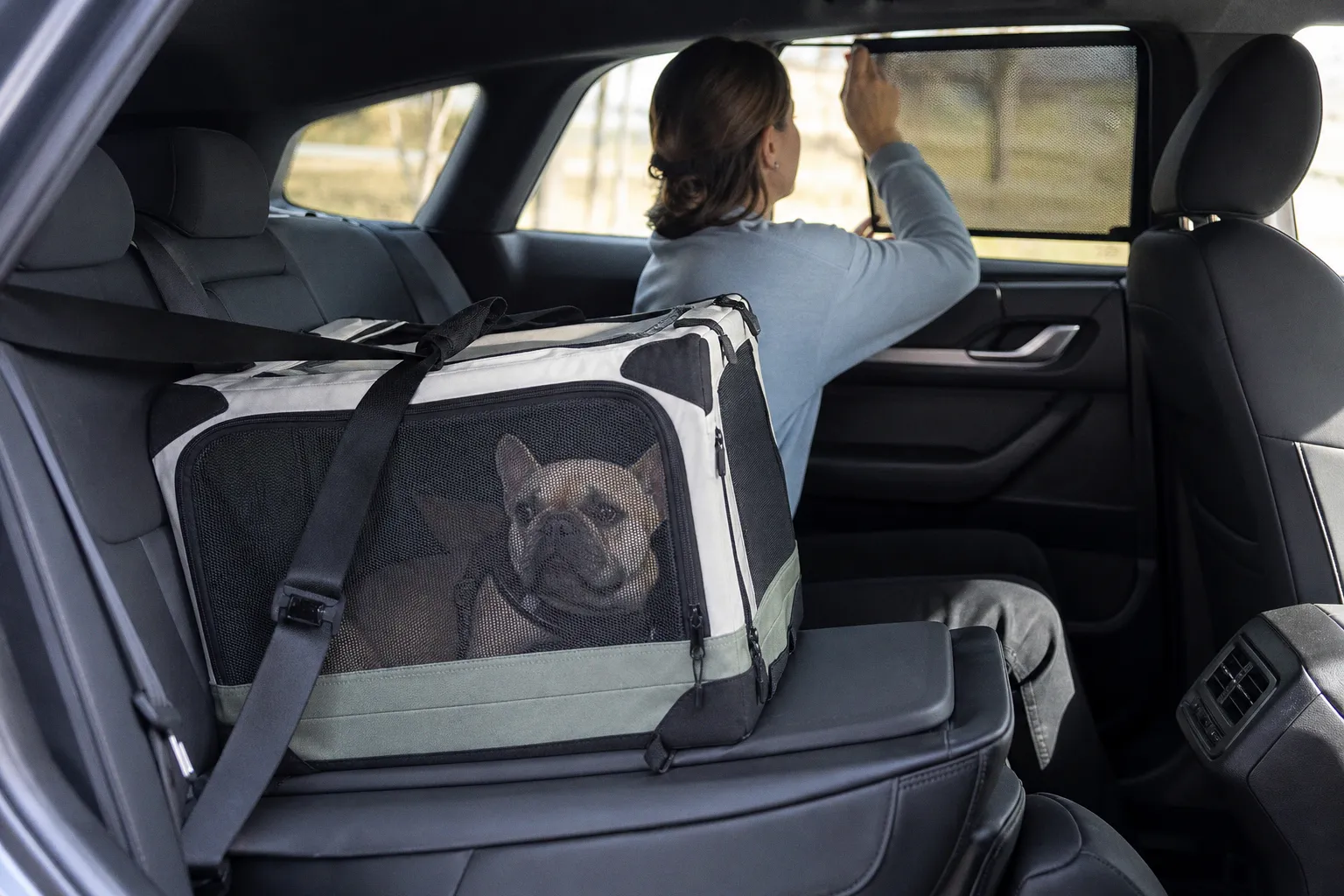
Delta, United, and American have all put permanent bans or strict seasonal restrictions on brachycephalic dogs in cargo holds — Boxers, Pugs, English Bulldogs, French Bulldogs, Boston Terriers, Mastiffs. Lufthansa pulled the same lever on January 1, 2020. The carriers weren't being dramatic. They were reading outcomes.
Airlines didn't ban snub-nosed breeds to be cruel. They banned them because the dogs kept dying. Ground transport is what you do when the airline won't take the bet.
Every summer the trade press runs the same story: a brachycephalic dog dies on a tarmac or in a cargo hold. The pattern is so consistent that British Airways tightened its heat embargo for these breeds to 75°F — ten degrees below the industry ceiling — before eventually closing the route entirely. Ground transport stepped into the gap. And so did the misinformation, because "ground transport" now covers everything from a USDA-registered Class T carrier with climate-controlled vans to a guy with a pickup truck and a Facebook ad. If your dog is short-snouted, the distance between those two operators is the distance between a controlled move and a respiratory emergency on the shoulder of I-95.
Why Air Cargo Closed the Door
The mechanism is straightforward. A brachycephalic dog's airway is already structurally compromised at sea level: shortened skull, elongated soft palate, pinched nares, narrow trachea. Drop cabin pressure, raise ambient heat in the cargo hold, add the stress of being crated in a vibrating metal tube, and you have the textbook trigger for a Brachycephalic Obstructive Airway Syndrome — BOAS — crisis. Estimates from the International Pet and Animal Transportation Association put severe BOAS prevalence around 5% of all brachycephalic dogs, but the milder cases — the ones that look "fine" at home and degrade fast under thermal and emotional stress — make up the bulk of in-transit mortalities.
That is why Delta, United, and American implemented permanent or seasonal restrictions, why Lufthansa barred the breeds outright, and why the in-cabin loophole most owners cling to is mostly closed. Most airlines cap in-cabin pets at a combined weight of 15–20 lbs, carrier included. A French Bulldog at 25–30 lbs in a structural crate does not fit under the seat in front of you. Boxers, Mastiffs, and larger English Bulldogs were never in-cabin candidates in the first place. The math settled this. The IPATA Fit-to-Fly assessment sheet exists to evaluate BOAS severity before any travel — it is the front end of the safety protocol, and a serious ground operator will ask for it.
| Travel Option for a Medium/Large Brachycephalic Dog | Viable? | Why |
|---|---|---|
| In-cabin commercial flight | Generally no | Combined weight cap of 15–20 lbs (carrier + dog) rules out medium and large brachy breeds |
| Cargo hold on major US/international airlines | No | Delta, United, American, and Lufthansa have all imposed permanent or seasonal bans on snub-nosed breeds |
| Hub-and-spoke ground (consolidated with other animals) | Sometimes | Cheaper, but every handoff and vehicle change is a new stress and thermal variable |
| Door-to-door USDA Class T ground transport | Yes — current gold standard | Single handler, climate-controlled vehicle, regulated under the Animal Welfare Act |
Ground Transport Is Not a Luxury Service — It Is a Federal Engineering Problem
In the United States, any commercial operator moving animals across state lines for payment is required to hold a USDA Class T registration under the Animal Welfare Act. Class T is not a vanity badge. It is a federal designation with enforceable standards for vehicle construction, temperature thresholds, ventilation, crate specifications, and recordkeeping.
The headline numbers are written for the worst case. Dogs in transit cannot be exposed to ambient temperatures above 85°F (29.5°C) or below 45°F (7.2°C) for more than four consecutive hours. Outside that window, the dog has to be in a climate-controlled environment. A Class T carrier is supposed to have climate-controlled cargo space, backup ventilation, a written SOP for thermal excursions, and a trip log that gets audited when something goes wrong.
Here is the part the glossy websites leave out: not every ground transporter is Class T registered. Local short-haul movers can legally operate under state kennel licenses that do not trigger USDA oversight. For a four-hour hop to a neighboring state, that may be fine. For a coast-to-coast relocation of a Bulldog, an unregistered operator means no federal accountability, no standardized thermal threshold, and no enforceable crate standard. You are trusting a stranger's van with a fragile airway.
The other axis is door-to-door versus hub-and-spoke. Door-to-door keeps the dog with one handler in one vehicle from pickup to delivery. The crate, the climate, and the handler's read on the dog's baseline all stay constant. Hub-and-spoke consolidates dogs into a larger vehicle, often with multiple handoffs and transfers. It is cheaper. For a brachycephalic dog, it is also worse: every handoff is a stress spike, every new vehicle is a new thermal environment, every new handler is a new variable. Consolidation is a logistics efficiency. It is also how transport-induced BOAS flare-ups start.
Temperature Is a Legal Ceiling, Not a Marketing Buzzword
The 85°F / 45°F / 4-hour USDA framework exists because dogs die when those numbers are crossed. For a brachycephalic dog, you should treat them as the upper bound, not the safe zone. A Frenchie that would be merely uncomfortable at 85°F is in distress at 80°F when humidity and stress stack on top of the heat. Some operators — and the airlines that used to take these breeds — apply a tighter internal threshold. British Airways used 75°F as the operational ceiling. The five degrees look small on a thermostat. For a Pug with a partially obstructed airway trying to pant-exchange heat, it is the difference between grumbling and gasping.
Four hours is the operational clock. A serious Class T carrier drives with a temperature log that gets checked at every fuel stop, plans routes around ambient heat, and runs overnight in summer. They do not load a Bulldog at noon in Phoenix in July and trust the AC, because AC fails. When it does, the protocol has to be pull over, vent, get the dog into a cooled rest stop, and document the excursion. Ask for the log. A blank spreadsheet is a red flag. A driver who can tell you what a "thermal excursion" is and what their response is has done this before.
Heat stress does not start when the dog enters the van. It starts when the dog walks across a hot parking lot into the building, or sits in a kennel that has not had the AC cycled since morning. Coordinate with both the origin and destination facilities. The AC has to be on, working, and verified below threshold before the dog enters the room. This is the kind of detail owners forget, and it is the kind of detail that is hard to recover from.
The Crate Is Doing Half the Job — Make Sure It Is the Right One
Move a brachycephalic dog in a standard-sized crate and you have built a heat trap with reduced ventilation. The International Air Transport Association recommends that travel crates for snub-nosed breeds be at least 10% larger than the standard calculation. That is the floor, not the ceiling.
Standard crate sizing is built around the dog being able to stand, turn around, and lie down. For a dog whose breathing already demands more chest and headroom, that geometry is not enough. A 10% increase gives the dog the room to lower the head, extend the neck, and use the tongue as a heat sink — all crucial when ventilation is poor and the dog is panting to thermoregulate.
The crate is doing half the work of keeping the dog alive. If it isn't the right crate, your transporter's climate control doesn't matter.
Ventilation placement matters as much as the 10%. Every compliant crate has openings, but on a snub-nosed dog you want openings on all four sides and the top, not the standard three. The crate should be loaded with the door facing outward so the dog can be checked without opening the kennel. It should be secured against sliding, padded on the floor, and acclimated to at home for at least two weeks before the move. A crated panic attack in transit is exactly what your dog cannot afford. Behavioral fallout from one bad crate experience also puts a dent in the next crate session, so the cost of getting it wrong compounds.
Buy the crate before you book the transport. Measure the dog, add the 10%, and buy from a manufacturer that documents ventilation specs. Then have the dog sleep in it, eat in it, and decompress in it for a fortnight. If the crate is brand-new on travel day, expect a stressed dog, an elevated respiratory rate, and a much harder trip.
Sedation Is Not a Comfort — It Is a Hazard
This is the topic where the friendly advice online is genuinely dangerous.
Sedation relaxes smooth muscle, including the muscles that keep the airway open in a brachycephalic dog. A sedated Pug or Bulldog does not sleep peacefully through the trip. The dog sleeps, loses pharyngeal tone, obstructs, and then the trip stops in the worst way. Most reputable ground transporters prohibit sedatives for these breeds outright. Some ban them for every animal in transit, period.
Owners reach for sedation because the dog is anxious. Crate anxiety is a real problem — elevated heart rate, open-mouth panting, body-heat generation — but sedation does not fix it. Sedation papers over it with a worse failure mode. The right fix is desensitization: pre-travel crate training, a worn shirt with the owner's scent, a high-value long-lasting chew, and in some cases a respiratory-safe mild anxiolytic prescribed by a vet who has actually weighed the airway risk. Not acepromazine. Not unsupervised trazodone. If your vet has not asked about soft-palate grade and nares patency before writing a sedative script, the vet has skipped a step.
Stress management during transit is its own protocol. Door-to-door with a single handler dramatically lowers cumulative stress compared to consolidation. Short legs of driving are broken up by scheduled stops. Water is offered at every stop. The dog is walked briefly on a harness — never a neck collar, because a neck collar restricts the already-compromised airway. The crate is positioned in the vehicle for airflow. Someone is in the back of the van watching the dog, not texting. None of this is exotic. All of it is the difference between a flat-line event and a clean handover.
The Hard Truth and Your Homework
Ground transport is the safest available option for a brachycephalic dog who needs to relocate. It is not risk-free — stress and ambient temperature still trigger respiratory events, and the protocol only works when the operator actually follows it. The carrier matters. The handler matters. The crate matters. The owner who has done the prep matters most.
The homework:
- Get the IPATA Fit-to-Fly assessment done by a vet who has read the sheet and can grade your dog's BOAS severity honestly.
- Buy the crate to IATA's 10%-larger spec with full four-side ventilation. Acclimate the dog to it for at least two weeks.
- Verify the USDA Class T registration through APHIS, and confirm whether the company holds the registration directly or is operating under a broker.
- Ask for the climate log template and the operator's documented thermal-excursion protocol.
- Do not sedate. Do not consolidate. Do not pick the cheapest quote without checking what it excludes.
- Walk the dog on a harness, not a collar, at every stop.
The airlines bailed on these breeds because the dogs were dying. Ground transport became the answer only when it was done with the same seriousness the airlines finally decided mattered. The protocol exists. It is not hard to follow. It is hard to follow when nobody on the booking call mentions it. Your job is to make them mention it.