Dog boarding facility types: which setup suits your pet?
Choosing among overnight dog boarding facility types becomes difficult the moment the labels start doing too much work.
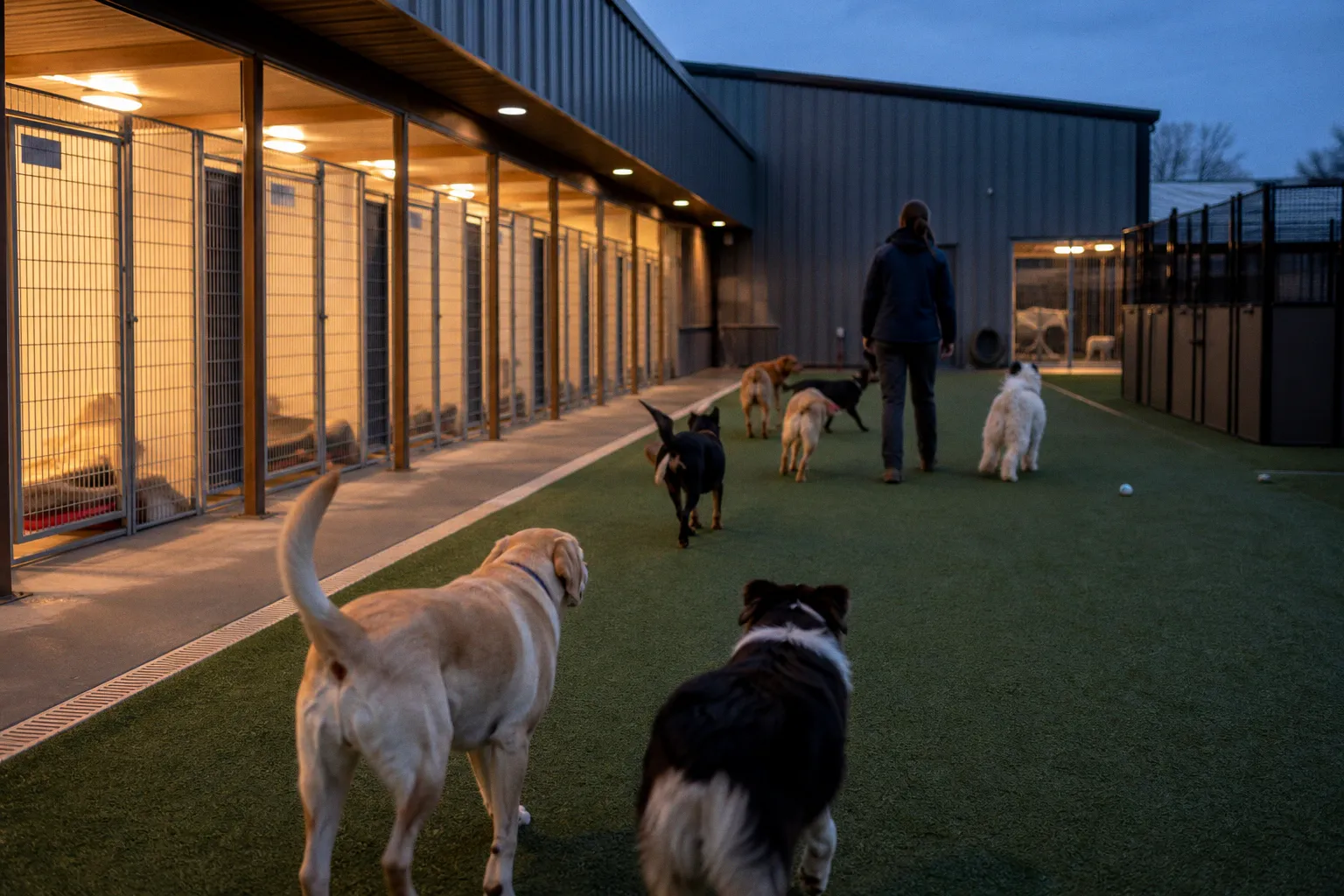
“Luxury,” “cage-free,” “home-style,” “medical,” and “camp” may describe a real feature of care—or they may simply describe a room upgrade, a polished lobby, or a marketing preference.
Compare car rental deals in United Kingdom
See available offersPartner link — DiscoverCars comparisonThe useful question is more grounded: where will your dog have the best baseline comfort while you are away? That answer depends on how they rest, eat, respond to unfamiliar people and dogs, manage separation, and whether their health routine needs clinical oversight. A sociable young retriever and a senior terrier who sleeps best behind a closed door do not need the same boarding environment, even if both are perfectly loved and well trained.
Traditional commercial kennels: individual space without social pressure
Commercial dog kennels are often treated as the old-fashioned option, but their central feature—individual housing—can be exactly what some dogs need. A dog has a dedicated run, kennel, or private enclosure for rest and meals; walks, outdoor time, staff interaction, and optional play may happen separately.
For a dog who becomes overstimulated by other dogs, guards food, rests lightly in busy environments, or simply prefers people to canine company, this arrangement can be more considerate than a communal setup. Individual housing is not automatically isolating if the facility has a predictable care rhythm: regular exercise, calm staff contact, clean resting areas, and an appropriate plan for the dog between activities.
The concern is not the word “kennel.” The concern is whether the facility treats the kennel as a sleeping base or as the dog’s entire world for the duration of the stay.
During a tour, look beyond the front desk and ask to see the actual housing areas, food-preparation space, outdoor runs, and play yards. A well-run facility should be comfortable showing you how dogs are housed, where waste is removed, how bedding is handled, and what happens when a dog needs quiet time away from the activity.
A private run can work particularly well for dogs who:
- need meals, medication, or supplements administered precisely;
- have a history of becoming tense in group settings;
- are older, recovering from an injury, or easily fatigued;
- settle better with a consistent rest space;
- enjoy walks and one-to-one attention but do not need dog-to-dog play;
- are traveling from a multi-pet household and need their own decompression zone.
AVMA companion-animal guidance is useful here because it focuses on welfare rather than décor: adequate space and population density, room for normal posture and movement, a suitable resting place, timely waste removal, and isolation or quarantine capacity when needed. Those are not luxury extras. They are the operational foundation of boarding.
A private sleeping space is not a lesser experience when it gives a dog the quiet, predictability, and recovery time they actually need.
Group-play boarding: compatibility matters more than enthusiasm
Group-play facilities often appeal to owners because the dogs appear active, social, and entertained. For the right dog, supervised social sessions can indeed be a very positive part of a boarding stay. But group play is not a universal welfare upgrade, and a facility should never treat every friendly-looking dog as a candidate for every playgroup.
A responsible program sorts dogs by more than size. Age, play style, energy level, arousal threshold, social history, and ability to disengage all matter. A young, bouncy dog who loves chase games may be a poor match for an adult dog who enjoys brief greeting rituals and then prefers to lie down nearby. Two dogs can both be “dog-friendly” and still be incompatible boarding companions.
This is where the intake process tells you a great deal. Good facilities ask detailed questions about your dog’s routines and behavior, then conduct some form of temperament assessment before placing them in a group. The assessment is not a promise that every future interaction will be effortless. It is a practical screening tool that helps staff decide whether group play, paired activity, solo enrichment, or a mixed plan is the safest fit.
Do not be reassured by blanket statements such as “all dogs play together all day.” Continuous group activity can be tiring even for social dogs, and it gives staff fewer opportunities to notice subtle stress signals before they become bigger problems. Dogs need breaks, water, rest, toilet opportunities, and an off-switch.
There is no universal industry-wide staff-to-dog ratio that proves a facility is safe. A number printed on a brochure cannot tell you whether staff members are trained to read body language, interrupt escalating play, separate dogs smoothly, and supervise the quiet dog at the edge of the room as closely as the obvious extrovert in the middle. If possible, observe a group in session. Notice whether staff are engaged with the room, whether dogs have space to move away, and whether the overall energy feels managed rather than merely busy.
The right question is not “Does my dog love other dogs?”
A more useful sequence is:
1. How does my dog respond after 20 or 30 minutes of interaction? Some dogs begin eagerly and then become tired, clingy, avoidant, or overexcited.
2. Can my dog take a break without distress? A dog who cannot settle outside the group may need a different care structure.
3. Does my dog have a known play style? Wrestling, chase, vocal play, body slams, and quiet parallel sniffing are all different social languages.
4. Will staff adapt the plan when the answer changes? A boarding plan should be responsive, not a contract forcing the dog to remain in a format that is not working.
A strong group-play facility will be comfortable saying that a dog is better suited to individual walks, quiet enrichment, or limited social sessions. That is a sign of professional judgment, not a rejection.
Luxury pet hotels: amenities are not the care plan
Luxury pet hotels may offer larger suites, webcam access, themed rooms, bedtime treats, private outdoor patios, grooming, concierge-style updates, or extra one-to-one sessions. Those additions can make an owner’s absence feel less stark, and some dogs genuinely benefit from more room, familiar bedding, or extra human contact.
But the word “luxury” does not identify an overnight care model on its own. One luxury pet hotel may operate very much like a traditional kennel with upgraded accommodation. Another may use rotating group play. A third may offer private suites with individual enrichment. The only meaningful comparison is the daily routine behind the room category.
Ask what is included in the base stay and what is optional. A premium suite is less relevant than the answers to these questions:
| Care question | What a clear answer should explain |
|---|---|
| Sleeping arrangement | Whether dogs sleep alone, near other dogs, with visual barriers, or in a more open setting |
| Exercise and toileting | How often it occurs, whether it is individual or group-based, and how the schedule changes for seniors or shy dogs |
| Meal handling | Where food is prepared, how special diets are labeled, and how staff prevent missed or incorrect meals |
| Overnight coverage | Who is responsible after regular hours and what the escalation process looks like if a dog becomes unwell or distressed |
| Enrichment | Whether it is tailored to the dog rather than offered as a generic add-on |
| Owner communication | How staff report appetite, elimination, behavior, medications, and meaningful changes—not just send cheerful photos |
The visual standard of a facility can be useful. Clean floors, fresh water, well-maintained gates, and organized supplies suggest disciplined operations. Yet a beautiful suite cannot compensate for weak health screening, poor sanitation, overcrowding, or staff who cannot explain how they respond to stress.
“Cage-free” deserves the same practical reading. It may mean dogs are not kept in wire crates. It does not tell you whether they can rest undisturbed, whether incompatible dogs are separated, whether meals are protected, or whether a nervous dog has access to a quiet familiarity anchor. For many dogs, an enclosed resting space is comforting precisely because it is theirs.
Medical pet boarding: valuable when clinical continuity is the priority
Medical pet boarding, sometimes offered through a veterinary hospital or in close coordination with one, is a different category of service. Its strength is not that it is inherently more comfortable for every dog. Its value is the capacity to support dogs whose medication schedules, mobility limitations, monitoring needs, or recent medical history require more than a standard boarding routine can reasonably provide.
This may include dogs recovering from surgery, dogs with conditions that require regular observation, dogs who need multiple medications administered on schedule, or dogs whose appetite and elimination patterns need closer tracking. The facility should explain exactly what medical support is available rather than using the word “medical” as a broad reassurance.
For example, establish:
- whether a veterinarian is physically on site, on call, or available only during specific hours;
- who administers medication and how doses are documented;
- what clinical signs prompt an owner call or veterinary examination;
- whether the dog can be separated from general boarding traffic when needed;
- how emergency transfer works if the boarding location and veterinary clinic are not the same;
- whether the environment can accommodate mobility support, therapeutic diets, or recovery restrictions.
A veterinary setting may not be the best default for a healthy dog who is easily unsettled by clinical smells, frequent handling, or the sound of other animals receiving care. On the other hand, for a dog with a complex health plan, the convenience of a boutique hotel can quickly become less important than regulatory compliance, medication records, and a clear emergency chain.
The right choice is often less dramatic than owners expect: a stable dog with routine oral medication may do well at a standard professional facility with excellent written protocols, while a dog with unpredictable symptoms may need the closer continuity offered by medical boarding.
Home-based dog boarding and in-home sitting: familiar surroundings have limits too
Home based dog boarding and in-home pet sitting are often grouped together, but they solve different logistical problems.
In home-based boarding, your dog stays in the sitter’s home, usually alongside the sitter’s own pets or other guest dogs. The setting may feel quieter and more domestic than a large facility. This can suit dogs who are comfortable joining another household, cope well with new people, and benefit from lower-volume activity.
In-home sitting means the sitter comes to your home, either for visits or overnight care. For multi-pet households, cats, dogs with tightly established routines, and pets with special needs, remaining at home can preserve crucial familiarity anchors: the usual feeding station, neighborhood smells, resting places, and household rhythm. It also avoids transporting several animals to a new place.
Yet home-based care is not automatically simpler. You still need to understand separation practices, household access, fencing, resident animals, supervision, transport procedures, and backup coverage if the sitter becomes ill or has an emergency. A sitter caring for several visiting dogs in a home is still managing a boarding environment, even if it does not look like one.
For overnight in-home care, make the plan specific. Confirm arrival and departure windows, the number of overnight hours, walk schedules, medication documentation, how updates will be delivered, and who has authority to seek veterinary care if you are unreachable. Ambiguity is stressful during the transition phase because both sitter and owner may assume the other has made a decision.
The most familiar setting is only reassuring when the person responsible for it has a clear, reliable care protocol.
Separation distress changes the selection process
A dog who barks briefly at departure is not necessarily experiencing separation anxiety. But persistent barking, howling, whining, destructive behavior, elimination changes, escape attempts, or intense distress specifically linked to being separated from an owner deserve careful attention. Boarding should not be presented as a guaranteed solution for these behaviors, and it should not be assumed to cause them either.
A new boarding environment adds several changes at once: transport, unfamiliar sounds, altered sleep patterns, different feeding routines, new handlers, and the owner’s absence. Research comparing measurements from dogs at home and in a boarding-kennel environment supports the sensible conclusion that individual dogs can respond differently to kennel stays. It does not prove that every kennel is harmful, nor does it establish one best format for all dogs.
If your dog has known separation-related distress, start the conversation with your veterinarian and the prospective provider well before travel dates. Share behavior history plainly. A professional facility may recommend a trial stay, a quieter accommodation plan, individual handling, a shorter care period, or an alternative such as in-home sitting. Their willingness to shape a realistic plan is far more useful than a promise that the dog will “settle in.”
Bring familiar items only when the facility permits them and can manage them safely. A blanket with home scent, the dog’s usual food, clearly labeled medication, and a written routine can support baseline comfort. Do not send irreplaceable objects or assume every facility can accommodate loose bedding, personal toys, or special feeding equipment.
The facility tour is an operations audit, not a sales visit
The practical quality of overnight dog boarding is visible in the questions a facility asks you and the questions it can answer without hesitation.
A reliable provider will want current immunization information and a full picture of your dog’s temperament, feeding, medications, emergency contacts, veterinary details, and behavioral triggers. Requirements vary by location, veterinary guidance, disease risk, and facility policy, so there is no single nationwide vaccine checklist that applies to every boarding setting. What matters is that the policy is defined, current, and consistently administered.
Be cautious if a business refuses to show core areas of the facility, seems overbooked, does not request health records, or displays little interest in your dog as an individual. Also be wary of vague assurances about overnight care. “Someone is always around” may mean very different things in different operations. Ask who is present, how frequently dogs are checked, and how a medical or behavioral concern is escalated.
Federal USDA licensing is also not a shortcut for evaluating ordinary boarding kennels. Many businesses housing animals for others are generally exempt from Animal Welfare Act licensing unless they operate in certain transportation-related roles. Local rules, business licensing, insurance, veterinary relationships, and facility practices are more relevant areas to clarify directly.
Use a trial stay to test the fit, not to force a result
A pre-boarding trial stay is one of the most practical tools available to owners, particularly when planning a longer trip. It may be a short daytime visit, an evening stay, or a single overnight, depending on the provider and the dog’s needs.
The purpose is not to “prove” that your dog will never struggle. A short stay cannot diagnose separation anxiety, predict every future response, or guarantee that a two-week booking will be seamless. What it can do is give staff and owner meaningful information: whether the dog eats, settles, accepts handling, rests, engages appropriately, and shows signs that the environment needs adjustment.
After the trial, ask for specifics rather than a general “they did great.”
- Did your dog eat normally, partially, or not at all?
- How long did it take them to settle after arrival?
- Did they sleep, pace, vocalize, or seek isolation?
- Were they comfortable with staff handling?
- If group play was offered, how did they enter, exit, and recover from it?
- Did staff alter the initial plan, and why?
- Would they recommend the same accommodation and schedule for a longer stay?
This debrief is especially valuable because it establishes communication expectations before the stakes are higher. A thoughtful provider will describe both strengths and concerns in measured terms. You are looking for accurate observation, not a performance review designed to make you feel better.
The best setup is the one your dog can understand
Comparing overnight dog boarding facility types is ultimately an exercise in matching needs to systems. Traditional commercial dog kennels can offer valuable privacy and routine. Group-play boarding can be excellent when compatibility screening and active supervision are real, not promotional. Luxury pet hotels can provide comfort and added services, provided the operational standards beneath the amenities are sound. Medical pet boarding has a distinct role when clinical oversight and medication continuity take priority. Home-based boarding and in-home sitting can preserve a more domestic rhythm, but they still require professional boundaries and detailed planning.
Start early enough to tour, ask questions, complete a trial stay, and revise the plan if your dog’s response suggests a different fit. Once you replace labels with observable care practices, the decision becomes much less overwhelming: you are not searching for the most impressive facility. You are arranging a stable, well-managed temporary routine your dog can safely settle into.