Reactive Dog Pack Walk Milestones from Solo to Group
A reactive dog does not become ready for a pack walk because it has “met other dogs.” Readiness is a handling problem with measurable outputs: distance tolerance, recovery speed, leash mechanics…
A reactive dog does not become ready for a pack walk because it has “met other dogs.” Readiness is a handling problem with measurable outputs: distance tolerance, recovery speed, leash mechanics, food intake under stimulus, and the ability to move through a shared environment without loading the kinetic chain into a lunge.
The reactive dog pack walk transition steps below use a 30-day progression. The schedule is not a guarantee. Some dogs remain safer on solo walks indefinitely. That is not failure. A controlled solo walk is preferable to a group format that repeatedly pushes the dog over threshold.
The 30-Day Calm Walk Foundation: Build Movement Before Social Exposure
The first operational error is using other dogs as the training environment before the dog has usable walking mechanics. A dog that cannot maintain a loose lead, disengage from visual input, or settle after mild arousal has no business entering a group.
For days 1–7, remove trigger-heavy routes where possible. This is not avoidance as a permanent lifestyle. It is pressure management. Every uncontrolled reaction rehearses the same motor sequence: orient, stiffen, accelerate, hit leash pressure, vocalize or lunge. Repetition makes that sequence efficient.
Use low-stimulus routes, quiet parking areas, wide paths, or off-peak residential blocks. The objective is not mileage. It is clean repetitions.
The equipment standard is simple:
- A body harness that distributes force over the torso rather than concentrating it at the neck.
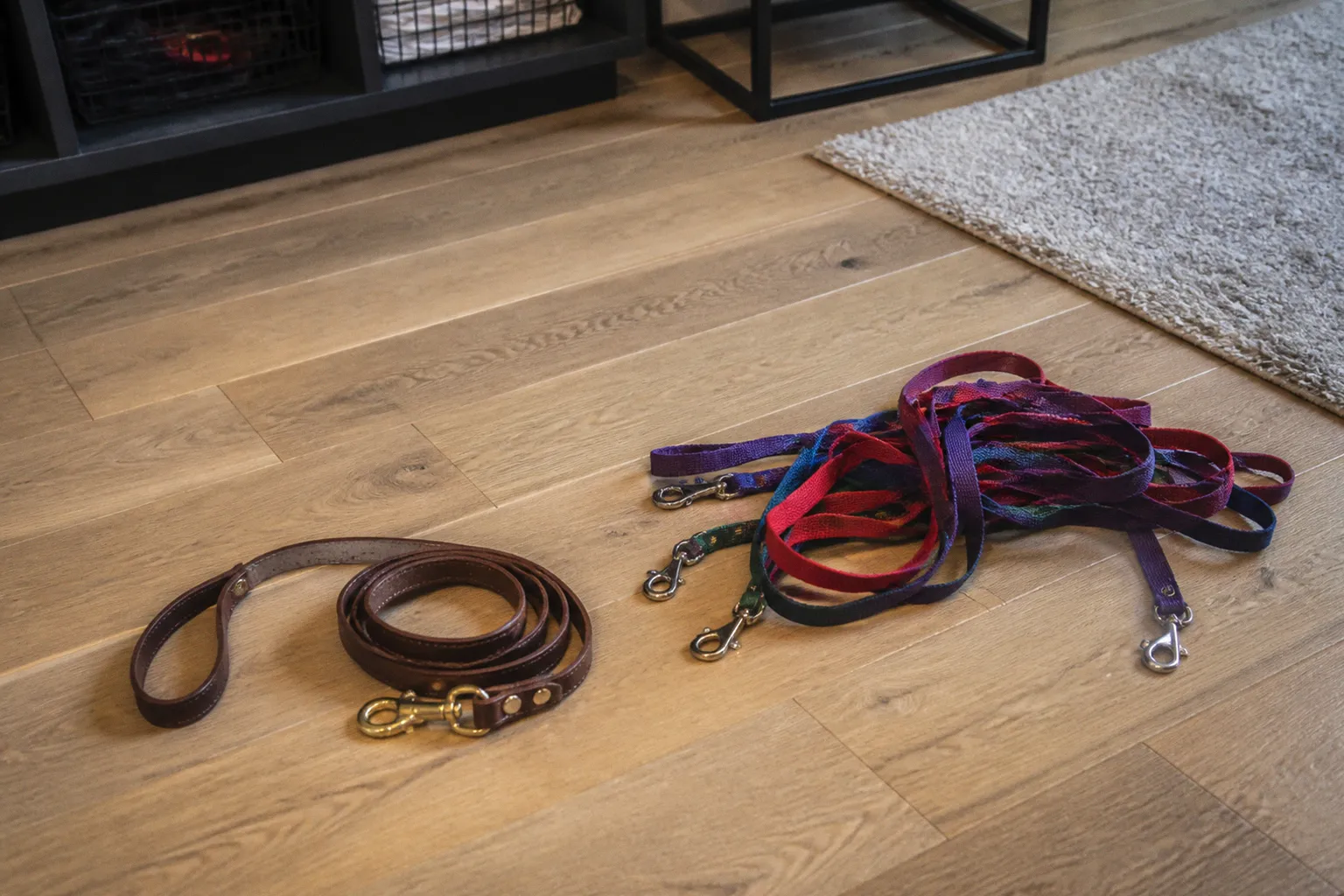
- A flat leash, 4 to 6 feet long. This provides enough range for normal gait without creating an unmanageable distance between handler and dog.
- High-value food that the dog can consume quickly. If the dog cannot eat it outdoors, the environment is already too difficult.
- No retractable leash. Constant low-level line tension alters handling feedback, reduces directional control, and permits the dog to reach speed before the handler can intervene.
During this first week, work three foundation tasks.
1. Engage cue: 50 repetitions per day. Say the cue once. Mark eye contact or head orientation toward the handler. Deliver food. The cue must become a low-friction way to interrupt fixation before it develops into a reaction.
2. Loose-leash walking: 20 or more consecutive steps. The leash is not a steering bar. Its baseline state should be slack. If the dog forges, stop or change direction without adding leash pressure. Reinforce the return to position.
3. Place or settle: 10 or more minutes. Use a mat, platform, or consistent resting location. The point is not rigid stillness. The point is a lower arousal state with normal respiration, reduced scanning, and voluntary disengagement from the environment.
A professional walker should document the session rather than rely on memory. Record the route, trigger type, first-alert distance, recovery time, and whether the dog took food. These data points expose patterns that vague labels such as “better today” do not.
A pack walk does not correct reactivity. It reveals whether the dog’s current handling system can function under moving social pressure.
Mastering Thresholds: Distance Is the Primary Control
Threshold is the point at which the dog can detect a trigger but still process the handler’s information. It is not a fixed number of yards. Wind, path width, visual barriers, accumulated stress, time of day, and the movement style of the other dog all change it.
A dog may remain composed at 30 yards from a slow, neutral adult dog and react at 100 yards to a rapidly moving adolescent dog. Treat distance as a variable, not a label.
Days 8–14 focus on attention conditioning at threshold. The target behavior is not forced eye contact. It is a sequence: dog notices a trigger, remains under control, turns back toward the handler, and receives reinforcement.
The Look at That, or LAT, pattern is useful here. Let the dog look at the distant trigger. Mark the calm observation before tension enters the body. Then feed as the dog returns attention to the handler or shifts its gaze away. A typical 15–20 minute session may include 10–15 successful repetitions. End before the dog becomes fatigued or starts scanning compulsively.
Do not wait for a hard stare. A hard stare is already information. Watch the earlier indicators:
- Mouth closes after relaxed panting.
- Head rises and stops moving naturally with the gait.
- Weight shifts forward over the forelimbs.
- Tail carriage changes or becomes still.
- Stride shortens.
- Ears lock toward the target.
- The dog stops accepting food it normally values.
When these appear, increase distance immediately. Do not negotiate at the edge of failure. The dog is not refusing a command; its arousal level has exceeded the available processing capacity.
A usable threshold range
The following distances are not universal prescriptions. They are a practical way to classify the dog’s current operating zone during professional dog walking socialization steps.
| Distance from trigger | Likely training use | Handler response |
|---|---|---|
| 100+ yards | Initial assessment for highly reactive dogs | Observe gait, food response, and orienting behavior. Do not close distance automatically. |
| About 60 yards | Low-pressure visual exposure | Run engage-cue and LAT repetitions if the dog remains loose. |
| About 30 yards | Moderate exposure for many dogs | Work only if the dog can eat, respond, and recover without leash loading. |
| 10–15 yards | Advanced proximity | Use only after repeated success at larger distances and with a known neutral dog. |
| Below the dog’s threshold | Training is no longer productive | Create distance, use a visual barrier, or leave the area. |
Days 15–30 are threshold-proofing days. The dog should work in more than one location, with more than one type of dog at a controlled distance. Do not progress merely because the dog completed a few quiet sessions at the same park corner. Context specificity is real. A dog that is stable near one familiar fence line may struggle on a narrow sidewalk, near a building entrance, or when another dog appears from behind a vehicle.
The minimum criterion is functional recovery. After noticing another dog, the reactive dog should return to normal walking within a short, observable period. It should not remain tense for the next block, drag the handler toward the trigger’s exit route, or keep checking behind itself.
Parallel Walking: The Buffer Strategy for Neutrality
Parallel walking is the bridge between solo training and a reactive dog pack walk. It is not a dog introduction in the conventional sense. The dogs do not need to greet. They need to share motion and space without treating each other as a problem.
Start with one neutral, socially competent dog. Avoid using an excitable greeter, a dog that pulls toward every animal, or a dog whose handler cannot maintain leash discipline. The neutral dog is part of the training setup. Its behavior determines the load placed on the reactive dog.
Begin in a neutral location. Each dog has a separate handler. Walk in the same direction, with the handlers positioned between the dogs. Start approximately 30–40 feet apart if that distance keeps both dogs under threshold.
This configuration matters. Forward movement reduces the social pressure created by direct approach. Handlers in the middle provide a physical and visual buffer. The dogs can collect information through peripheral vision, scent carried on the air, and normal environmental investigation without being forced into face-to-face contact.
The first parallel session has one purpose: establish that the other dog can exist in the same moving environment.
Use this sequence:
1. Set the initial distance. Begin farther apart than you think necessary. A calm first five minutes is more useful than an ambitious first thirty seconds.
2. Walk in the same direction. No converging path. No standing in place while the dogs stare. Movement supports gait continuity and reduces social compression.
3. Mark calm noticing. Each time the reactive dog sees the other dog without tightening, freezing, or accelerating, mark and feed.
4. Maintain independent leash lines. Leashes should not cross. Neither handler should pull a dog toward the other. Tension transmitted through the leash can alter posture and create conflict.
5. Assess recovery after each exposure. The dog should resume sniffing, take food, move with a normal stride, and respond to the handler. If not, distance was too small or the session ran too long.
6. Finish while the dog is still functional. Do not extend the walk to test endurance. Short, clean exposures create better data and less cumulative stress.
Retractable leashes are especially poor tools at this stage. They allow variable distance, delayed brake response, and a long acceleration path before the line goes tight. In a parallel walk, predictable line length is a safety feature.
Neutrality is the milestone. Play, greeting, and close contact are optional outcomes, not the job.
Progressing to Group Dynamics Without Compressing Space
Once the dog can parallel walk with one neutral dog, the next step is not immediate insertion into a dense group. The dog must first tolerate changing geometry.
Handlers can stagger positions so that the order becomes dog–person–dog–person rather than two dogs directly abreast. This allows both animals to investigate scent on the ground and gather social information without being forced into visual confrontation. Ground scent, including urine marks, can provide information at far lower pressure than a face-to-face greeting.
Brief rear-end sniffing may be appropriate only when both dogs show loose bodies, curved approaches, responsive handlers, and no persistent fixation. It is not required. Direct face-to-face greeting remains a poor early-stage choice because it concentrates social pressure and limits escape routes.
Before introducing a third dog, verify that the reactive dog can do all of the following with one partner:
- Pass the neutral dog at a managed distance without lunging.
- Take food after noticing the dog.
- Recover from a momentary increase in proximity without prolonged scanning.
- Respond to an engage cue while moving.
- Maintain loose-leash walking for a meaningful portion of the route.
- Show normal gait rather than shortened steps, forward weight shift, or repeated bracing against the harness.
A group should expand only one variable at a time. Add a dog, not a new route and a closer distance on the same day. Change the route, not the dog count and duration simultaneously. This is basic load distribution. If multiple stressors are added together, the handler cannot identify which one exceeded the dog’s threshold.
The first structured pack walk
The first pack walk should look less social than many owners expect. That is correct.
Place the reactive dog at the outside edge of the formation, not in the center. The center position exposes the dog to pressure from both sides and reduces available lateral space. Maintain spacing based on the dog’s demonstrated threshold, not on the group’s preferred walking formation.
For the first sessions:
- Use a small group of known dogs with stable leash behavior.
- Keep the route wide enough for spacing adjustments.
- Avoid narrow trails, crowded entrances, dog park perimeters, and locations where off-leash dogs commonly appear.
- Keep the pace consistent. Sudden stops, bunching, and repeated greetings create arousal spikes.
- Assign one handler primary responsibility for the reactive dog. Do not divide leash handling, feeding, and route decisions among multiple people.
- Exit early if the dog begins stacking stress signals. A clean early departure is better than a reactive final ten minutes.
The group does not have to walk as a tight pack to be successful. In fact, proximity is often the wrong measurement. The relevant canine pack walk safety milestones are stable movement, workable distance, predictable handling, and recovery after stimulation.
Post-Walk Decompression Is Part of the Protocol
A reactive dog can complete a controlled group walk and still be physiologically loaded afterward. The absence of an incident does not mean the nervous system has returned to baseline.
Do not follow the walk with another busy outing, a training class, visitors, rough play, or a second social exposure. Stack enough manageable events together and they become unmanageable.
Use one decompression option after the walk:
- A quiet solo sniff walk in a low-traffic area.
- A long-lasting chew in a calm room.
- Access to water and a low-stimulation resting area.
- Quiet rest with reduced visual access to windows, hallways, or other triggers.
Monitor recovery through behavior, not only silence. The dog should be able to rest, eat normally, and stop scanning. Persistent pacing, repeated alerting, frantic drinking, redirected behavior, or inability to settle indicates that the total load was too high.
This is also where thermal regulation matters. Reactive dogs often generate excess heat through sustained muscle tension, pulling, vocalization, and elevated respiratory effort. In warm conditions, shorten the route, provide water, avoid heat-retaining pavement, and do not mistake heat stress for behavioral noncompliance. A dog with compromised thermal regulation has a lower behavioral threshold.
The Decision Standard for Group Access
The purpose of this protocol is not to make every dog comfortable in every group. It is to establish a defensible decision process.
A dog is ready to trial a structured group walk when it can:
- Walk past other dogs at a managed distance without lunging.
- Recover promptly after visual exposure.
- Take food and respond to handler cues around triggers.
- Maintain a workable loose leash and normal gait.
- Parallel walk with a neutral dog without escalating across multiple sessions.
- Tolerate changes in walking position and group geometry.
- Decompress after exposure without prolonged stress behavior.
If one of these parameters fails, return to the previous stage. Increase distance. Reduce session length. Use fewer dogs. Improve route selection. The response is not to apply more pressure or force a greeting.
A group walk is a moving social environment with competing scent, sound, motion, and leash inputs. For a reactive dog, safe participation depends on controlled load distribution across the entire system: dog, handler, equipment, route, distance, and time.
The final standard is strict. The dog should be capable of moving near other dogs without losing mechanical control, behavioral recovery, or access to the handler. Until that standard is met, solo walking and parallel work are not lesser options. They are the correct protocol.