Airline pet travel: choosing between cabin and cargo transport
The airline will not negotiate with your dog. That is the first hard truth anyone flying with a pet has to swallow.
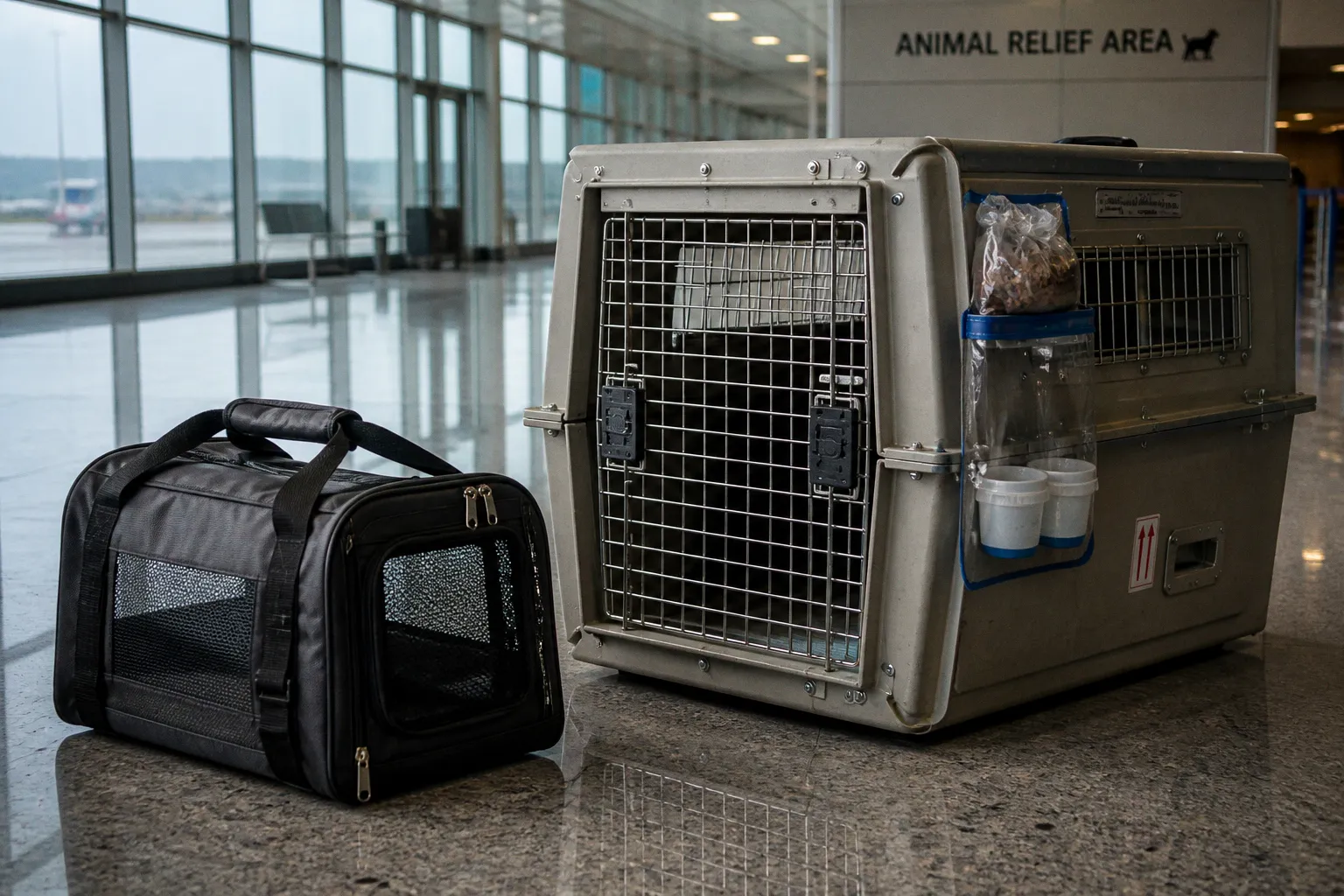
Whether your animal rides beside you at 30,000 feet or in the belly of the aircraft, the decision is made by a combination of weight, breed, crate dimensions, route, and the carrier's policy on the specific aircraft type assigned to your flight. Owners who imagine that paying a surcharge and purchasing a soft-sided carrier will guarantee a seat for a 40-pound retriever are in for a brutal reality check at the check-in counter. The romantic notion of "they let me hold him the whole flight" dies fast when the gate agent pulls out a scale.
Compare car rental deals in United Kingdom
See available offersPartner link — DiscoverCars comparisonThis is the comparison nobody in the pet travel industry wants to print clearly. Cabin and cargo are not interchangeable tiers of service you can upgrade between. They are two structurally different systems with non-negotiable entry requirements, and pretending otherwise leads to surrendered animals, last-minute ground transport scrambles, and dogs who land in a different emotional state than they took off in. Below is the working breakdown of how the choice actually gets made — not the marketing brochure version.
In-Cabin Travel: Weight Limits and Carrier Specifications
In-cabin travel is not a perk. It is a narrow corridor carved out for genuinely small animals, and most medium-to-large dogs will never qualify no matter how much you offer the airline. The combined weight of the pet and the carrier typically caps out around 8 kg, or roughly 17.6 lbs. That figure includes the bag itself, the dog, any bedding tucked inside, and the collar with tags. Cramming a chunky harness in to shave perceived weight does not work; gate staff weigh the whole package.
The carrier dimensions matter as much as the weight, and this is where owners get caught. A typical soft-sided in-cabin carrier measures around 18 x 11 x 11 inches (46 x 28 x 28 cm), though this is the airline average, not a universal guarantee. Every carrier publishes its own under-seat dimensions per aircraft, and a regional jet often has tighter constraints than a widebody on a transatlantic route. Before booking anything, you need to confirm the exact under-seat clearance for the specific flight, the specific aircraft, and the specific fare class. A bulkhead seat with no under-seat storage will physically not accommodate a carrier regardless of how polite you are to the gate agent.
A few operational realities to keep front of mind:
- The pet counts as your one permitted carry-on item. No laptop bag, no backpack, no second personal item. Travelers who try to sneak a rolling case past the gate lose it, and sometimes the booking.
- The animal must remain inside the carrier for the entire flight, including taxi, takeoff, and landing. Opening the bag to "comfort" a stressed dog is grounds for the animal being refused at the destination gate.
- Brachycephalic breeds — pugs, French bulldogs, Boston terriers, Persian cats — face heightened restrictions on many carriers because of airway collapse risk at altitude. Some airlines ban them outright from cargo; some ban them from cabin on hot routes. Check the breed-specific policy before you commit.
- In-cabin counts are limited per flight. Most carriers cap at four to six pets in cabin across the whole plane. Booking early is not optional; it is structural.
The decompression period after an in-cabin flight is shorter than after cargo, but it is not zero. A dog who spent four hours wedged in a carrier under a seat will still land slightly overstimulated, mildly dehydrated, and ready to either bolt or shut down. Plan for a quiet hour at the destination before any real activity.
Understanding Climate-Controlled Cargo and Manifest Shipping
Cargo is not the horror show that viral internet posts suggest. Commercial pet cargo holds on passenger aircraft are pressurized and temperature-controlled, designed specifically to carry live animals in addition to luggage. The misconception that your dog rides in an unheated metal tube next to suitcases is false, and repeating it to other owners is not helpful. What cargo actually is, however, is a separate logistics system that operates on a parallel booking track from your passenger ticket.
Manifest cargo is the term for pets traveling as booked freight on a passenger flight. This is distinct from "excess baggage," which is a checked-pet service offered by some airlines on routes where the pet travels under the passenger's reservation rather than as a separate shipment. Excess baggage tends to be simpler to book but is being quietly phased out on many long-haul international routes in favor of manifest cargo because of liability and routing complexity.
Cargo is not a punishment for bad owners. It is the regulated shipping lane that airlines built specifically because a Labrador simply does not fit under an economy seat.
The booking process for manifest cargo typically involves a cargo department separate from the passenger reservations desk, which is the first place owners get bounced around. You cannot book a manifest cargo shipment through the same channel you book your own seat. You will likely need to call, sometimes fax, and increasingly use a freight forwarder specialized in live animal transport. Expect a longer lead time than your own ticket: most airlines close cargo manifests 48 to 72 hours before departure, with some international routes requiring 7 to 10 days of advance booking.
Ground logistics add another layer. The animal must be delivered to the airline's cargo terminal — usually a separate building at the airport, sometimes shared with freight operations — a minimum of three to four hours before departure on domestic routes and longer on international. You are not walking your dog to gate B12 with your boarding pass. You are transporting the animal to a freight facility, handing the crate to a live animal specialist, and trusting the chain of custody.
IATA Crate Standards: Ensuring Proper Space and Ventilation
The crate is the single most regulated object in this entire process, and the place where owner improvisation causes the most damage. IATA LAR (Live Animals Regulations) standards exist because animals died in transit when carriers didn't. The standards are not suggestions. They are the floor.
A compliant crate must allow the animal, while standing on the floor of the container without touching the ceiling, to stand fully erect, sit upright without the head or ears touching the top, turn around normally while standing, and lie down in a natural position. "Natural position" is the phrase that trips people up. A Labrador crammed into a crate tall enough for him to stand but too short for him to curl on his side is not compliant, regardless of what the label on the side of the kennel says.
Key specifications that come up in every cargo booking conversation:
- Two attachable water containers must be fastened inside the crate, accessible from the outside without opening the door. Owners sometimes fill them; some airlines require them empty until the animal is loaded.
- Up to 16 ounces (roughly 2 cups) of dry food may be attached to the top of the crate for longer flights, secured in a sealed container so cargo handlers do not throw it away thinking it is loose freight.
- Ventilation openings must account for at least 14% of the total wall area of the crate. A solid plastic kennel with a wire door does not meet this requirement regardless of how sturdy it looks.
- Fastenings must include screws or bolts on the top and bottom halves; snap-latches alone are rejected at check-in. Airlines have seen too many snap-latch failures during turbulence.
- The crate must be labeled with the animal's name, owner contact information, destination contact, and "LIVE ANIMALS" with directional arrows indicating upright orientation.
The phrase "airline approved" printed on a crate box means very little. It usually means the manufacturer has a model on file that meets certain carriers' policies, not that your specific purchase automatically qualifies. Verify the actual kennel model and dimensions against the airline's published LAR-compliant list before you buy.
Essential Documentation: USDA Certificates and International Rules
Documentation is where the well-meaning owner turns into the person holding up the entire cargo line. Domestic and international travel carry different requirements, and the rules shift more often than airlines care to publicize.
For domestic air travel within the United States, a veterinary health certificate must typically be issued by a USDA-accredited veterinarian within 10 days of travel. This is not a rabies certificate. It is a separate document certifying that the animal is healthy, fit to travel, and free of communicable disease. Airlines will not load the animal without it, and the certificate must be valid on the date of arrival, not the date of departure. A seven-hour flight crossing time zones can quietly push your travel date into a window where the certificate has expired. Plan the vet visit around the destination date, not the departure.
International travel stacks additional requirements on top of this baseline:
- CDC rules were updated August 1, 2024 for bringing dogs into the United States, with requirements that vary based on the country of origin and the dog's previous travel history. Dogs that have been in countries classified as high-risk for rabies face the strictest documentation and entry inspection requirements.
- Many countries require an import permit issued by the destination country's agricultural or veterinary authority, applied for weeks in advance and sometimes requiring an in-person visit to a consulate.
- Some destinations — Great Britain being the well-known example — do not permit pets to enter via cabin on commercial passenger flights at all. Entry is only via manifest cargo on approved routes, or via specialized pet transport services that handle the entire chain including customs clearance on arrival.
- Rabies titer testing, microchip verification, and parasite treatment records are commonly required and frequently have validity windows measured in months, not days. A dog whose titer test expired the week before departure does not get on the plane. There is no grace period.
Mexico added a documentation requirement effective August 3, 2026 specifically for New World screwworm, a parasitic concern that has pushed several countries to tighten entry requirements for arriving dogs. Owners flying into Mexico after that date should confirm the current requirement rather than assuming the pre-2026 rules still apply. The regulatory landscape shifts on a quarterly basis; a guide written eighteen months ago is already stale.
Logistics of Booking: Passenger Tickets vs. Cargo Manifests
Most owners try to book their pet the way they book their seat, which is the structural mistake at the center of every "they lost my dog at the airport" news story. Pet cargo is not a seat add-on. It is a parallel shipping transaction.
For an in-cabin pet, the booking flow is straightforward: reserve the passenger ticket, call the airline's pet desk (not the general reservations line) to add the pet to the reservation, pay the pet fee, confirm the carrier dimensions against your assigned aircraft, and arrive at the airport with the animal already weighed and contained. Lead time is usually one to two weeks, but peak summer and holiday travel compresses availability fast.
For cargo, the sequence is materially different:
1. Confirm the route accepts live animals. Not all city pairs have cargo service that accommodates pets, particularly on regional carriers operating smaller aircraft without climate-controlled holds.
2. Contact the airline's cargo department directly. Passenger reservations cannot book cargo. Some airlines route this through their freight division; others outsource to ground handling agents.
3. Provide crate dimensions, animal weight, breed, and destination. The cargo department will confirm whether the assigned aircraft has space in the appropriate hold and whether the route has an animal-trained handler available.
4. Reserve and pay for the shipment separately. Expect a separate freight quote, often higher than the in-cabin pet fee, particularly on international routes.
5. Deliver the animal to the cargo terminal at the prescribed window, with all documentation physically attached to the crate in a waterproof pouch.
The cost differential is real but rarely the deciding factor. In-cabin fees run typically between $95 and $200 per flight segment for domestic routes; cargo runs higher, often $200 to $500 domestic and significantly more international. What determines the choice is almost always whether the animal physically qualifies for cabin, not which option is cheaper.
Behavioral Fallout and Post-Arrival Reality
The piece nobody in the booking flow talks about is what happens to the dog on the other side. Travel anxiety in dogs is not a fringe concern. It is the predictable behavioral consequence of being crated, transported, exposed to engine noise, kenneled with strangers, and landed in an unfamiliar location. The animal who boards as a confident, social dog can arrive shut down, hypervigilant, or reactive for days afterward.
Plan for decompression. This is the term rescue and shelter professionals use for the post-stress recalibration window, and it is the right framework for travel recovery. For three to seven days after arrival, the dog should have minimal new stimuli: no dog parks, no major social gatherings, no grooming appointments. Walks in familiar-feeling environments, predictable feeding times, and limited visitor access. Skipping this window because the family is excited to show off the newly-arrived dog is one of the fastest ways to trigger behavioral fallout — guarding, withdrawal, redirected aggression, or house training regressions.
For owners flying internationally with a dog, plan the decompression for the destination country, not the return trip. Arriving in a foreign environment already stressed is a setup for escape attempts, fence-line reactivity, and bonding failures that compound over the following weeks. Get the animal stable before any sightseeing, guests, or training programs enter the picture.
Decompression is not coddling. It is the regulated recovery period the dog's nervous system needs to reset before you start asking it to integrate into a new environment.
The Demand List Before You Book
Nobody flying with a pet should be shopping flights before completing this list. If you cannot tick every item, do not book the trip. Ground pet transport, pet taxi services, or postponing the move are all legitimate alternatives to forcing an unfit animal through an airline cargo system.
- Confirmed animal weight under the cabin limit, or confirmed eligibility for the specific cargo route.
- Crate model and dimensions verified against the airline's published LAR-compliant list for the assigned aircraft.
- USDA health certificate dated within the 10-day window calculated against the destination arrival date.
- International permits, titer tests, and microchip documentation confirmed against the current entry requirements of the destination country.
- Cargo terminal location, drop-off window, and pickup logistics at the destination airport mapped out in advance.
- Decompression plan for the first three to seven days after arrival, including a quiet space and limited visitor schedule.
Anyone who treats this list as optional is treating their animal as luggage. The cargo hold is pressurized and climate-controlled, the regulations exist because animals used to die in transit, and the documentation exists because countries have spent decades managing disease risk through animal movement. The system is annoying precisely because the stakes are real. Skipping steps is not a time-saver; it is a gamble with the animal's welfare and your liability.
The decision between cabin and cargo should not be made based on which option feels safer. It should be made based on which option the animal physically qualifies for, on the route you are actually flying, with the documentation you can produce on the required dates. Everything else is preference.