Acropolis Museum tickets: choosing the right entry path
The most common mistake with Acropolis Museum tickets is not buying the wrong kind of ticket. It is assuming that the Acropolis archaeological site and the museum operate as one attraction. They do not.
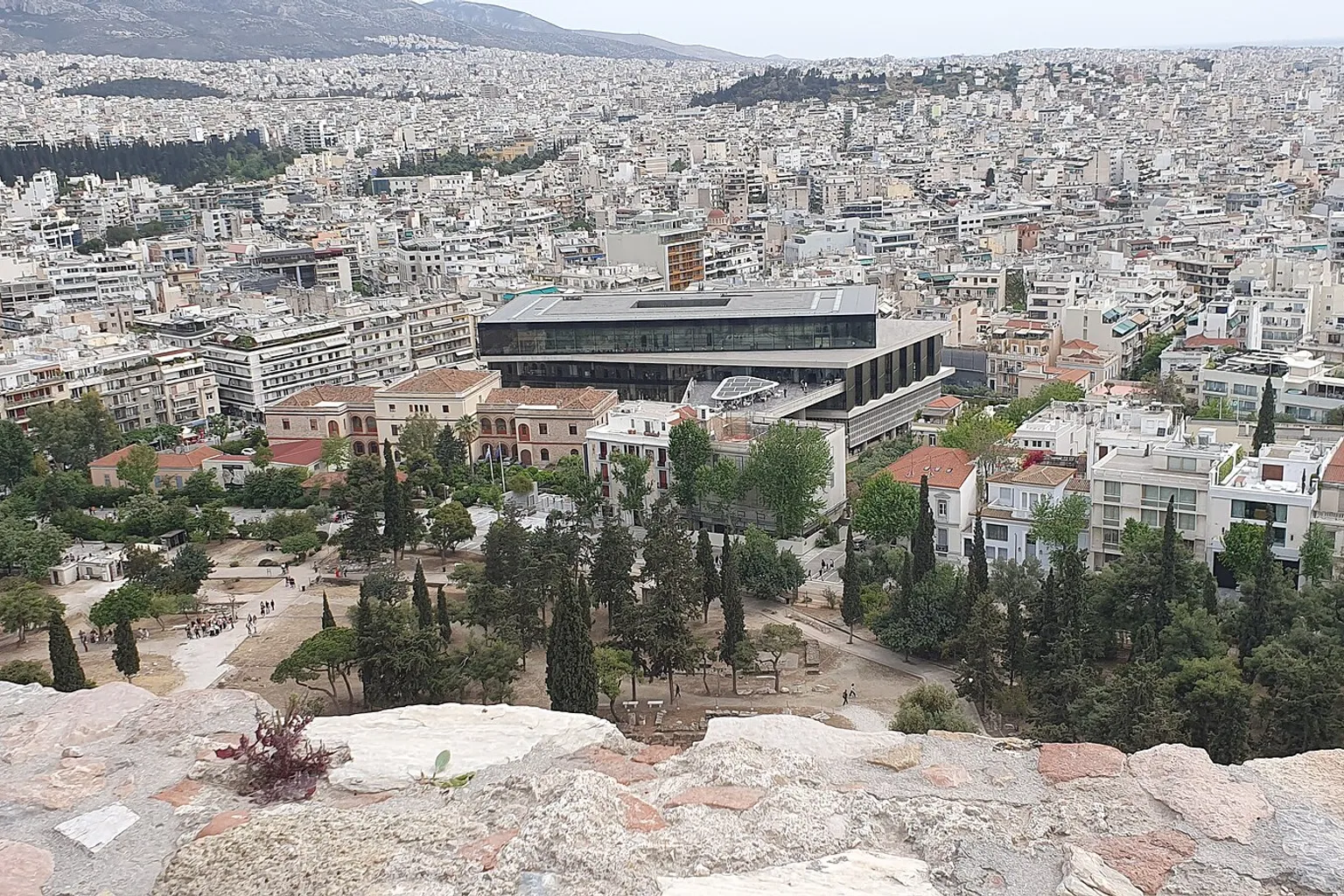
Each has its own admission system, ticketing channel, and entrance procedure, so a plan that covers the Parthenon does not automatically cover the galleries below the hill.
Tickets and prices
Acropolis Museum
Athens
01 · GetYourGuide
Entry ticket · App audio guide
€30
02 · Official
Official ticket · General admission
€20
That distinction matters most when your visit is tightly scheduled. The Acropolis Museum is close to the southern entrance of the archaeological site—roughly a short walk of about 300 metres—but the two visits still need to be planned as separate steps. Once the ticketing is understood, the process becomes much more manageable: choose the museum entry route, confirm the date-specific opening information, allow time for security, and decide whether the museum belongs before or after the Acropolis hill.
The first decision: museum, Acropolis site, or both?
The Acropolis Museum presents the archaeological story of Athens through its own collection and galleries, including the Parthenon Gallery, the Caryatids, the Archaic Acropolis Gallery, and the excavation of an ancient Athenian neighborhood beneath the building. The Acropolis archaeological site, by contrast, is the hill itself, with the Parthenon, the Erechtheion, and the other monuments experienced in their original setting.
They complement each other, but they are not interchangeable.
A ticket purchased for the Acropolis hill through the archaeological site’s ticketing system does not provide admission to the museum. The museum’s own ticket must be purchased separately, either online through its official ticketing platform or at the museum ticket desk. There is no single combined ticket covering both attractions, so any itinerary that lists an “Acropolis and Museum combo ticket” should be read carefully: it may describe a tour package or a bundled service offered by a provider, but it should not be confused with one standard admission ticket issued jointly by both institutions.
This is the basic planning map:
| What you want to visit | What you need | Where the admission is handled |
|---|---|---|
| Acropolis Museum only | Museum admission | Acropolis Museum’s official online ticket system or museum ticket desk |
| Acropolis archaeological site only | Separate archaeological-site admission | The archaeological site’s designated ticketing system |
| Museum and Acropolis site | Two separate admissions | Each attraction’s own ticketing channel |
| Museum with an explanation of the collection | Museum admission plus a tour or audio-guide option | Museum ticket route and, where relevant, the tour provider |
| Museum café only | No museum admission for the ground-floor café | Café access without entering the galleries |
| Museum restaurant on the second floor | Free admission ticket from the museum ticket desk | Ticket desk, subject to the restaurant access arrangements |
The practical consequence is simple: count admissions, not just attractions. If your day includes both the hill and the museum, place both tickets in your travel plan before you arrive in Athens.
The Acropolis and the Acropolis Museum belong in the same itinerary, but they do not belong on the same ticket.
Acropolis Museum tickets: the main entry options
Most visitors will choose between general admission purchased online and a ticket bought at the museum desk. There are also reduced-admission and free-admission categories, but those require a different level of preparation because eligibility must be demonstrated in person.
Booking museum tickets online
Online booking is usually the most straightforward route when your travel dates are fixed. It allows you to arrange admission in advance and avoid the ticket-office line, which is particularly useful when the museum is one part of a larger day involving the Acropolis hill, a guided tour, or a timed meal reservation.
The online route works best when:
- you already know the day on which you want to visit;
- you prefer to begin with a confirmed admission plan;
- you are visiting during a busy period;
- you want to connect the museum visit with an audio guide or organized tour;
- you need to protect a limited morning or afternoon schedule.
Booking online does not remove every part of the entry process. All visitors still pass through the museum’s security checkpoint, including an airport-style X-ray screening. An online ticket can save time at the ticket office, but it is not a way to bypass mandatory security.
That distinction is worth making before you select an option described as an Acropolis Museum skip-the-line ticket. In practice, “skip the line” commonly refers to avoiding the ticket-purchase queue. It should not be interpreted as guaranteed immediate entry through security, and it does not eliminate screening.
Buying tickets at the museum desk
The physical ticket desk remains important for visitors who need reduced admission, free admission, or access based on documentation. Reduced and free tickets can only be obtained at the museum ticket desk when the visitor presents valid proof of eligibility.
This means that an online booking strategy may not be suitable for every traveler. If your admission category depends on age, nationality, student status, or another qualifying condition, bring the required documentation in its original or accepted form and allow additional time at the desk. The exact eligibility rules can depend on the category, so it is sensible to confirm the current requirements before leaving for the museum rather than discovering a documentation gap at the entrance.
The desk may also be the relevant stop for visitors seeking a free admission ticket connected with second-floor restaurant access. The ground-floor café can be accessed without a museum ticket, while the second-floor restaurant requires a free admission ticket obtained from the ticket desk.
Guided tour and app-based options
A standard museum ticket is designed for independent entry. A guided tour or app audio guide adds interpretation, which can be useful in a collection where the context matters as much as the objects themselves. The best choice depends on how much structure you want during the visit.
An app audio guide is often a practical middle ground for travelers who want a planned narrative without joining a fixed group. A live Acropolis Museum guided tour may suit visitors who prefer to ask questions and move through the Parthenon Marbles, Caryatids, and other highlights with an expert’s sequence already established.
Before booking, check what the option actually includes:
- museum admission itself;
- a digital or live guide;
- a meeting point outside the museum;
- a fixed start time;
- assistance through the security checkpoint;
- access to the archaeological site, if mentioned in the title;
- any restrictions on changing the date or arrival time.
A tour title can make two attractions sound like one package, while the actual inclusions remain separate. Read the entry details as a logistics document, not just as a description of the experience.
Reduced admission, free days, and documentation
The museum has reduced and free admission categories, but they are not simply lower-priced versions of the general online ticket. Eligibility must be established at the physical ticket desk with valid documentation. If you are relying on a reduced or free category, the document is part of your entry plan.
The museum also offers free admission on several specific annual dates:
- 6 March, Melina Mercouri Day;
- 25 March, a Greek national holiday;
- 18 May, International Museum Day;
- 28 October, a Greek national holiday.
These dates can make the museum more accessible, but free admission does not necessarily mean a frictionless visit. Demand may be higher, and visitors still need to complete the entry process and security screening. If your schedule is narrow, a regular pre-arranged admission on another day may be more predictable than building the whole itinerary around a free-admission date.
For travelers who may qualify for free or reduced entry but are unsure whether their category can be booked online, the safest approach is to plan for the ticket desk. The requirement to show documentation is confirmed; the online treatment of every individual eligibility category may vary, so it should not be assumed that a discounted or free ticket can be secured in advance through the same process as general admission.
Opening hours and the right time to visit
Opening hours are one of the details that should be checked for the exact date of travel. Museum schedules can change by season, holiday, or special operating arrangement, and a general itinerary should not be built around an unverified closing time.
The reliable planning sequence is:
1. Check the museum’s official opening information for your date.
2. Confirm whether the ticket selected is valid for the intended arrival period.
3. Add time for the security checkpoint rather than treating the ticket time as door-to-gallery time.
4. Leave a buffer if you are connecting the museum with an Acropolis hill visit, transport, or a reservation.
5. Recheck the information shortly before the visit if your trip is several weeks away.
For a typical visit, allow around 90 to 120 minutes inside the museum. That is enough for a purposeful visit through the major galleries, but it is not an invitation to rush past the collection. Visitors who want to read labels carefully, spend longer in the Parthenon Gallery, or include the excavation display may need more time.
The best time to visit the Acropolis Museum depends on the rest of your day. A morning visit can establish the historical and architectural context before you climb the Acropolis. An afternoon visit can provide a cooler, more structured indoor period after time on the hill, especially when outdoor walking has already taken most of your attention.
The museum is also a useful planning anchor because it gives you a defined cultural block in an otherwise physically demanding day. The Acropolis site involves uneven surfaces, exposure, and walking between monuments. The museum offers a different pace, but the transition between the two still requires realistic timing.
Treat the museum as a scheduled visit with its own entry process, not as an optional room added to an Acropolis ticket.
How to combine the museum with the Acropolis site
The museum and the archaeological site are close enough to combine, but proximity should not be mistaken for instant transfer. The approximate 300-metre distance between the museum and the southern entrance of the Acropolis hill is manageable on foot, yet the overall movement includes leaving one attraction, walking through the surrounding streets, reaching the correct entrance, and completing the next admission and security procedures.
There are two sensible orderings.
Museum first, Acropolis second
This sequence works well for visitors who prefer to understand the monuments before seeing them from the hill. The Parthenon Gallery and the museum’s archaeological displays can provide a framework for what you will encounter outdoors. You enter the Acropolis site with more visual references already in place, which can make the monuments easier to read rather than simply photograph.
Choose this order when:
- you want the museum’s interpretation before the outdoor visit;
- you are comfortable spending the first part of the day indoors;
- your Acropolis admission is planned for later;
- you would rather climb the hill after establishing the historical context.
Acropolis first, museum second
This arrangement is useful when you want to see the monuments outdoors while your energy is highest, then move into the museum for a more controlled and air-conditioned setting. It can also work well if your museum visit is scheduled later in the day and you want to use it as the second major stop.
Choose this order when:
- you want to prioritize the hill and its monuments;
- you prefer outdoor walking earlier;
- you expect to spend longer at the Acropolis site;
- you want the museum to provide a quieter conclusion to the cultural portion of the day.
Whichever order you choose, avoid booking the two admissions so closely together that a short delay creates a chain reaction. The museum’s security line, the walking distance, the pace of the first visit, and the physical conditions on the hill all introduce variables that no ticketing page can remove.
What security and entry queues actually mean
Security is part of the museum’s entry procedure for every visitor. Online booking can reduce the time spent at the ticket office, but it cannot eliminate the mandatory X-ray checkpoint. This is the point at which many otherwise careful plans become too optimistic: a traveler sees a digital ticket and assumes the remaining process will be immediate.
A more accurate expectation is that online booking gives you a cleaner starting point. You arrive with admission arranged, proceed to the entrance, and complete the required screening. Depending on visitor volume, that may still take time.
A practical arrival plan includes:
- the digital or printed admission confirmation;
- identity or eligibility documents where relevant;
- enough time to locate the correct entrance;
- a buffer before any onward booking;
- an understanding that security screening applies even with an online ticket;
- a willingness to keep bags and personal items within the museum’s current entry requirements.
Avoid scheduling a restaurant reservation, transport connection, or separate archaeological-site entry immediately after the museum’s nominal start or end time. A 90-to-120-minute museum visit is a useful baseline, but the complete door-to-door block should include arrival, screening, and the transition to your next stop.
Practical planning for families, groups, and mixed itineraries
A group often contains several different admission needs. One traveler may qualify for reduced admission, another may require general admission, and a child’s category may depend on documentation or the current rules. In that situation, gather the documents before you reach the desk and keep the group’s ticket arrangements together.
Families should also decide whether the museum is the main event or one part of a longer Acropolis day. A full outdoor visit followed by a museum visit can be rewarding, but it may be demanding for younger children or anyone who struggles with heat and extended walking. A shorter, focused museum route before the hill may create a more comfortable transition phase.
For larger groups, a guided format can reduce the effort of coordinating meeting points, admission timing, and interpretation. For independent travelers, an app audio guide can provide structure without locking the entire visit to a live group schedule.
The museum’s baseline comfort is also easier to manage when the day has breathing room. Do not treat every available hour as a ticket slot. Build the itinerary around the actual pace of the people in your group, not only around the distance shown on a map.
A dependable booking sequence
When the available options feel unnecessarily complicated, use this order of decisions:
1. Separate the attractions. Decide whether you are visiting the museum, the Acropolis archaeological site, or both. Assume separate admission unless the exact package terms clearly explain otherwise.
2. Choose the museum format. Select independent entry, a guided tour, or an app audio guide according to the level of support you want.
3. Check the date-specific opening information. Do this before fixing transport, meals, or the second attraction.
4. Decide whether you qualify for reduced or free admission. If the category requires documentation, plan to use the physical ticket desk.
5. Book general admission online when predictability matters. This can remove the ticket-office queue, but it does not remove security screening.
6. Allow 90 to 120 minutes for the museum itself. Add a separate buffer for arrival, screening, and movement between the museum and the hill.
7. Keep the Acropolis ticket separate. A museum ticket does not provide entry to the archaeological site, and an Acropolis site ticket does not provide entry to the museum.
8. Recheck the details before departure. Ticket conditions, opening information, and tour inclusions are the parts of a travel plan most likely to change.
This sequence is deliberately unglamorous. That is its advantage. It prevents the most expensive form of travel mistake: arriving with enthusiasm, limited time, and an admission plan that covers only half of what you intended to see.
The most practical choice for most visitors
For a traveler with fixed dates and no special admission category, the simplest route is usually general museum admission arranged online, followed by enough time for security and a visit of roughly 90 to 120 minutes. If the day also includes the Acropolis hill, purchase that admission separately and leave a realistic transition period between the two.
Visitors who need reduced or free admission should prioritize documentation and the ticket desk rather than assuming the online process will handle every category. Visitors who want interpretation should decide whether a guided tour or app audio guide adds enough structure to justify a fixed format. Those who only want a coffee at the ground-floor café do not need museum admission, while the second-floor restaurant requires a free ticket from the desk.
There is no single best entry path for every itinerary. The right choice depends on whether your priority is speed at the ticket office, interpretive support, flexibility, or eligibility for a special admission category. What remains constant is the underlying logistics: separate ticketing systems, mandatory security, date-specific opening information, and a need to leave room between connected plans.
Once those elements are mapped, Acropolis Museum tickets stop being a source of uncertainty. They become what they should have been from the beginning: one clear part of a well-managed Athens visit.
Practical info
Currency: EUR
Driving: on the right
Emergency number: 112
FAQ
Do I need a separate ticket for the Acropolis Museum and the Acropolis archaeological site?
Can I skip the security line by booking my museum ticket online?
How can I get a free or reduced-price ticket for the Acropolis Museum?
Do I need a ticket to visit the Acropolis Museum café or restaurant?
How much time should I allow for a visit to the Acropolis Museum?
Photo: Yair-haklai / CC BY-SA 4.0 — Wikimedia Commons