Stray dog rescue: milestones from discovery to safe shelter
A loose dog is not automatically an abandoned dog. It is a found animal with an unknown handling history, unknown health status, and unknown legal status.
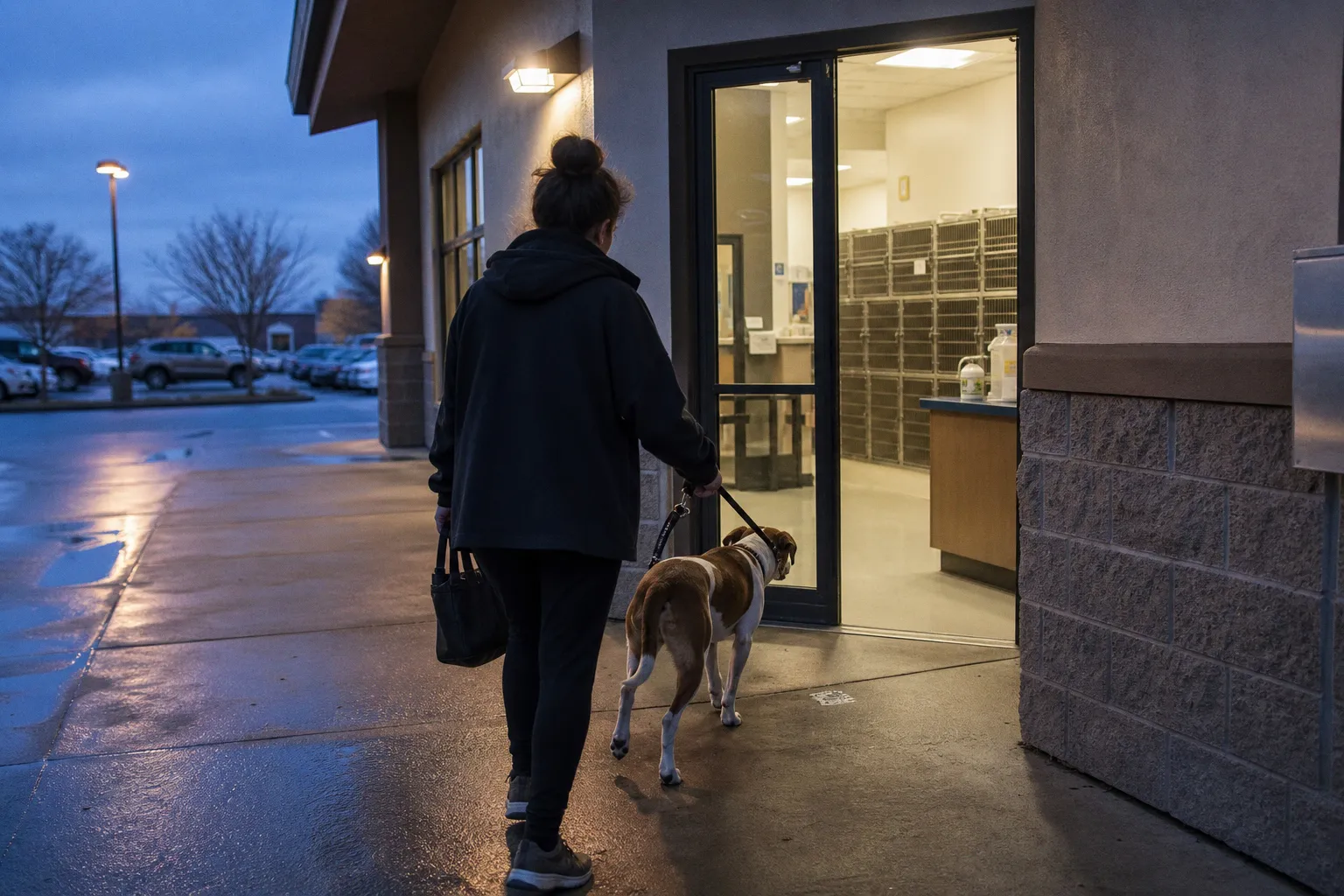
For a professional pet sitter, that distinction controls every decision made in the first ten minutes.
The stray dog rescue protocol for pet sitters begins with risk control, not capture. A dog that is calm at twenty feet can still bite when cornered, defend a pain site, bolt into traffic, or trigger a leash conflict with the sitter’s assigned dog. Nearly one in five people bitten by a dog requires medical attention. The operational target is simple: prevent a second emergency while creating a reliable path to local reunification and formal intake.
Initial contact: control the scene before approaching the dog
A sitter’s first duty remains the animal already in their care. Do not abandon a client’s dog, leave a gate unsecured, or turn a routine walk into an improvised recovery operation. Create separation first.
If the found dog is moving freely, assess its position in relation to traffic, people, other dogs, open gates, and escape routes. Distance is data. A dog moving in a predictable arc through a quiet residential block presents a different risk profile from one pacing at a multilane road shoulder.
Use a defensive sequence.
1. Stop forward movement. Do not run toward the dog. Do not extend a hand. Do not lean over its head. Direct pressure changes the dog’s flight response and can shorten its reaction time.
2. Remove your assigned dog from the interaction zone. Increase spacing. Avoid face-to-face alignment and taut parallel leashes. A loose dog can redirect onto either animal when the kinetic chain becomes crowded.
3. Read gait and posture from a distance. Weight-bearing asymmetry, a lowered head, stiff vertical tail carriage, repeated lip lifts, whale eye, or a fixed stare indicate that physical intervention is a poor choice. Limping does not equal harmlessness. Pain lowers bite thresholds.
4. Use neutral body orientation. Stand angled rather than square. Avoid direct eye contact. Keep movements slow. CDC guidance for an unfamiliar approaching dog is equally plain: remain calm and slowly back away.
5. Call the appropriate local authority when restraint is not clearly safe. Animal control, the designated shelter, or the non-emergency police line may have jurisdiction. The correct agency depends on the address, not on the sitter’s preference or a rescue group’s social-media reach.
6. Document the location without escalating the encounter. Record the street, nearest cross street, direction of travel, time, apparent condition, and any visible collar information. A clear photograph taken from a safe distance can materially improve a lost-pet report.
Do not use food as a universal solution. Food can reduce distance, but it can also produce guarding, competition, or a sudden rush toward the handler. It is not an authorization to capture. A sitter managing another person’s dog has limited bandwidth and limited equipment. That is a safety constraint, not a lack of compassion.
A found dog is not a recovery project until the scene is stable enough to prevent injury, escape, or cross-contamination.
When a collar or leash changes the calculation
A visible collar does not establish that the dog can be handled. A dragging leash can be caught on fencing, vehicle components, landscaping, or another dog’s legs. The risk is load transfer: when the leash snags, the dog may experience abrupt cervical or thoracic force and react defensively.
If a dog voluntarily approaches, maintains loose movement, and can be safely contained without placing the sitter or client dog at risk, a temporary restraint may be possible. “Possible” is not the same as required. Do not attempt to muzzle, corner, trap, sedate, or transport a dog solely because it looks sociable.
The safe threshold is narrow:
- You can separate the client animal completely.
- The dog is not showing active fear, pain, or defensive behavior.
- A secure containment method is already available.
- The destination and responsible authority are known.
- The sitter’s employer, client agreement, and local rules do not prohibit the action.
If one condition is absent, report and monitor from a safe distance when feasible. That remains a legitimate rescue action.
Reporting found pets: jurisdiction comes before improvisation
Reporting found pets to animal control is not administrative cleanup. It establishes the recovery chain. Lost pets are often located by their owners through municipal shelter systems, local animal-control reports, found-pet databases, veterinary offices, and neighborhood notices. A dog moved informally across county lines can disappear from that chain.
The sitter should notify the local shelter, animal control office, or applicable non-emergency police number and file a found-pet report. Provide only observed facts:
- Exact location and time found.
- Travel direction if the dog left the area.
- Description: approximate size, coat color, visible markings, collar, tag, harness, or leash.
- Condition indicators: limping, bleeding, heat stress, visible injury, inability to stand, entanglement, or apparent lactation.
- Whether the dog has been safely contained, remains loose, or has entered a private property.
- Any bite, scratch, or animal-to-animal exposure.
Do not classify the dog as abandoned based on appearance. A clean coat, a dirty coat, a missing collar, or a dog’s proximity to a commercial area proves nothing about ownership. A frightened pet may have escaped minutes earlier. A dog that looks neglected may still be legally owned and actively sought.
The local authority also determines the required holding procedure. There is no single United States stray-hold period. Requirements can be set by state, county, city, tribal authority, or the designated shelter. A well-meaning sitter cannot substitute a generalized internet rule for local custody law.
| Decision point | Appropriate action | Common operational error |
|---|---|---|
| Dog is loose and cannot be handled safely | Report location; maintain distance if safe; request animal-control response | Chasing the dog through traffic or into an unfamiliar yard |
| Dog is safely contained with identification | Contact listed owner when feasible and report to the responsible agency | Returning the dog without documenting the find or confirming identity |
| Dog has no visible identification | File found-pet report; arrange authorized scan and intake pathway | Assuming no collar means no owner |
| Dog is injured, collapsed, or in thermal distress | Contact emergency animal services or veterinary direction through the responsible authority | Loading the dog into a personal vehicle without safe handling capacity |
| Dog has bitten or scratched a person or pet | Wash wounds, seek medical or veterinary guidance, report exposure | Treating the incident as private because the wound appears minor |
Professional pet sitters should also notify their own dispatch system, supervisor, or business owner. This creates a timestamped record, protects continuity of care for the assigned animal, and prevents conflicting decisions by multiple staff members.
Identification is a reunification procedure, not a quick scan
Scanning stray dogs for microchips is one milestone in a larger identification process. It is not a transfer of ownership. A microchip may be unregistered, registered with old contact information, or linked to an organization rather than an individual. The responsible shelter or agency must verify the record and manage the contact process.
When a dog can be safely restrained and the proper facility is available, the identification sequence is direct:
1. Check the collar and tag without placing hands near the dog’s mouth or neck under tension. Photograph tag information if the dog cannot safely be held still.
2. Obtain a microchip scan at a veterinary office, shelter, or other facility equipped to scan. Scan systematically. Chips can migrate from the original implant location.
3. Report the found dog before making placement decisions. A microchip number is useful only when connected to a documented recovery effort.
4. Preserve location data. The point where the dog was found matters. It may define jurisdiction, indicate likely travel radius, and help owners identify the animal.
5. Maintain intake documentation. Shelters should check potentially lost animals for identification, including microchips and tattoos, as part of intake.
A sitter should not post every detail publicly. Publishing a full tag number, complete microchip information, or highly specific unique markings can weaken ownership verification. A claimant should be able to supply details not included in a broad public description.
This is where informal “temporary foster care for strays” becomes operationally risky. Bringing a found dog into a private home with resident animals can erase location history, create exposure events, and complicate legal custody. The dog may also be incubating disease, carrying parasites, or showing behavior that is suppressed by fear during the first hours.
The microchip scan identifies a lead. The shelter report and verified claimant establish the reunification route.
Exposure, injury, and the 10-day observation rule
The health assessment begins before the dog enters a vehicle, lobby, kennel, or foster home. Observe without handling whenever possible. Look for respiratory effort, neurologic instability, active bleeding, non-weight-bearing gait, abdominal distension, heat stress, severe coat contamination, discharge from eyes or nose, or altered responsiveness.
Gait analysis is useful here, but it has limits. A shortened stride, toe-touching, head bob, pelvic sway, or repeated sitting may indicate musculoskeletal pain. It may also be caused by fear, fatigue, thermal stress, or a surface the dog does not trust. The correct conclusion is not a diagnosis. The correct conclusion is that the dog may be unsafe to manipulate.
If a person is bitten or scratched:
- Wash a minor wound thoroughly with soap and water.
- Apply pressure with a clean, dry cloth to a deep wound and seek immediate medical attention.
- Consult a clinician when the dog’s rabies vaccination status is unknown.
- Record the exposure details and report through the local public-health and animal-control process.
If the found dog has exposed a person or another pet, do not make informal decisions about quarantine, vaccination, or release. CDC guidance calls for a 10-day confinement and observation period for a healthy dog, cat, or ferret that has exposed a person or pet, coordinated with public-health authorities. The animal should not be vaccinated during that observation period because a vaccine reaction could be confused with clinical rabies signs.
That rule is frequently misunderstood. It is not a ten-day deadline for a sitter to hold a dog at home. It is a public-health procedure. The location, custodian, documentation, and observation terms must be directed by the competent authority.
The same principle applies to canine exposure. A client’s dog that has been bitten, had saliva contact with an open wound, or fought with the found animal may need veterinary assessment. Do not allow greeting behavior because the loose dog appears calm. Nose-to-nose contact is not a temperament test. It is an exposure pathway.
Shelter transport has mechanical and thermal limits
Relocation is not the first step after discovery. It comes after local reporting, identification efforts, custody determination, and health and behavior screening. This is especially critical after disasters. Newly found dogs should generally remain in the local area for an extended hold period so displaced families have a realistic opportunity to find them.
When a dog is accepted into an organized shelter transport program, the transport operation needs more than a vehicle and a crate. The Association of Shelter Veterinarians’ 2022 standards describe a controlled system.
Before travel, trained staff should examine each animal within 24 hours and determine that it is fit to travel. A veterinarian must confirm fitness for animals with medical concerns or those recovering from surgery. That is a separate decision from whether the dog can physically enter a kennel.
The enclosure must support normal standing, turning, sitting, and lying. It must carry the dog’s unique identifier. Unfamiliar animals should not be placed together. The kennel must be secured to the vehicle, and its door must be secured against accidental opening.
The mechanical logic is simple. A kennel that shifts converts braking, turning, and road vibration into repeated impact loading. An unstable dog braces through the forelimbs, shoulders, spine, and hindquarters. That changes load distribution across the kinetic chain and raises stress and injury risk, especially for older, injured, or poorly conditioned animals.
Transport conditions also require active monitoring:
- Maintain vehicle ambient temperature between 45°F and 85°F (7.2°C to 29.5°C). The preferred comfort range in the animal compartment is 64°F to 80°F (18°C to 26.6°C).
- Maintain humidity within the recommended 30% to 70% range.
- Keep at least 1 inch (2 cm) of unobstructed clearance between kennel vent openings and adjacent structures.
- Visually observe every animal at least every four hours.
- Offer water at least every four hours.
- Limit driving to no more than 12 hours per day to an intermediate or final destination.
- Keep total vehicle confinement to a recommended maximum of 28 hours, excluding an overnight rest stop.
These are transport standards, not a substitute for binding local, state, federal, airline, or destination requirements. Interstate movement can require health certificates, vaccinations, and route-specific compliance at both origin and destination. A rescue transport coordinator must verify those requirements before loading the vehicle.
Do not confuse a private ride with organized transport
A pet sitter driving a contained dog five minutes to a designated local shelter is operating within a different risk envelope than a rescue moving multiple dogs across state lines. But both tasks require the same baseline controls: secure containment, separation from unfamiliar animals, ventilation, temperature management, and a destination that expects the animal.
A dog should not ride loose in a vehicle cabin. It can interfere with driving, escape at a stop, or become a projectile under abrupt braking. Do not place an unfamiliar dog in the front seat, on a client’s dog’s bedding, or in shared confinement with another animal.
Custody limitations protect the dog and the finder
A sitter may be capable of providing food, water, shade, and temporary physical security. That does not automatically confer authority to foster, authorize treatment, transfer ownership, or relocate the animal. The gap between capability and authority is where many otherwise competent interventions fail.
Immediate adoption is not a rescue milestone. Neither is sending the dog to a friend, a distant foster, or a preferred out-of-area rescue before local procedures are complete. Each shortcut can interfere with owner recovery and can expose resident animals to unknown health and behavior risks.
Use this troubleshooting path:
1. Can the dog be handled without foreseeable injury to people, the client’s animal, or the dog?
If no, create distance and call the responsible authority. Do not force contact.
2. Can the dog be contained without mixing it with other animals or compromising the client’s care?
If no, report location and request collection. Do not improvise shared restraint.
3. Has the proper local agency been notified?
If no, file the report before discussing foster placement, adoption, or transport.
4. Has identification been checked through an appropriate channel?
If no, arrange the scan and preserve the dog’s found location in the record.
5. Has the dog been screened for injury, illness, and exposure concerns by qualified personnel?
If no, treat the dog as unassessed. Avoid home placement and long-distance movement.
6. Has legal custody or release for transfer been confirmed?
If no, the dog remains a found animal, not an available rescue placement.
This sequence can feel slow when the dog is standing in front of you. It is still faster than correcting a bite incident, a missing-owner claim, an escape during transport, or a disease exposure in a foster home.
The operational endpoint is safe intake, not possession
A competent stray dog rescue protocol for pet sitters does not reward the person who gets hands on the dog first. It rewards the person who maintains safe spacing, records accurate facts, activates the correct local system, and avoids creating new risk.
The final safety parameters are non-negotiable:
- Client animals remain separated from the found dog.
- Unsafe capture attempts are not made.
- The location, time, description, and direction of travel are documented.
- Local animal control, shelter intake, or the correct non-emergency authority receives a report.
- Collar information and microchip data are treated as reunification evidence, not ownership proof.
- Any bite, scratch, or exposure enters the appropriate medical, veterinary, and public-health process.
- No informal adoption, foster transfer, or out-of-area relocation occurs before legal custody and screening are resolved.
- Any transport uses secured individual containment, thermal regulation, ventilation, and a confirmed receiving destination.
That is the route from discovery to safe shelter. It is procedural by design. The dog’s best chance of recovery depends on it.