Ground Transport vs. Air Travel for Rescue Dogs
A foster coordinator in Tennessee calls on a Tuesday morning with three shepherd mixes ready for their forever homes—two in Vermont, one in Oregon. The receiving rescues want them by the weekend.
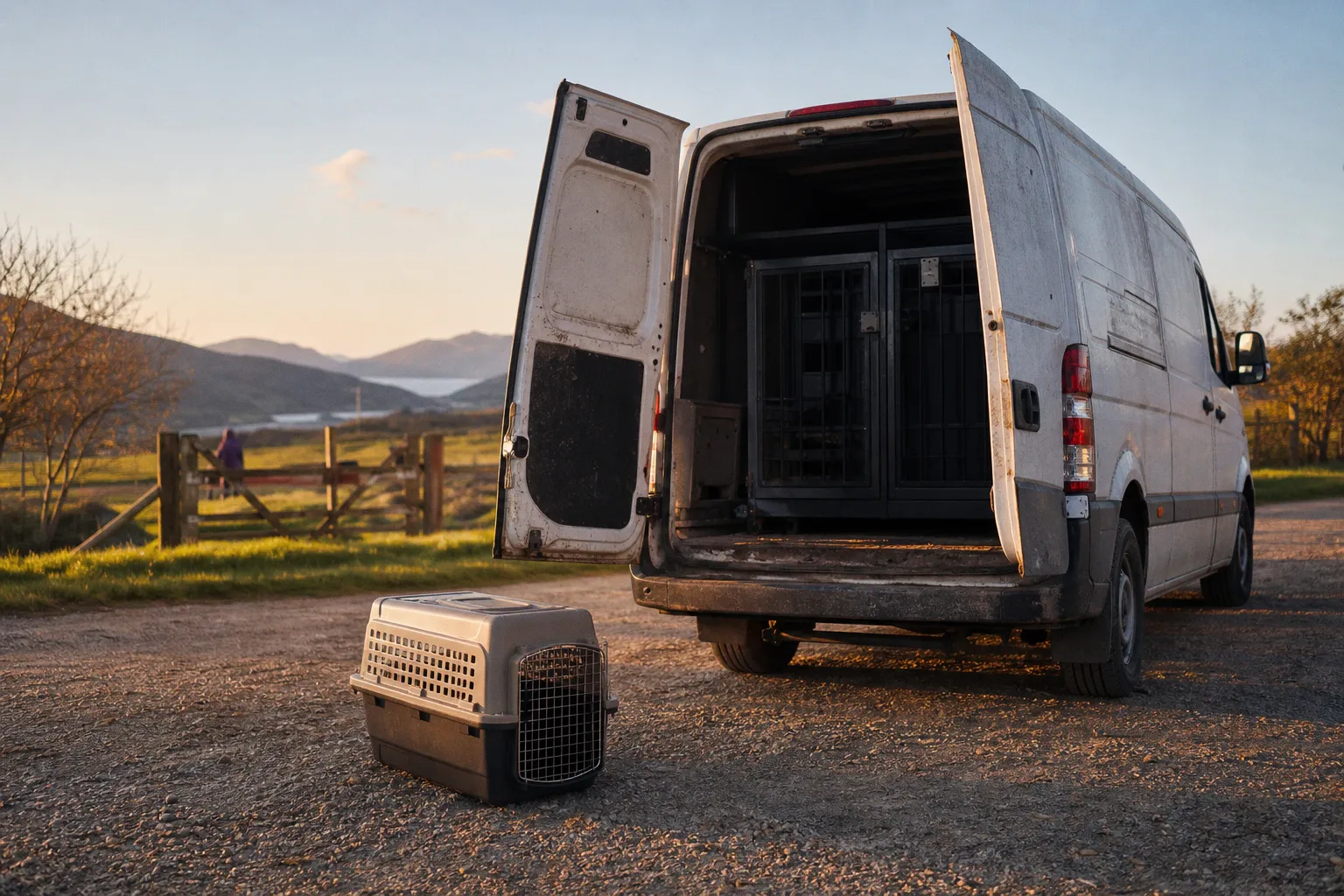
The question that follows is one I hear almost every week: should we drive them or fly them?
Compare car rental deals in United Kingdom
See available offersPartner link — DiscoverCars comparisonIt sounds like a simple transportation choice, but it sits on top of a layered decision tree: veterinary protocols, breed-specific physiology, weather windows, crate tolerance, receiving capacity, and the plain reality of what happens when a frightened dog loses the one familiar person in the room. In the rescue dog ground transport vs air travel debate, speed matters. So does the quality of the dog’s experience while that speed is being purchased.
Air travel can compress a long-distance shelter dog transport into a single day. Ground transport may take two or three. But a road route keeps a dog under human observation, gives a coordinator options when something goes wrong, and creates room for the animal to settle between transitions. Neither mode wins by default. The right answer belongs to the dog in front of you, not the empty space on a transport calendar.
The Evolution of Shelter Relocation: From Local to National Scale
Relocation is no longer a niche tactic. It is a structural part of how animal welfare organizations balance shelter capacity across regions. The ASPCA Relocation Program moved approximately 500 dogs from the South in 2014. By 2018, that number had climbed past 40,000 dogs in a single year—an eightyfold jump that reflects the broader professionalization of transport networks, regional partnerships, and airlift operations.
With that kind of volume, shelter dog relocation ground vs air is not an abstract planning exercise. It is a daily decision for shelter managers trying to reduce overcrowding without treating living animals like interchangeable freight. A seat in a receiving shelter, a foster home in another state, or an adopter willing to take a senior dog can change an animal’s outcome. Transport is how that opportunity becomes real.
What changed during the expansion was not simply funding or reach. It was the gradual codification of safety standards. The Association of Shelter Veterinarians published the first edition of its Guidelines for Standards of Care in Animal Shelters in 2010, followed by a second edition in 2022. Those guidelines help establish a welfare baseline for transport programs: temperature control, observation, sanitation, feeding, hydration, disease prevention, and recovery after medical procedures.
When ASV guidelines are treated as a baseline rather than an aspiration, the question stops being “which mode is safer?” and becomes “which mode fits this dog’s transition phase?”
That distinction matters. A healthy, crate-trained adult dog going to a prepared foster home may handle a flight well. A dog emerging from a crowded kennel environment, recovering from surgery, or displaying fear-based behavior may need the slower, more observable rhythm of the road.
Navigating ASV Guidelines for Ground Transport Safety
Ground transport is the workhorse of rescue relocation because it can be run as a controlled, monitored environment rather than an unpredictable moving crate. It is not merely “driving the dog there.” A credible operation is built around route planning, climate control, documented stops, clean housing, trained handlers, and a backup plan for every leg.
Two thresholds define much of the operating envelope. Drivers should not exceed 12 hours of driving in a day, and total confinement time in the vehicle should not exceed 28 hours, excluding overnight rest periods when animals are unloaded, exercised, and given appropriate care. Most experienced transport captains build routes around the shorter driving ceiling even when the schedule tempts them to push further. Driver fatigue is not separate from animal welfare. Dogs feel hard braking, rushed handling, skipped stops, and the general tension of a vehicle trying to make up lost time.
The environmental requirements inside the animal compartment are equally important. Ambient temperature should be maintained between 45°F and 85°F, with humidity between 30% and 70%. In practice, many coordinators aim for a narrower comfort band, roughly 64°F to 80°F, where most dogs can thermoregulate without prolonged panting or shivering.
A serious vehicle does not rely on the cab’s climate control drifting toward the rear. It has dedicated airflow to the animal area, visible temperature monitoring, backup equipment, secure crate placement, and enough space for staff to inspect each dog without turning a welfare check into a wrestling match.
Juvenile animals add another layer. Puppies under six months need close attention to feeding and hydration. A small meal may be offered no more than four hours before departure, with small amounts of food offered on a regular schedule during the trip. Water must be made available at least every four hours during stops. That recordkeeping is not paperwork for paperwork’s sake. If a puppy begins to show signs of stress, gastrointestinal upset, or low blood sugar late in the route, the log tells the next handler or receiving shelter when the animal last ate, drank, eliminated, and appeared normal.
Ground transport also has a decisive advantage for dogs who do badly in motion or under stress. A dog that starts vomiting, panicking, overheating, or shutting down can be assessed promptly. The driver can pull over, change the immediate environment, call the coordinator, or divert to veterinary care. There is no equivalent intervention available at cruising altitude.
What the road gives a vulnerable dog
Ground transport is not automatically gentle. A badly organized relay with chaotic handoffs can be deeply stressful. But a well-run route can provide things air travel cannot:
- A handler can observe breathing, posture, drooling, vomiting, trembling, and changes in responsiveness as they happen.
- Stops can be adjusted for the individual dog rather than dictated by an airport schedule.
- A dog can be transferred to a quieter crate, separated from a triggering neighbor, or given a decompression break when safe to do so.
- Coordinators can reroute around weather, traffic, or a delayed receiving partner instead of leaving the dog stranded inside an airport process.
- The same transport team can carry context from one stop to the next: this dog startles at men in hats, this one will drink only from a bowl held low, this one needs a slow approach before a leash change.
That continuity is often the difference between a dog arriving tired and a dog arriving overwhelmed.
The Hidden Risks of Air Travel for Brachycephalic and Anxious Dogs
Air travel is fast, and speed has real welfare value when distance is extreme or a shelter faces immediate overcrowding. It also introduces risks that ground transport does not carry.
The most widely recognized concern is brachycephalic physiology. French Bulldogs, English Bulldogs, Pugs, Boston Terriers, and other flat-faced breeds can have narrowed airways and reduced respiratory reserve. Changes in temperature, excitement, stress, and air pressure can turn an already difficult breathing situation into an emergency. Many major airlines restrict or refuse brachycephalic dogs in cargo. For those dogs, ground transport is usually the safer default, regardless of how appealing the flight time looks on paper.
But airway anatomy is not the only concern. The vulnerable period around a flight includes the drive to the airport, check-in, security procedures, loading, time on the tarmac, transfer points, unloading, and the wait for ground pickup. A flight listed as four hours is not four hours of travel from the dog’s perspective. It can be an entire day of unfamiliar handling and confinement.
Commercial airlines also operate under hard weather restrictions. Pet transport may be denied if ground temperatures exceed 85°F or drop below 20°F. Those conditions can matter at departure and arrival, not merely in the aircraft itself. A flight that seemed workable a day earlier can become a no-fly decision on the morning of departure because a heat spike, cold snap, or operational delay pushes conditions outside the carrier’s policy.
Cargo holds may be pressurized and temperature-controlled, but that does not make them interchangeable with a climate-controlled rescue vehicle staffed by people who know the dog. Airline policy, weather exposure during loading, and the possibility of last-minute denial all have to be part of the plan.
Anxiety creates a parallel problem. A shelter dog that has spent weeks decompressing in foster care does not necessarily benefit from several hours in a loud, unfamiliar, highly regulated environment with limited human contact. For dogs with separation sensitivity, noise phobia, generalized anxiety, or a history of shutting down under stress, ground transport can preserve a measure of handler continuity that air travel breaks.
Some organizations use flight nannies: volunteers who escort a dog in the cabin on a commercial flight. A rescue dog flight nanny vs ground transport comparison is more nuanced than cargo versus car. In-cabin travel can be a humane middle ground for a small, calm dog who fits the airline’s carrier requirements and can tolerate the airport process. It is not a universal answer. It depends on the dog’s size, airline policy, route availability, the volunteer’s reliability, and whether the receiving team can meet the dog promptly at the other end.
The fastest transport mode is not always the lowest-stress mode. For a rescue dog in the middle of a decompression arc, stress is a clinical variable, not just a comfort issue.
Critical Veterinary Protocols: Pre-Travel Health and Recovery Windows
Every transport decision, whether it involves tires or wings, should pass through a veterinary filter first. The two areas that most often catch new coordinators unprepared are vaccination timing and post-surgical recovery.
Wings of Rescue requires transported dogs to be vaccinated upon intake or at four weeks of age with a modified live virus vaccine covering distemper, adenovirus, and parvovirus, plus an intranasal Bordetella/parainfluenza vaccine. That combination forms a respiratory-disease baseline for dogs entering a transport pipeline, and documentation has to travel with the animal.
The recovery window after surgery is where rushed planning most often creates avoidable risk. AVMA-ASV guidance is clear: an animal should not be transported less than 24 hours after an anesthetic or surgical procedure, including a routine spay or neuter. The incision may look fine. The dog may be standing, eating, and trying to climb out of the kennel. That does not mean the animal is ready for a moving vehicle, an airport transfer, or a long stretch without immediate veterinary access.
Anesthetic recovery is not a cosmetic detail. Nausea, disorientation, pain, dehydration, and delayed complications are harder to manage on the road and harder still in an air-travel chain. Build the recovery window into the timeline before anyone books a seat, assigns a driver, or promises an adopter a pickup date.
| Protocol Area | Ground Transport | Air Transport |
|---|---|---|
| Continuous confinement | Up to 28 hours, excluding overnight rest periods | Governed by airline and route requirements; the flight is only part of the total confinement period |
| Vaccination baseline | Documented core vaccination and respiratory disease prevention protocols | Documented core vaccination; carrier and destination paperwork may also apply |
| Post-surgical recovery | At least 24 hours after anesthesia or surgery | At least 24 hours after anesthesia or surgery; airline requirements may be more restrictive |
| Temperature management | Vehicle compartment maintained within safe temperature and humidity ranges | Vulnerable to airline temperature policies at departure and arrival |
| Young animals | Regular food and water opportunities with logged welfare checks | Feeding and hydration procedures vary by airline and route |
| Brachycephalic dogs | Often manageable with appropriate climate control and observation | Cargo travel may be restricted or unsuitable |
The table is useful only if it leads back to the individual dog. A heartworm-positive hound finishing treatment, a senior dog with arthritis, a nursing mother, a puppy with a fragile appetite, and a confident young adult with excellent crate skills do not belong in the same transport calculation.
Operational Constraints: Temperature Thresholds and Disaster Hold Policies
The last layer of the decision tree is operational, and this is where even experienced coordinators get caught. Weather, receiving capacity, mechanical backup, disaster response rules, and handoff quality can override an otherwise sensible plan.
A critical distinction is needed around disaster-displaced animals. Wings of Rescue has a documented 30-day hold before pets displaced by disasters can be flown out of the affected region. The purpose is painfully clear: owners separated during an evacuation or emergency need a meaningful chance to locate and reclaim their animals before an airlift moves them elsewhere.
That policy should not be casually generalized. It is a Wings of Rescue air-transport rule, not proof that most transport organizations impose the same 30-day hold or that ground transport is governed by an identical requirement. Ground movement after a disaster may still be constrained by local shelter policies, reunification efforts, emergency management direction, health documentation, available destination placement, and the ethics of moving an animal whose family may still be searching. But those constraints must be verified with the relevant agencies and rescue partners rather than assumed from an aviation policy.
Weather windows layer on top of everything else. A ground run through the Plains in winter may face ice, closures, or a stalled vehicle. An air booking in summer may face tarmac heat restrictions that cancel the plan with only hours of notice. The best transport plans do not pretend these are rare annoyances. They build time around them.
A useful buffer allows the dog to settle before departure, gives the sending organization time to resolve last-minute medical or paperwork issues, and prevents the receiving rescue from improvising an intake kennel when a foster home falls through. The exact buffer depends on the route and the animal, but the principle is constant: a schedule with no slack is a schedule that will eventually ask someone to take a welfare shortcut.
Handoffs are part of the transport, not an administrative detail
Ground routes often run on relay legs. A volunteer drives a dog for part of the distance, transfers the crate and paperwork at a planned meeting point, and another volunteer takes over. This can be excellent when each handoff is disciplined: confirmed identity, secure leash and crate protocol, updated health notes, water status, medication schedule, and an actual person waiting at the destination.
Air transport consolidates the handoff into fewer points, but each point can carry more consequence. A missed relay at a rest stop is often inconvenient and recoverable. A missed airport pickup can leave a dog waiting in a crate in a high-stimulation environment while staff scramble for a solution.
For long distance shelter dog transport, reliability is not just arriving on time. It is knowing exactly who has physical custody of the dog at every moment, what they know about the dog, and what they will do if the plan breaks.
Matching the Mode to the Dog
The practical framework I share with new coordinators is less glamorous than a flight map, but it prevents many bad decisions.
1. Start with health and recovery. If the dog is post-surgical within the recovery window, medically unstable, very young, or still being evaluated for infectious disease risk, delay or choose the route that allows the highest level of observation. Transport urgency does not erase medical reality.
2. Look honestly at airway and temperature risk. A brachycephalic dog, a dog with compromised respiratory function, or an animal that overheats easily should not be treated as a standard cargo candidate. Climate-controlled ground transport is often the more defensible option.
3. Assess the dog’s behavior, not just the distance. A confident, crate-comfortable dog may tolerate air travel better than a fearful dog going half as far. If the dog freezes, thrashes, bites at the crate, refuses water, or panics when separated from a familiar handler, the shorter route may carry the bigger welfare cost.
4. Check the entire journey, not the advertised duration. Flying a rescue dog vs driving is not five hours versus two days. Include check-in, loading, weather delays, airport waiting, destination pickup, and travel from the airport to the receiving home.
5. Treat disaster-displacement status as its own question. If a dog was displaced by a disaster, confirm reunification procedures and the rules that apply to the specific organization and jurisdiction. A Wings of Rescue flight must account for its documented 30-day hold; other movement decisions require their own verified guidance.
6. Confirm the destination before departure. A dog should be traveling toward a prepared foster, adopter, or receiving organization—not merely toward another kennel with an uncertain plan. The final handoff is part of welfare, not the end of logistics.
The honest truth is that many shelter dogs—the long-timer shepherd mix, the heartworm-positive hound finishing treatment, the senior beagle whose owner died—benefit from ground transport even when air is technically available. The slower pace provides a transition phase that air travel can skip, and continuous human observation can mean the difference between a dog arriving shut down and one arriving tired but curious.
The best transport plan is the one that gives the dog the most support through the least familiar part of their life—not the one that produces the most impressive arrival time.
The Transport Plan Is the Rescue
A well-built plan begins before a crate door closes. It starts with current veterinary records, confirmed vaccination compliance, an appropriate recovery window after any procedure, a route checked against weather, and a realistic backup if the primary plan fails.
It also ends properly. The receiving foster or adopter should know what the first days may look like: reduced appetite, extra sleep, loose stool from stress, reluctance to walk, or a dog who seems unusually quiet. Those are not reasons to assume the transport failed. They are reasons to give the dog time, routine, calm handling, and a low-pressure place to decompress.
When that system is in place, transport becomes one of the most powerful tools in rescue. The temperature logs, feeding schedules, health certificates, relay texts, crate labels, and weather contingencies disappear from view once the dog settles onto a foster couch. But they are the reason that moment can happen safely.
Ground transport and air travel are not competing ideologies. They are tools with different failure points. Choose the mode that gives this dog—the actual dog, with this medical history, this temperament, this route, and this receiving home—the safest path forward.