Relay vs. Direct Routes for Shelter Dog Transport
Two partner shelters, same destination, two very different ideas. One coordinator wants to break the trip into a relay, with volunteer drivers taking defined portions of the route and meeting at planned transfer points.
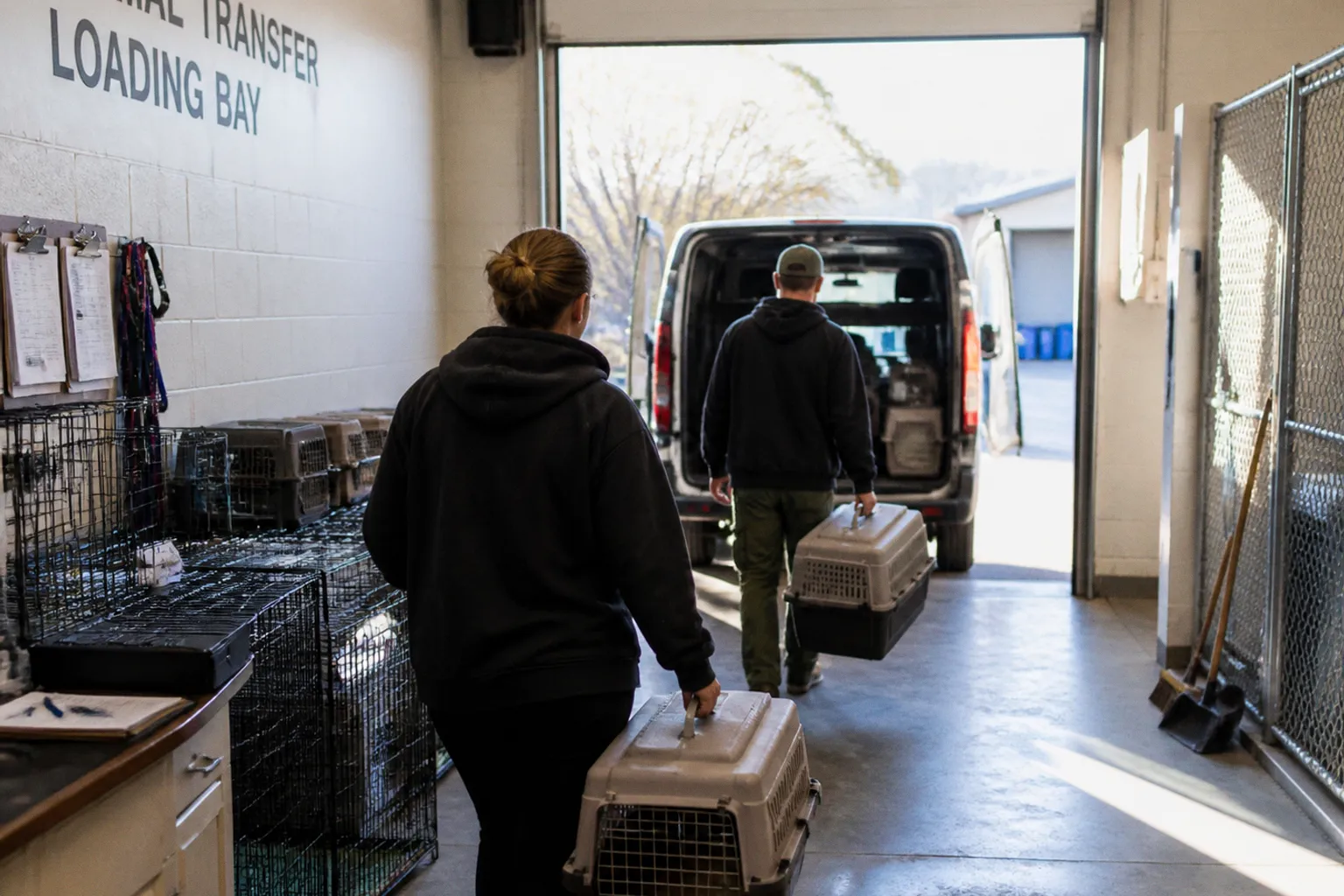
The other wants to load a van and hand the dogs to the receiving shelter without changing drivers or vehicles along the way. Both are real, common rescue models in the United States. Neither is automatically the right answer.
Compare car rental deals in United Kingdom
See available offersPartner link — DiscoverCars comparisonThe decision comes down to the dogs, the distance, the available people and equipment, the documentation discipline each leg demands, and the climate variability along the route. A relay can make a long relocation possible when no single driver or vehicle can reasonably cover it. A direct haul can reduce handling and simplify accountability. Either model can become unsafe when the plan is built around convenience first and animal welfare second.
That is usually where a logistics coordinator stalls, because the question “relay or direct?” arrives wrapped in trade-offs the operator has to weigh in real time. Guidance on shelter dog relocation from the Association of Shelter Veterinarians, along with related recommendations from the ASPCA and USDA APHIS, focuses on what happens to the dog during the move and at every transfer point rather than naming one routing model as superior. If you are weighing relay vs direct shelter dog transport for an upcoming run, the working path is to map the journey against a short list of operational variables and let those variables decide.
Each leg of a relay route is its own small transport: every handoff is a moment when familiarity resets and the documentation chain has to stay intact.
Operational Realities of Multi-Leg Relay Transport
A relay is not one transport event. It is a sequence of connected transports, each one ending where the next begins, with a designated person responsible for the animals and the records at every transfer point.
In a typical volunteer relay, the originating organization identifies drivers for defined portions of the route, sets meeting points and arrival windows, prepares an individual travel crate or kennel for each dog, and distributes the information needed to complete the trip. The receiving shelter, transport coordinator, and drivers need to know who has custody of each dog at any given moment. That sounds obvious until a driver arrives early, the next driver is delayed, a dog’s crate is moved to another vehicle, or a medical note stays in someone’s phone instead of traveling with the animal.
The practical advantage of a relay is flexibility. A rescue group may have many people willing to contribute part of a day but very few who can commit to the entire route. Personal vehicles may be available in several regions even when the organization does not own a long-distance transport van. A relay can also create a local support network around a relocation program: people learn the handoff procedure, become familiar with the organization’s records, and gain experience recognizing when a dog should not continue.
But flexibility is not the same as simplicity. Every additional leg creates another schedule to coordinate, another person to brief, another vehicle to assess, and another opportunity for the plan to drift away from the original instructions. A coordinator has to account for traffic, weather, driver cancellations, breakdowns, unexpected behavior, and the possibility that a dog arrives at a meeting point too stressed or unwell to continue.
The most reliable relay plans are built as if each leg could fail. That does not mean expecting failure at every turn. It means deciding in advance what happens if a driver is late, if the next vehicle cannot arrive, or if a dog needs to stop for veterinary attention. The contingency may involve a staffed partner facility, a temporary foster placement, an approved boarding arrangement, or a different driver who has already agreed to remain available. “We’ll figure it out at the handoff” is not a contingency plan.
A relay also needs a clear answer to a less dramatic but equally important question: where do the dogs rest? The dogs may remain in their travel crates during the transfer, but the organization must know whether the meeting point is suitable, whether water can be offered safely, whether the animals can be observed, and whether the area exposes them to unfamiliar or potentially infectious animals. A parking lot selected because it is halfway between two cities is not automatically an appropriate animal transfer site.
The hidden cost of volunteer relay pet transport
The financial appeal of volunteer relay pet transport is real, especially for small rescue groups. Drivers may donate mileage, fuel, or their time. The organization can avoid paying one professional driver for the full journey and may be able to use vehicles already available within the network.
The operational cost moves elsewhere:
- Someone must recruit, confirm, and brief every driver.
- The route needs a shared timeline with realistic arrival windows rather than optimistic point-to-point estimates.
- Each driver must receive the dog’s identification details, medical notes, emergency contact information, and instructions for feeding, watering, medication, and incident reporting.
- Handoff locations need to be evaluated for safety, lighting, parking, weather exposure, and access to help.
- A coordinator must monitor progress instead of assuming the route is proceeding normally.
- Crates, vehicles, and any reusable equipment need cleaning according to the organization’s biosecurity protocol.
- The receiving shelter must be notified if the route changes enough to affect intake, isolation, or veterinary scheduling.
The relay model distributes the driving, but it does not distribute responsibility into nothing. Responsibility exists at every leg. A good coordinator makes that responsibility visible.
Direct Haul Logistics and Resource Allocation
A direct haul is easier to describe on paper and harder to execute on the ground. One vehicle, or one transport team, leaves the source shelter and arrives at the destination without changing drivers, swapping vehicles, or transferring custody along the route. From the dog’s perspective, this can mean fewer unfamiliar handling events, fewer changes in sound and smell, and a more consistent temperature and observation routine.
For destination shelters expecting a predictable arrival, a direct haul is often easier to plan around. The receiving coordinator can schedule intake exams, kennel assignments, isolation space, and foster or adopter communication around one arrival window rather than tracking a chain of moving parts. For sending shelters, a direct haul removes the risk that one missed relay leg slows the entire pipeline.
The tradeoff is concentration. A vehicle breakdown, driver emergency, or sudden weather event becomes the only problem on the trip, and it is the entire trip’s problem at once. A direct haul can also create driver-fatigue concerns when the route is long. The team has to be honest about who will drive, when that person will rest, how observations will be conducted while the vehicle is moving, and what happens if the original schedule becomes unrealistic.
Direct-haul programs therefore tend to invest in vehicle redundancy, mechanical inspections, route planning, and clear driver policies. A second driver may be appropriate for some routes. So may a planned overnight stop, although that stop must be arranged in a facility capable of safely housing the dogs and maintaining the required separation and cleaning practices. The objective is not to make the trip look continuous on a calendar. The objective is to keep the animals safe throughout the actual journey.
Resource allocation is more than fuel and mileage
When comparing direct haul shelter dog transport with a relay, organizations often begin with mileage and fuel. Those matter, but they are only part of the resource picture.
A direct haul may require:
- A vehicle capable of maintaining ventilation and temperature control for the full route.
- A qualified driver or transport team able to manage the journey without unsafe fatigue.
- A pre-trip inspection and a plan for mechanical failure.
- Enough capacity for crates to remain stable, separated as needed, and accessible for observation.
- A route with identified stops, emergency veterinary options, and a way to respond to weather or road closures.
- A receiving team ready to take custody immediately upon arrival.
A relay may require fewer resources in one category but more in another. It may use several smaller vehicles rather than one specialized van, but it needs more coordination, more handoff records, and more opportunities to clean and inspect equipment. A rescue organization that has a strong volunteer base but limited vehicle capacity may be well suited to a relay. A group with a reliable transport van and an experienced team may gain more from a direct route.
The useful question is not “Which model costs less?” It is “Which model can we execute without cutting corners that affect the dogs?” A low-cash route can still be expensive in staff time, delay risk, and welfare exposure. Conversely, paying for a direct transport may be a responsible use of funds if it removes several weak points from a complicated relocation.
Relay vs. Direct Shelter Dog Transport: Comparing the Models
Neither model is better in principle. Each behaves differently under measurable conditions.
| Operational variable | Relay route | Direct haul |
|---|---|---|
| Custody | Changes at planned transfer points | Remains with one transport team until arrival |
| Handling events | More frequent, depending on the route design | Fewer planned transfers |
| Staffing pattern | Several drivers or teams with defined responsibilities | One driver or a small dedicated team |
| Documentation | Must be reviewed and transferred at every handoff | Maintained as one continuous record |
| Schedule sensitivity | A delay in one leg can affect every later leg | A delay affects the single route but does not require downstream handoffs |
| Vehicle demands | Distributed across several vehicles, which may vary | Concentrated in one vehicle that must support the full journey |
| Main coordination risk | Missed communication, late driver, incomplete handoff | Driver fatigue, vehicle failure, weather, or route disruption |
| Strength | Uses regional volunteer capacity and breaks up the commitment | Reduces transfers and simplifies custody |
| Weakness | More points where information or accountability can be lost | More responsibility rests on one team and vehicle |
The relay model distributes operational complexity across many smaller commitments. The direct haul consolidates that complexity into one longer commitment. The right choice depends on which kind of complexity the organization can absorb without losing the dog in a paperwork gap, a climate-control problem, or an improvised delay.
Biosecurity Standards and Pre-Transport Fitness
The medical baseline for transport does not change because the route has been divided into legs. Every dog needs an assessment that supports the conclusion that the animal is fit to travel. That assessment should take account of illness, injury, age, pregnancy when relevant, recent procedures, medication needs, stress tolerance, and behavior that could create a risk during handling or confinement.
Records should travel with the dog. Depending on the circumstances and applicable law, the packet may include vaccination history, rabies documentation, parasite treatment, test results, medication instructions, behavior notes, identification information, and a Certificate of Veterinary Inspection. The sending organization should know which documents are required for the jurisdictions on the route rather than assuming that a familiar local practice applies everywhere.
For dogs six months of age and older, heartworm testing is commonly included in pre-relocation planning, along with vaccination at or before intake when medically appropriate and treatment for fleas, ticks, and internal parasites. These measures do not replace a physical assessment. A dog can have current vaccines and still be too ill, injured, or distressed for a particular transport plan.
The disease-risk picture is worth understanding in concrete numbers, but it should not be turned into a false promise. In one structured ground-relocation study of 4,088 puppies aged 8 to 19 weeks, the reported incidence of post-transport canine parvovirus diagnoses was 2.3%. That is a finding from one study under its own conditions, not a universal risk estimate for every shelter movement and not evidence that a specific routing model prevents infection. The authors connected the outcome to the broader transport and biosecurity approach rather than presenting relay or direct routing as the decisive factor.
Biosecurity is a system of linked practices:
- Clean and disinfect crates and vehicle surfaces according to a protocol suitable for the pathogens of concern.
- Keep ill or visibly symptomatic dogs from entering a routine relocation whenever veterinary guidance says travel should be postponed.
- Prevent unnecessary contact between transport dogs and unfamiliar animals at stops or handoff points.
- Keep each dog’s records and supplies clearly identified.
- Avoid sharing bowls, bedding, leads, or cleaning tools between groups unless they have been properly cleaned.
- Make sure every driver knows which signs require an immediate call to the coordinator.
- Plan where a dog can be isolated if illness becomes apparent during the route.
A direct haul keeps the same record packet and vehicle team together, which can make the process mechanically easier. A relay creates more moments when crates, leashes, records, and observations change hands. That does not make a relay inherently unsafe. It means the protocol has to be designed for repetition, and every person involved has to follow the same standard.
Accountability and Documentation at Handoff Points
If there is one operational variable where a relay has more work to do, it is the handoff. Relocation guidance recommends written agreements among participating organizations, a designated contact person at each transfer point, and a continuous record of each animal’s journey from source to destination. These recommendations exist because accountability can blur quickly when custody changes.
At minimum, the record should answer:
- Which dog is this, and how is the identification being confirmed?
- Who is responsible for the dog before the handoff and after it?
- Where and when did the transfer occur?
- What was the dog’s condition at arrival and departure?
- Was food, water, medication, or a bathroom break provided?
- Was there a delay, accident, escape risk, bite, injury, or behavior change?
- Who was notified, and what decision was made?
A practical handoff protocol includes a check-in at the transfer point, confirmation of the dog’s identity and crate, a brief welfare observation, and a written or digital acknowledgment by both the outgoing and incoming parties. The goal is not paperwork for its own sake. The goal is to create a reliable account of what happened when memory is incomplete and several people are working under time pressure.
The handoff should also include the dog’s current instructions, not just a signature. If a dog refuses food, vomits, has diarrhea, becomes unusually lethargic, or shows escalating fear, the next driver needs to know. If medication was administered, the time and dose need to be recorded. If the dog’s crate was damaged, that fact should be addressed before the vehicle leaves.
A relay that runs on goodwill alone is a relay waiting to lose a dog in the paperwork gap. Goodwill is valuable; it is what gets many volunteer transports off the ground. It is not a substitute for an accountable chain of custody.
For direct hauls, the same record-keeping applies, compressed into one custody period. The transport lead’s documentation covers the journey, and the destination intake is the formal transfer. The team should still log observations, medication, delays, temperature concerns, and incidents. Fewer signatures do not mean fewer responsibilities.
Environmental Controls and Animal Welfare Compliance
Transport enclosures in either model must be appropriate for the dog’s size and condition. Each dog should be able to stand and sit erect, turn around normally while standing, and lie in a natural position without being forced to lie on another animal. Crates must be secured so they do not slide, tip, or shift during normal driving. Dogs that should not share a space need separate enclosures, and dogs with special handling risks need a plan that protects both the animal and the people moving it.
Ventilation and climate control are not accessories. A vehicle that feels comfortable when empty may become unsafe when loaded with multiple dogs, crates, bedding, and people. Heat can build quickly, especially during loading, traffic delays, or a stop when the vehicle is not moving. Cold presents its own risks for puppies, seniors, underweight dogs, short-coated dogs, and animals recovering from illness.
Relocation guidance emphasizes ready visual observation, ventilation, climate control, and temperature monitoring. The transport team should know where the thermometer is located, who is responsible for checking it, and what action follows an unsafe reading. “The dogs seem fine” is not an adequate climate-control protocol. Panting, drooling, agitation, lethargy, shivering, weakness, and unusual quietness can all be important signals, and a stressed dog may not display the same signs as a healthy dog in a familiar environment.
The route plan should identify:
- Where the vehicle can stop safely without exposing the dogs to unnecessary contact.
- Which stops offer shade, shelter, or climate-controlled indoor space.
- How water and bathroom breaks will be managed without increasing escape or disease risk.
- Which veterinary clinics or emergency facilities are accessible along the route.
- What happens if the vehicle becomes disabled.
- How the dogs will be monitored during loading, waiting, driving, and unloading.
- Which person has authority to stop the transport.
The last point is often overlooked. Drivers and volunteers need explicit permission to pause the route if a dog is in distress. If everyone believes the coordinator must approve every decision, an animal may remain in an unsafe situation while people search for the right phone number. The escalation plan should identify what requires an immediate stop, what requires a call to the transport lead, and what can be documented for the receiving shelter.
There is also a regulatory layer worth understanding without treating it as universal. Under Animal Welfare Act regulations, regulated surface transporters have specific responsibilities related to observation, air and temperature conditions, distress, and veterinary care. Those requirements apply to people and activities covered by the regulations; they should not be casually presented as a complete legal rulebook for every volunteer moving a dog in a personal vehicle. A volunteer relay driver without compensation may not fall into the same regulated category as a business transporting animals for hire. That distinction does not remove the welfare obligation. It means the organization should determine which legal requirements apply to its structure and route, especially as the program expands.
A dog that is obviously ill, injured, or in physical distress should not be placed into an ordinary relocation simply because the schedule has already been arranged. If a dog becomes unwell mid-route, the plan needs a “stop and treat” answer that does not depend on the next driver happening to notice.
When the Decision Tilts Toward a Relay
A relay may make operational sense when the organization has a dependable network of drivers and coordinators distributed along the route. It can also be the more realistic choice when no single vehicle is available for the full distance, when several people can contribute defined portions of the trip, or when the organization wants to build regional transport capacity over time.
The model is strongest when:
- Every leg has a confirmed driver and a named backup.
- Handoff points are selected for animal safety rather than convenience alone.
- The schedule includes realistic arrival windows and room for ordinary delays.
- The same welfare and biosecurity standards apply to every driver.
- A coordinator monitors progress and can make decisions during the route.
- Records are transferred and acknowledged at every change in custody.
- The receiving shelter knows how delays or condition changes will be communicated.
The relay is a poor fit when the plan depends on a series of unconfirmed volunteers, when no one can supervise the handoffs, or when the receiving facility has a narrow intake window that leaves no room for disruption. A relay run loosely is a worse welfare outcome than a direct haul run carefully.
One useful distinction is between a relay that reduces an unreasonable driving burden and a relay that merely adds handoffs to an otherwise manageable trip. If a direct route can be completed safely by a prepared team and vehicle, removing unnecessary transfers may be sensible. If a direct route would create unsafe fatigue or leave the dogs without adequate observation, the relay may be the more responsible design.
When the Decision Tilts Toward Direct
Direct hauls make operational sense when one experienced team and one suitable vehicle can take responsibility for the full journey without creating unacceptable fatigue or climate-control problems. They are also attractive when the sending and receiving shelters can coordinate one predictable arrival and when reducing handling is a meaningful welfare advantage for the dogs involved.
A direct route may be the better choice when:
- The distance and timing are manageable for the assigned team.
- The vehicle can maintain appropriate ventilation and temperature control.
- The transport lead has a mechanical and roadside contingency plan.
- The team can observe the dogs throughout the journey.
- The receiving shelter can accept the animals promptly.
- A single custody record is clearer and more reliable than several handoff records.
- The dogs are likely to become more stressed with repeated loading and unloading.
Direct hauls do not eliminate the welfare work. The dogs still need a fitness assessment, appropriate medical records, safe enclosures, climate monitoring, observation, and an emergency plan. A single vehicle can reduce transfer risk while increasing the consequences of a breakdown or driver problem. The direct model is not a shortcut around planning; it is a different concentration of planning.
For long-distance rescue dog relocation, the question is especially important. The route may cross different weather conditions, time zones, road types, and regulatory environments. The team should not judge the trip only by the number of miles. A route with fewer miles but heavy traffic and extreme heat may be more demanding than a longer route with reliable stops and stable conditions.
A Practical Way to Decide
Start with the dog’s experience rather than the organization’s habit. How long will each dog actually be in motion? How many times will the dog be loaded, unloaded, or transferred? How many people will handle the dog? At how many points can information be lost? What conditions will the vehicle encounter? What redundancy exists if a driver, vehicle, or road becomes unavailable?
Five variables usually clarify the decision:
1. Duration: the total time from source departure to destination intake, including waiting and transfer time.
2. Handoffs: the number and quality of custody changes, not just the number of driving legs.
3. Paperwork: whether medical, identification, and incident information can remain accurate and accessible.
4. Climate: the conditions inside and outside the vehicle during loading, stops, and travel.
5. Redundancy: the backup drivers, vehicles, facilities, and veterinary options available if the original plan changes.
Build the timeline backward from the destination intake slot, not forward from the source shelter’s last walk-through. The receiving window is the constraint that holds the route in place. Once that anchor is fixed, the relay leg count or direct-haul departure time can be evaluated against the actual needs of the dogs and the team.
One published study provides a useful point of comparison without serving as a universal benchmark. In a study of 431 transported dogs, the mean distance traveled was 1,088 miles, with reported distances ranging from roughly 675 to 7,000 miles. The mean transport duration was about seven hours, with a reported range from two to 48 hours. Those figures describe the dogs and routes included in that single study. They do not establish a target duration, define a safe distance for every dog, or show that one routing model is preferable. Use them as context, then run the calculation against your own animals, route, vehicle, weather, staffing, and intake arrangements.
The decision should also be revisited when the facts change. A relay that was reasonable in mild weather may need a different design during a heat event. A direct haul that worked for calm adult dogs may not be appropriate for puppies with medical monitoring needs or dogs with severe handling anxiety. Route choice is not a permanent organizational identity. It is an operational decision for a particular group of animals on a particular day.
Closing the Loop
The honest answer to “relay or direct?” is whichever model your organization can execute with full accountability from source shelter to receiving kennel.
A relay is not automatically gentler because it divides the miles. A direct haul is not automatically better because it removes handoffs. Dogs experience the quality of the transport plan, not the label attached to it. They experience the temperature inside the vehicle, the stability of the crate, the competence of the handler, the timing of water and rest, the response to distress, and whether the next person already knows what happened before the dog arrived.
Choose the relay when distributed capacity genuinely improves safety and every handoff can be managed as a formal transfer of care. Choose the direct route when a prepared team and vehicle can reduce handling without creating an unreasonable burden of distance, fatigue, or climate exposure. In both cases, the standard is the same: fit dogs, clean equipment, complete records, controlled conditions, and a person with the authority to stop the trip when the animals need something different.
That is the real comparison in relay vs direct shelter dog transport. The route is only the visible part of the decision. The quality of the system underneath it is what determines whether the dogs arrive ready for the next stage of rescue.