Professional cat sitting: milestones for high-standard care
Professional cat sitting service standards begin before the first key exchange. The operational failure point is usually not feeding or litter scooping. It is accepting a case without a complete risk picture.
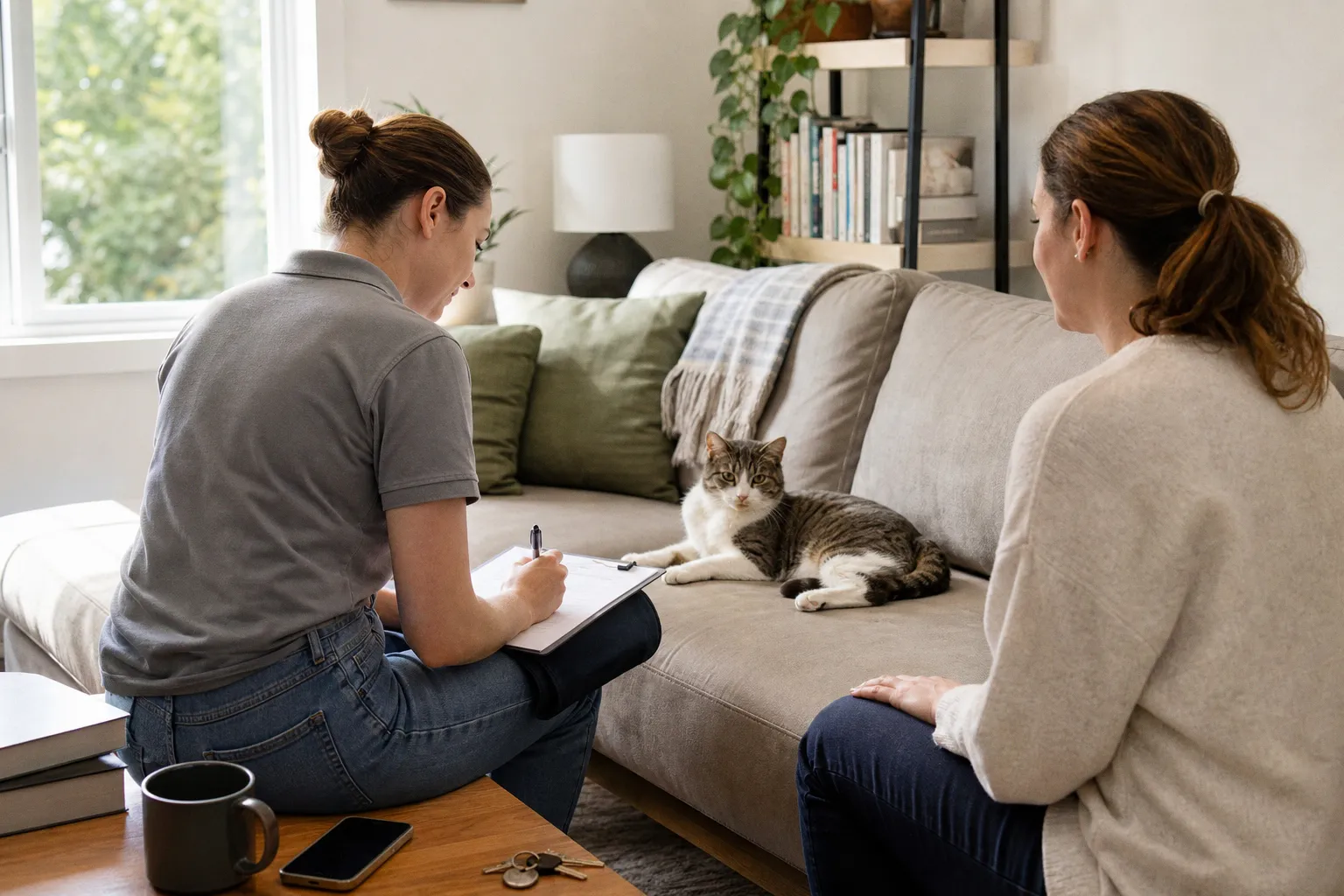
Cats conceal stress, pain, and early illness efficiently. A sitter entering an unfamiliar home works with limited observation windows, changing resource access, and a client who may be several time zones away. The service therefore needs defined milestones: intake, environmental mapping, daily observation, sanitary control, escalation, and closure.
The 2025 Pet Sitters International Global Standards frame these controls as industry baseline practices, not law. Their value is practical. They reduce ambiguity at the point where small omissions become welfare or liability incidents.
Milestone 1: Complete the intake before accepting the assignment
A professional cat sitting service does not begin with a booking form. It begins with an in-home consultation.
Remote onboarding can establish availability and basic compatibility. It cannot verify the home’s access points, resource layout, escape routes, medication storage, or the cat’s actual response to an unfamiliar person. The consultation is a field assessment. Conduct it before accepting the job, not during the first paid visit.
Build one maintained profile for each cat. Multi-cat households are not one case with several names. Each animal has a different gait, appetite pattern, litter-box use, hiding preference, medication exposure, and tolerance for handling.
The profile should document:
- Full identification: name, age or life stage, sex, color and markings, microchip status where known, and a current photo.
- Veterinary information: primary clinic, emergency clinic, regular veterinarian, known diagnoses, medication instructions supplied by the client or veterinarian, and transport authorization.
- Feeding mechanics: food type, measured portion, meal timing, treats, water preferences, feeding location, and whether food access must be separated.
- Elimination baseline: usual litter type, box location, scooping routine, normal stool and urine pattern, prior house-soiling history, and mobility limits affecting box access.
- Behavior under stress: hiding sites, defensive signals, handling tolerance, known triggers, play preferences, safe lure methods, and escape behavior.
- Home operations: alarm procedures, key custody, Wi-Fi-dependent equipment, cameras disclosed by the client, breaker panel location if relevant, water shutoff, and emergency contacts.
- Household hazards: toxic plants, openable windows, balcony access, construction activity, automatic feeders, loose strings, rodent poison, and rooms that must remain closed.
Written service terms must match the actual assignment. Specify visit windows, scope of work, pricing, cancellation terms, update procedures, veterinary-consent arrangements, and the response path for emergencies. A client who says “do whatever is necessary” has not created a usable authorization. The document must identify who can approve care, how funds are accessed, and what happens if the client cannot be reached.
The access test is not optional
Keys, lockboxes, garage codes, and smart locks are operational dependencies. Test them during the consultation. A code that works only when the client is nearby is not a system. It is a future access failure.
Record a backup entry method. Record who holds duplicate keys. Record whether a building concierge, neighbor, or property manager can interfere with access. Then verify whether that person has actual authority to release entry.
A cat sitter is not evaluating whether a home is tidy. The sitter is identifying how the cat’s routine fails when the owner is absent.
Milestone 2: Map the feline environment, not just the feeding station
Feline environmental enrichment is often reduced to toys. That is incomplete. The environment is a resource network: food, water, toileting, resting sites, vertical territory, scratching surfaces, play opportunities, and scent continuity.
AAFP and ISFM feline environmental guidance organizes this work around five pillars. For a sitter, the framework converts directly into a visit routine.
| Environmental pillar | What the sitter assesses | Operational failure to prevent |
|---|---|---|
| Safe places | Covered beds, quiet rooms, under-furniture retreats, elevated perches | Pulling a fearful cat from concealment or blocking its preferred retreat |
| Multiple and separated resources | Food, water, litter, scratching, beds, and access routes | Competition, ambush behavior, and resource guarding in multi-cat homes |
| Opportunity for play and predatory behavior | Toy type, play tolerance, food puzzles used by the household | Forcing interaction or leaving unsafe toys accessible without supervision |
| Positive, predictable human interaction | Approach distance, touch tolerance, play sequence, end-of-visit routine | Escalating fear through direct pursuit or prolonged handling |
| Respect for scent | Bedding, scratching posts, familiar resting zones, cleaning products | Removing familiar scent cues or using strong fragrances during service |
The central principle is separation. A water bowl beside a litter box is not simply poor aesthetics. It can reduce water use. A feeding station placed in a corridor where another cat can block passage can produce conflict without any overt fight. A litter box behind a closed utility-room door can become inaccessible after a household member changes the door position.
Walk the route each cat uses. Start at the resting area. Follow access to water, food, litter, and vertical retreat. Note pinch points: narrow hallways, stair landings, doorways, and blind corners. These are the locations where one cat can control another cat’s movement.
In multi-cat homes, do not assume proximity means affiliation. Cats may share a room while avoiding one another’s resources. Watch for delayed feeding, waiting behavior, rapid exits after litter-box use, or one cat occupying the only elevated perch. These are load-distribution problems in the household environment: too much traffic directed through one resource or one route.
Preserve routine before adding enrichment
A sitter’s first task is continuity. Do not rearrange furniture, replace a familiar litter substrate, introduce a new food puzzle, or begin intensive interactive play because it appears enriching in theory. A change can add stress during an already altered social routine.
Use the equipment the cat already understands. If the client has established a wand-toy routine, match its duration and sequence. If the cat reliably retreats after eating, allow the retreat. Predictability has a regulatory function.
For cats with known separation-related distress, the visit plan should define observable indicators rather than promise emotional outcomes. Track food intake, litter output, vocalization reported by neighbors where relevant, hiding duration, interaction threshold, and any destructive or escape-directed behavior. Feline stress management is measurement first. Interpretation second.
Milestone 3: Build the visit around observation, then intervention
There is no universal number of daily cat-sitting visits that fits every case. Age, health, medication schedule, social behavior, environmental risks, and the duration of owner absence determine the interval. A healthy adult cat in a stable home does not have the same monitoring requirement as a kitten, a diabetic cat, a cat with chronic kidney disease, or a cat with a history of urinary obstruction.
The cat sitter visit routine should follow a fixed order. Random task sequencing produces missed observations.
1. Entry and containment. Enter slowly. Close and verify the primary door before placing bags down or opening interior doors. Scan for the cat before moving items. Do not assume a cat is “missing” because it is not visible within the first minute.
2. Visual whole-cat assessment. Observe posture, mobility, respiratory effort, coat condition, alertness, eye discharge, and willingness to move. Watch the cat walk when possible. Gait analysis does not require a diagnosis. It identifies deviation from baseline: shortened stride, reluctance to jump, asymmetric loading, stiffness after rest, or a guarded hind limb.
3. Resource check. Confirm water availability and condition, food consumption relative to the plan, litter-box output, room temperature conditions where relevant, and access to all required areas. Check that automatic devices are functioning, but do not treat them as proof that feeding occurred.
4. Hands-on tasks. Feed, refresh water, scoop litter, administer only client- and veterinarian-directed medication within the sitter’s competence and authorization, and complete approved enrichment. Maintain the cat’s preferred distance. Handling is not a performance metric.
5. Final perimeter sweep. Recheck windows, balcony doors, exterior doors, appliance doors, and rooms designated as off-limits. Confirm the cat’s location if it is safe to do so. Then secure the home.
The sequence matters because food and litter data are clinical signals. If the sitter begins by cleaning, topping up bowls, and moving boxes, the baseline is erased before it is recorded.
What to record on every visit
A professional update is not a photo with a reassurance sentence. It is a short operational report. The client needs enough information to recognize continuity. The sitter needs enough information to detect drift across visits.
Record:
- Arrival and departure time.
- Food offered and observed consumption where measurable.
- Water refreshed and any abnormal contamination or spill.
- Urine and fecal output observed, including absence of expected output when relevant.
- Vomit, diarrhea, blood, inappropriate elimination, or damaged household items.
- Cat location, posture, mobility, and interaction level.
- Medication administered, withheld, refused, or impossible to administer, with the exact reason.
- Environmental faults: feeder malfunction, HVAC issue, water leak, inaccessible resource, broken screen, or access problem.
- Actions taken and client notification time.
Avoid declaring “everything is fine” if the observation record says only that the cat was not seen. A cat that remains hidden may be following its normal pattern. It may also be ill, injured, trapped, or highly stressed. The profile determines which interpretation is plausible. When the profile is insufficient, the uncertainty itself is the finding.
Observation without a baseline is surveillance. Observation against a baseline is care.
Milestone 4: Treat litter-box management as sanitation and clinical monitoring
Litter care is one of the highest-value tasks in professional cat sitting. It affects hygiene, resource access, household odor, client trust, and early detection of health changes.
For a single-cat home, feline guidance supports two litter boxes in separate locations. In multi-cat homes, the common rule of thumb is one box per cat plus one additional box. This is a starting configuration, not an absolute formula. Social relationships, mobility, box size, privacy, and floor plan determine whether the available boxes function as usable resources.
A technically adequate litter setup can still fail if:
- One box is located beside a loud appliance or furnace.
- A covered box traps odor and discourages a particular cat.
- A senior cat must climb stairs to reach the only available box.
- One cat can ambush another at the exit.
- A box is too small for the cat to turn without contacting soiled litter.
- The sitter places a clean box in a new location during the owner’s absence.
Remove waste at least daily. In many active or multi-cat households, a single daily scoop may be insufficient for the existing load. Follow the client’s established schedule, then document any condition that prevents normal use. Full box washing is generally performed every one to four weeks with soap and hot water. Strong fragrances and ammonia-based cleaning products are poor choices around feline toileting areas.
The sitter should not diagnose urinary disease or gastrointestinal disease from litter observations. The sitter should recognize deviation and escalate it. Small, frequent urine clumps; straining; vocalization during elimination; no observed urine where output is normally visible; repeated box entry; or blood require immediate communication and veterinary-direction escalation. A male cat with suspected urinary obstruction is not a “monitor until morning” scenario.
Resource management in multi-cat households
Feeding and litter procedures need individual attribution. If two cats share a bowl, “both ate” may be an assumption. If three cats use one heavily soiled box, “normal output” may be impossible to assign.
Use the least disruptive monitoring method available:
- Feed in established separate locations if the household already uses them.
- Photograph or log portion levels before refresh when intake is a concern.
- Keep each cat’s medication, food, and instructions physically separated.
- Observe post-feeding movement. A cat walking away from food may be finished, displaced, nauseated, or unable to access the station.
- Do not close a cat into an unfamiliar room simply to obtain data unless the client has established that routine and the cat tolerates it.
The objective is not perfect information. It is reducing ambiguity without increasing stress.
Milestone 5: Define clinical escalation before there is an incident
A sitter does not diagnose, prescribe, force-feed, or alter medication. The sitter recognizes threshold events, preserves useful information, contacts the designated party, and transports only within the written authorization and safety plan.
Loss of appetite is a high-priority variable. Cornell’s Feline Health Center notes that sustained appetite loss can severely affect a mature cat in as little as 24 hours. For kittens younger than six weeks, 12 hours without food can be life-threatening. A sitter should not wait for a vague “tomorrow might be better” decision if a cat is refusing food and the pattern is outside baseline.
The escalation tree should be written in advance:
1. Identify the deviation. What changed from the profile: intake, output, breathing, gait, consciousness, behavior, access, or environmental safety?
2. Stabilize the scene. Prevent escape. Remove immediate hazards only when this can be done safely. Do not chase a frightened cat or attempt risky restraint.
3. Document objective facts. Time observed, photos or video where appropriate, food amount remaining, litter findings, medication status, and environmental conditions.
4. Notify according to the authorization chain. Contact the client, emergency guardian, and veterinary provider in the sequence defined by the agreement. Leave concise, time-stamped messages.
5. Follow veterinary direction. Transport or continue monitoring only as directed and authorized. Record every action, instruction, and expense.
6. Maintain continuity. If the primary sitter is incapacitated or delayed, activate the backup sitter plan. The backup must have access credentials, pet profiles, and authority boundaries before the assignment begins.
The home should also have a contingency protocol for weather disruption, power loss, evacuation, sitter injury, lost keys, and household damage. These are not rare theoretical events. They are predictable service interruptions. A plan that exists only in the owner’s text thread is not a contingency plan.
Milestone 6: Control cross-home contamination and business exposure
A cat sitter moves between environments. That movement carries biosecurity risk. The risk is not limited to visible illness. Litter dust, fecal material, respiratory secretions, contaminated footwear, carriers, and reusable equipment can transfer between homes.
Use a defined hygiene sequence. Handwashing should occur on arrival when practical, before food or medication handling, after litter care, and before leaving. Clean and disinfect reusable equipment according to the product’s directions and the material being treated. Use footwear protocols appropriate to the route and household requirements. If a communicable disease concern is identified, alter visit order and communicate the control plan to affected clients as needed.
Do not improvise from one contaminated home to the next. Equipment management needs separation:
- Carry dedicated waste bags, disposable gloves, hand hygiene supplies, and clean feeding tools.
- Avoid using client food scoops, bowls, or towels in another home.
- Do not transport cats in a shared carrier unless it has been appropriately cleaned and the transport is authorized.
- Keep soiled footwear and used protective items away from clean supplies.
- Document exposure concerns and follow the client communication protocol.
Professional liability safeguards are equally concrete. Pet-sitting-specific general liability insurance, including care, custody, and control coverage, addresses a category of risk that generic business coverage may not. Current pet first-aid and CPR training supports initial response competence. Neither insurance nor certification replaces case assessment, clear scope limits, or veterinary authority.
Certification can demonstrate structured knowledge of feline behavior, body language, dietary needs, litter techniques, illness recognition, medication handling, household hazards, escape prevention, safe transport, and consultation procedures. It does not establish competence for every complex medical, behavioral, or end-of-life case. Refer rather than overextend.
The operating standard: predictable, documented, cat-specific
High-standard cat sitting is not built on longer messages, more toys, or a polished booking page. It is built on controlled variables.
The sitter should be able to answer, at any point in an assignment:
- Is each cat’s current behavior compared against an individual baseline?
- Are food, water, litter, rest, vertical access, and retreat spaces usable without conflict?
- Is the visit sequence preserving observations before it changes the environment?
- Is the written emergency authority specific enough to act without delay?
- Can a backup sitter enter the home and continue the plan without reconstructing it from messages?
- Are sanitation and cross-home biosecurity procedures active, not assumed?
- Has every deviation been documented, communicated, and escalated at the correct threshold?
These are the professional cat care milestones that matter. The cat does not need a sitter to create a new lifestyle during the owner’s absence. It needs stable resource access, low-friction handling, sanitary conditions, accurate observation, and fast escalation when baseline breaks.