Pet emergency details to collect before sitting starts
Here's a scenario that plays out more often than anyone in this industry wants to admit. A pet sitter finishes a routine drop-in, walks into the kitchen, and finds the Labrador has torn into a forgotten bag of dark chocolate on the counter.
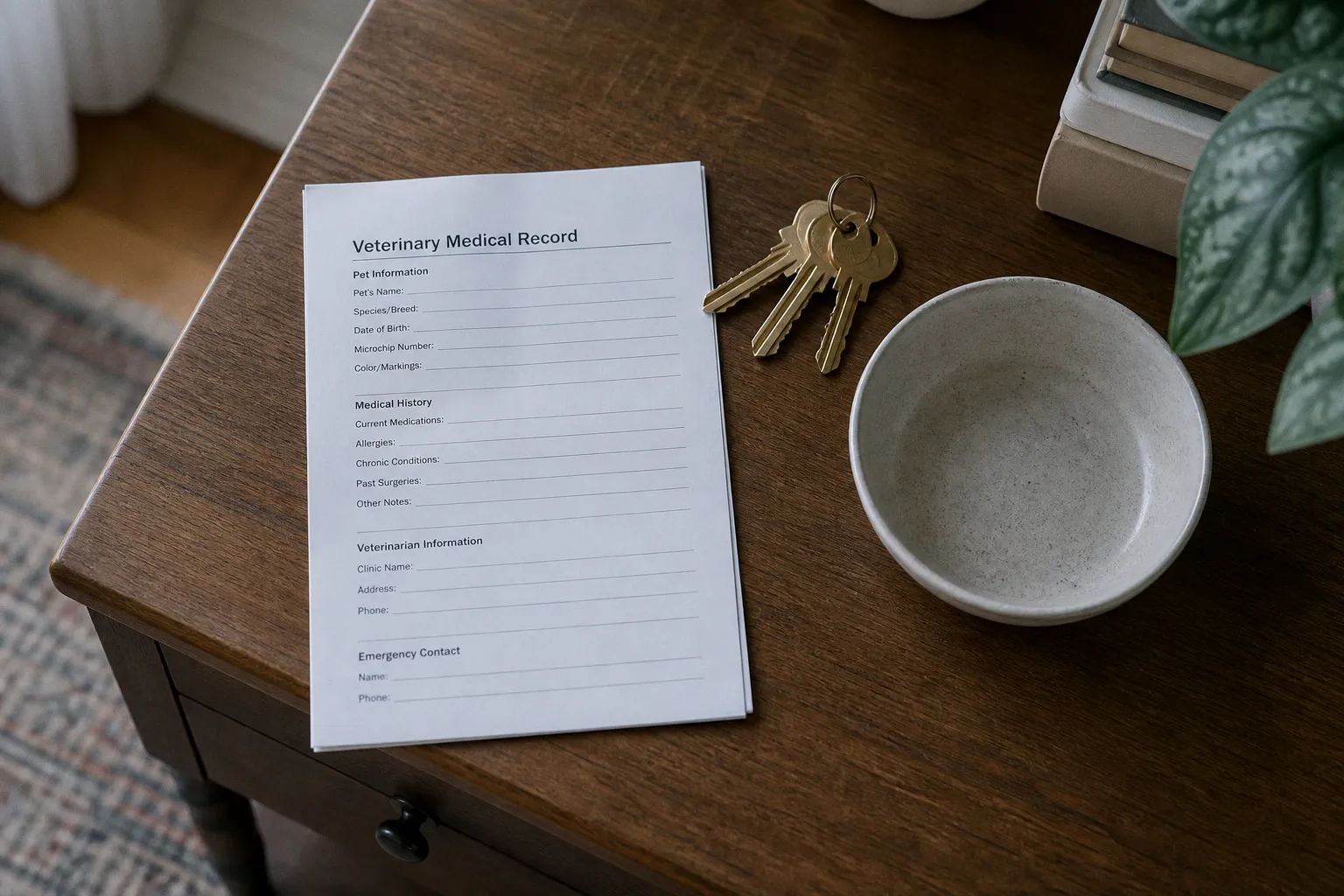
The dog's heart rate is elevated. Tremors are starting. The sitter loads the dog into the car and rushes to the nearest emergency clinic. At the intake desk, the staff asks who is authorized to approve treatment, how the bill will be paid, and whether the dog has any relevant medical history. The sitter has a key to the house, but no written authorization. The owner is on a flight with the phone in airplane mode.
That does not automatically mean a clinic will refuse to help. Emergency hospitals and veterinary practices handle authorization differently, and the rules affecting consent, disclosure, and payment can vary by state, province, country, and individual clinic. A practice may begin stabilizing care while trying to reach the owner; another may require specific documentation before proceeding with more extensive diagnostics or treatment. The point is not to predict what every clinic will do. The point is to avoid discovering the clinic's policy while an animal is already in distress.
This is the part of pet sitting nobody puts on the brochure. The cute dog pictures on Instagram don't show the twelve hours of vomiting you might manage alone in someone else's bathroom, or the moment a veterinary technician asks for a medication list you cannot find. The romantic version of the job — long walks in the park, sweet videos for the client — skips the part where you're the only adult in the room when something goes sideways.
The job of a pet sitter isn't just cuddling. It's being the person who already found the information when the crisis hits.
A pet sitter emergency info checklist isn't a nice-to-have. It is the difference between a workable crisis and a preventable scramble. Before the first visit, you need more than the owner's name and the Wi-Fi password. You need a usable emergency network: permission that the clinic can evaluate, a payment plan that does not depend on your personal credit card, a medical history that can be handed over in seconds, and supplies you can actually locate in the house.
Navigating veterinary authorization and medical privacy laws
The most common mistake is assuming that a verbal “just do what you need to do” answers every legal and operational question. It may help establish the owner's wishes, but it may not satisfy a clinic's consent process. Veterinary practices set their own policies within the laws and professional rules that apply where they operate. Some accept a signed veterinary release form for pet sitters. Some want the owner to complete the clinic's own authorization form. Some require a phone conversation, a credit card on file, or confirmation from a previously listed agent. Others may limit what a sitter can approve even when a general release is signed.
The practical answer is simple: ask the primary veterinarian and the likely emergency hospital what they require before the owner leaves.
Do not treat “the owner gave me permission” as a universal legal category. Ask specific questions:
- Can the sitter consent to examination, diagnostics, hospitalization, surgery, and medication?
- Is there a difference between permission to transport the pet and permission to authorize treatment?
- Does the clinic require its own form, or will it accept the owner's written authorization?
- Can the practice discuss the pet's medical history and treatment plan with the sitter?
- What happens if the owner cannot be reached and the animal needs urgent care?
- Is there a separate policy for euthanasia, and who may authorize it?
- Does the form expire after a particular date or apply only to a specified sitting period?
Medical privacy is also not one single rule that works the same way everywhere. Veterinary records may be governed by local law, professional obligations, clinic policy, and the terms under which the records were created. A practice might be comfortable sharing information with a designated caretaker, but it may still ask for proof of the owner's identity or a signed release before discussing non-emergency details. A sitter who has been given keys to a house is not automatically entitled to every veterinary record.
The release form should be specific enough to be useful without pretending to replace local legal advice. At minimum, it should identify:
- The pet by name, species, breed or description, age, and microchip number if available
- The legal owner and the sitter or agency acting as the designated caretaker
- The dates covered by the authorization
- Permission to transport the pet for veterinary evaluation
- The types of care the sitter may approve, from examination and testing to hospitalization and procedures
- The owner's instructions for situations in which the owner cannot be reached
- Any limits on euthanasia decisions, including the person who must be contacted
- Permission for the clinic to share relevant updates with the designated caretaker
- The owner's signature, printed name, reliable contact details, and date
A form is not magic. It does not guarantee that a clinic will interpret every clause as sufficient, and it does not eliminate the need to call the owner when the owner is available. Its value is that it gives the clinic a clear starting point and gives the sitter something more useful than a text message sent three months earlier.
If the client uses a veterinary practice regularly, ask the owner to place the sitter's name and phone number in the pet's file. For a longer house sit, ask whether the emergency hospital can receive the authorization in advance. Keep a copy in a secure cloud folder and on the phone used for the job. A screenshot buried in someone's email thread is not a backup plan. It is a hope.
The same caution applies to forms downloaded from the internet. A generic veterinary release form may be a helpful conversation starter, but the clinic may use different terminology or require additional information. If the authorization includes a sensitive decision such as euthanasia, a significant spending limit, or permission to approve invasive treatment, the owner should understand exactly what they are signing. When local requirements are unclear, the owner should ask the clinic or obtain advice from a qualified local professional rather than expecting the sitter to interpret the law.
Establishing financial boundaries before the clock starts
The financial conversation has to happen at intake, not at discharge. Emergency care can involve an examination, imaging, laboratory work, hospitalization, surgery, medications, and repeated updates. The cost depends on the condition, the location, the treatment plan, and the hospital's policies. A sitter should never promise an open-ended budget based on a vague instruction such as “do whatever is necessary.”
Two pieces of information need to be settled in writing:
1. A spending limit or decision structure. The owner may authorize care up to a stated amount, approve particular categories of treatment, or identify the person who can authorize additional expenses. The number is a client decision, not an industry-standard threshold. What matters is that the sitter knows when they may proceed and when they must escalate.
2. A payment mechanism already in place. The owner can ask the clinic about a card on file, a deposit, direct billing, pet insurance procedures, or another arrangement the hospital accepts. The sitter should not be expected to put an unpredictable emergency bill on a personal card and negotiate reimbursement later.
A spending cap also needs a process for what happens when the cap is reached. If the owner authorizes care up to a certain amount, does that include the initial exam only, or does it include overnight monitoring? Can the sitter approve stabilization while waiting for a call? Who decides if the pet needs transfer to another facility? These details sound fussy until the hospital is asking for an answer and the owner's phone keeps going to voicemail.
The owner should also provide:
- The preferred method of payment and the name of the person authorized to use it
- Any pet insurance information, including policy or claim details if applicable
- Whether the sitter may pay a small transport or examination charge and seek reimbursement
- The backup decision-maker's spending authority
- Instructions for communicating estimates, invoices, and medical records
- A clear statement that the sitter is not personally responsible for costs the owner has authorized
That last point is not a substitute for a contract or legal advice. It is a prompt to put expectations on paper. A pet sitting agreement can explain who is responsible for veterinary charges, how the sitter will be reimbursed, and what happens if the owner cannot be contacted. It should not be written as though a clause automatically overrides a clinic's payment policy.
Money conversations feel transactional until you're on the phone at 11 p.m. trying to explain to a stranger why their dog needs treatment and nobody knows who can approve the bill.
Before the job begins, call the clinic if the owner has arranged anything unusual. Confirm that the staff can locate the pet's account, identify the authorized contact, and explain the payment process. The written authorization in your folder and the information in the clinic's system should agree. If they do not, the discrepancy will surface at the worst possible time.
Building an emergency contact network that works
A list of names is not an emergency network. A useful network has people who answer, know what they are authorized to do, and can act in the place where the pet actually is.
The primary veterinarian is more than a clinic name. Record the full address, main phone number, after-hours instructions, and the name of a veterinarian or technician familiar with the animal if the owner has one. Ask whether the practice provides urgent appointments and what it recommends outside business hours. A regular clinic may have the pet's history but no overnight service, while an emergency hospital may be open around the clock but unfamiliar with the animal.
The closest appropriate emergency clinic is not always the facility closest to the owner's house. It should be selected based on the sitter's route, the pet's location during the sitting period, opening hours, and the kind of care available. Map the route in advance and note practical details: parking, entrance location, whether the hospital accepts walk-ins, and whether a second facility is needed for emergencies involving exotic species or specialty treatment. Drive times change with traffic, weather, road closures, and the time of day.
An animal poison service can be useful for ingestion events, toxic exposures, and dosing questions involving hazards such as chocolate, xylitol, lilies, grapes, rodenticide, and human medications. In the United States, the ASPCA Animal Poison Control Center can be reached at 1-888-426-4435; consultation fees may apply. The owner may have a preferred poison service or local resource, so record that information too. A poison hotline is not a replacement for emergency veterinary care when the animal is collapsed, seizing, struggling to breathe, or showing other severe signs.
A secondary local contact is the person who can act when the owner is genuinely unreachable. This might be a neighbor with a spare key, an in-town relative, a co-owner, or another person named in the pet's records. Do not assume that being related to the owner means being authorized to make decisions. Get the person's full name, phone number, location, relationship to the pet, and written authority.
The network should also include the sitter's own operational contacts. If the sitter works for an agency, record the manager or on-call supervisor. If another walker may cover the route, include that person's number. For a dog walker, the dog walker emergency protocol should specify who transports the animal, who calls the owner, who stays with the other pets, and who documents the incident. One person cannot safely drive, restrain a frightened animal, speak to a clinic, and send a complete update at the same time.
Keep the contact sheet short enough to use under pressure. For each contact, include:
- Name and role
- Primary and alternate phone number
- Time zone or likely availability
- What the person is authorized to do
- Whether the person has access to the home
- The last date the information was confirmed
A contact who changed numbers last year is not a backup. Neither is an owner who says, “My sister knows everything,” without giving you the sister's phone number.
Compiling the pet's medical identity and history packet
When a dog or cat arrives at an emergency clinic without history, the staff has to work from observation and whatever the sitter can remember. Sometimes that is enough. Sometimes it means delaying a decision while the team tries to identify medications, prior reactions, or the animal's normal behavior.
The medical packet should include:
- Microchip number and registry, if the pet has one
- Current identification details, including a recent full-body photo
- Primary veterinarian and relevant specialist contacts
- Chronic conditions and previous diagnoses
- Current medications, with exact dose, route, frequency, and last time given
- Known allergies and previous adverse reactions to medications or anesthesia
- Past surgeries, hospitalizations, and significant injuries
- Recent laboratory results or treatment instructions the owner has been given
- Vaccination and preventive-care records, when available
- Insurance information and the owner's preferred emergency-care instructions
- Feeding restrictions, seizure logs, diabetic routines, or other condition-specific notes
Vaccination records deserve careful wording. The owner should provide whatever records are available, especially rabies documentation where it is relevant to local animal-control and public-health requirements. But there is no universal rule that every clinic will refuse admission without proof of vaccination, and a pet with incomplete records is not automatically subject to quarantine. Requirements can depend on the jurisdiction, the animal's exposure history, whether a bite or scratch occurred, the animal's clinical condition, and the instructions of local public-health or animal-control authorities. If the pet has an unclear history, ask the regular veterinarian what documentation should travel with the animal and ask the emergency clinic how it handles an unverified record.
The same applies to a bite-risk animal. A clinic may use its own safety protocol, require restraint, separate the animal from other patients, or contact authorities if a reportable incident has occurred. Those are case-specific decisions. The sitter's job is to describe the facts accurately: what happened, when it happened, whether skin was broken, what the animal's vaccination records show, and how the animal behaves during handling. Do not promise an outcome based on a general assumption about quarantine or admission.
Behavioral information is medical information in practice, even when it does not appear in a diagnosis field. A dog that has historically required a muzzle at the vet is not the same intake as a friendly Labrador. “She's a rescue, just take it slow” is not enough. “She was muzzled for her last three visits, becomes defensive when her feet are touched, and was prescribed pre-visit medication by her veterinarian” is useful.
Record the details that affect handling:
- Fear, aggression, panic, or escape behavior
- Whether the pet tolerates a muzzle, carrier, restraint, or nail handling
- Triggers such as feet, ears, strangers, loud equipment, or separation
- Previous sedation or medication reactions
- The safest way to move the animal when injured
- Whether the pet may bite when painful, even if normally gentle
A medical packet that omits behavior is incomplete. The clinic needs to know not only what the animal has been diagnosed with, but how that animal may respond when frightened or in pain.
Make the packet readable at a glance. A long exported medical record can be stored as supporting documentation, but the first page should answer the questions a triage nurse asks immediately: Who is this animal? What is wrong with it normally? What medication does it take? What must staff avoid? Who can approve care? Who pays?
Placing emergency gear where it can actually be used
Walk into the home on day one and do not assume anything is where the owner said it would be. Walk in and find it yourself, hands-on.
Ask the owner to demonstrate the carrier, crate, harness, medication routine, and any equipment used for a chronic condition. Open the carrier. Test the latch. Check whether the harness still fits. Look at the medication label rather than relying on memory. An emergency plan built around equipment nobody can operate is not a plan.
Locate and confirm access to:
- A carrier or crate sized appropriately, with a door that opens and latches cleanly
- A spare leash and harness within reach of the exit
- A collar with current identification tags, plus a backup if one exists
- A pet first-aid kit with gauze, self-adhering wrap, tweezers, wound-cleaning supplies, saline, disposable gloves, and a digital thermometer
- Towels, a blanket, and a way to secure the animal during transport
- Food and water, including any diet-specific supplies
- Required medications, dosing syringes, pill pockets, refrigeration instructions, and written schedules
- Cleaning supplies and waste bags for vomiting, diarrhea, or contamination
- A flashlight and a charged phone power bank if the sitter may be traveling at night or during a power outage
First-aid supplies are for temporary support, not home treatment of a serious condition. Do not improvise with human pain medication, induce vomiting without professional direction, or apply a medication that was not prescribed for that animal. The emergency information should say which veterinary service to call when a situation is uncertain. A sitter's confidence is not a diagnostic tool.
The medication supply window is another detail owners routinely underestimate. “There are meds on the counter” may mean there is one dose on the counter. Ask how much is available, when the prescription runs out, which pharmacy fills it, whether the medication needs refrigeration, and what to do if a dose is vomited or missed. For insulin, seizure medication, cardiac drugs, steroids, and other time-sensitive treatments, include the prescribing veterinarian's instructions and a contingency plan for a delayed flight, road closure, or extended stay.
Do not move essential supplies to a place where the owner cannot find them later. Instead, agree on one known location and label it. The emergency summary should say where the carrier, medical packet, medications, and spare keys are kept. If another person may need to enter the home, the arrangement should account for security and privacy as well as speed.
Turning the information into a working system
Paperwork is not a stack. It is a system that has to work when your hands are full and your attention is divided.
Build one emergency file for each pet with a first page containing the essentials:
1. Pet name, description, microchip number, and current photo
2. Owner and backup contact information
3. Primary veterinarian and emergency clinic details
4. Medication list, allergies, chronic conditions, and handling warnings
5. Authorization status and where the signed form is stored
6. Spending limit or decision instructions
7. Payment information and insurance details
8. Home access information and the location of emergency supplies
Keep a digital copy in a secure, password-protected location and a printed copy in the home. The sitter should be able to reach the digital file from a parking lot, but the backup contact should be able to find the printed summary if the sitter's phone is lost or dead. Do not store sensitive medical or payment information in an unsecured group chat. Share only what each person needs to perform their role.
Run the plan before the first real emergency. Ask the owner to walk through a few plausible situations:
- The pet vomits repeatedly but is still alert.
- The dog eats an unknown object.
- The cat cannot urinate.
- A medication dose is missed.
- The pet bites someone or is bitten.
- The owner cannot be reached for several hours.
- The regular clinic is closed and the emergency hospital needs payment confirmation.
The purpose is not to turn a sitter into a veterinarian. It is to expose missing information. If the owner cannot explain who may authorize care, where the records are, or how the clinic will be paid, the job is not ready to begin.
At the end of the intake, confirm the date. Vaccination records, phone numbers, medication supplies, and payment arrangements change. Recheck them before repeat sits, especially after a diagnosis, a new prescription, a move, a change in ownership, or a difficult veterinary visit.
A professional pet sitter emergency info checklist should make the first ten minutes of a crisis less chaotic. It cannot guarantee a particular medical outcome, force a clinic to accept a form, or replace veterinary judgment. What it can do is remove avoidable uncertainty: who the pet is, what the pet needs, who can decide, where to go, and how the care will be paid for.
That is the standard worth setting before the first walk, not after the first emergency. Collect the authorization. Confirm the clinic's policy. Write down the medical history. Put the carrier by the exit. Test every phone number. Then do the work that separates a prepared sitter from a hopeful one: review the system with the owner while everyone is calm. When something goes sideways, calm will not be guaranteed. The information can be.