Pet sitter vet release forms: avoiding financial traps
A signed veterinary release form does not guarantee treatment, clinic acceptance, or protection from an unpaid bill. It only establishes that the pet sitter may act as the owner’s agent when the owner cannot be reached.
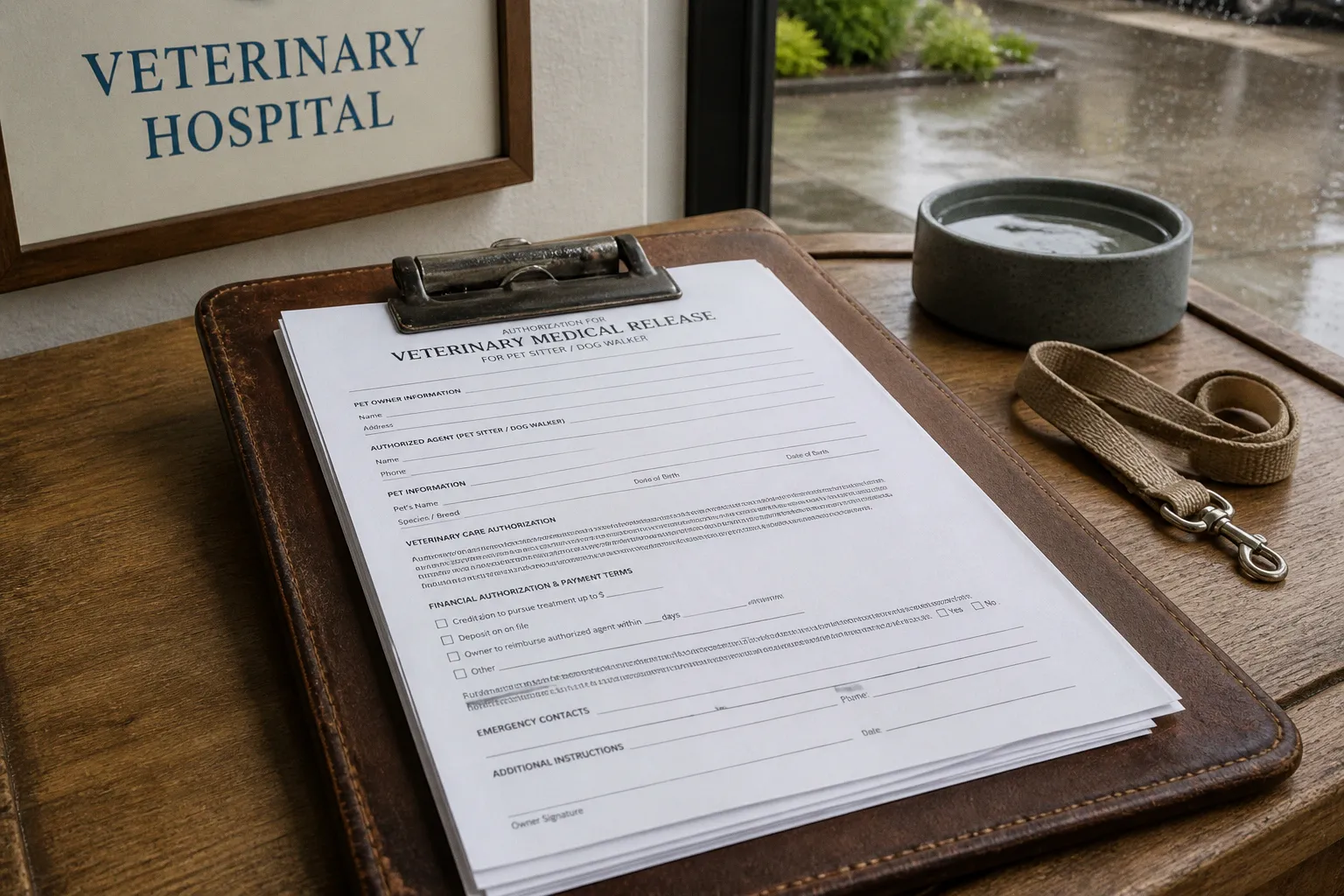
The financial and operational terms determine whether that authority works under pressure.
The most expensive pet sitter vet release form mistakes are usually administrative. The owner signs a generic document. The sitter keeps a photograph on a phone. The veterinary clinic has no record of the authorization. No spending limit is defined. No payment method is attached. Then an emergency occurs, and every party discovers that the form answers the least important question: who may call the veterinarian.
A functional release protocol must answer four others:
- Which treatment may the sitter authorize.
- How much may be spent without additional approval.
- Who pays the clinic at the time of service.
- What happens if the owner remains unreachable during a critical decision.
What a veterinary release form actually authorizes
A veterinary release form gives the pet sitter, dog walker, or other named caregiver authority to seek veterinary treatment and make medical decisions within the scope defined by the owner. It does not transfer ownership of the animal. It does not automatically create an unlimited power of attorney. It does not force an emergency hospital to accept the form.
The document normally operates in three layers.
1. Medical access
The sitter must be able to contact a veterinary practice, emergency hospital, poison control service, or other appropriate provider. The form should identify the animal precisely:
- Registered name and common name.
- Species, breed, sex, age, and identifying features.
- Microchip number, if available.
- Current medications.
- Known allergies.
- Existing diagnoses.
- Primary veterinarian.
- Preferred emergency hospital.
- Insurance or wellness-plan information, if applicable.
A vague description such as “my dog” creates avoidable friction. Veterinary staff need to match the animal to a medical record. A microchip number and the clinic’s patient-account details are more useful than a long narrative about the dog’s temperament.
2. Treatment consent
The form should state that the authorized caregiver may consent to examination, diagnostic testing, stabilization, medication, hospitalization, and emergency procedures within the defined limits.
The language must be operational. “The sitter may make decisions in an emergency” is less useful than a tiered authorization:
- Immediate stabilization is authorized when delay could worsen the animal’s condition.
- Diagnostic procedures are authorized up to the stated financial limit.
- Hospitalization is authorized up to a defined period or cost.
- Surgery or invasive procedures require owner approval unless the veterinarian determines that delay presents a serious risk.
- The sitter may authorize treatment beyond the limit only under a separately defined emergency rule.
The owner should not attempt to prescribe treatment inside the release form. The veterinarian remains responsible for clinical recommendations. The form defines who can consent, not what the clinician must do.
3. Financial responsibility
This is the section that prevents the most serious disputes. A sitter may have authority to approve treatment but lack the ability to pay the bill. Those are separate questions.
The form must identify:
- The maximum amount the sitter may authorize.
- Whether the limit applies per incident, per day, or for the entire care period.
- The person responsible for all charges.
- The payment method available to the clinic.
- The reimbursement process if the sitter pays anything personally.
- The required documentation for reimbursement.
- What happens when the estimated cost exceeds the limit.
Without these terms, the sitter may face a choice between delaying treatment and personally accepting a large financial obligation.
A medical release creates decision authority. It does not, by itself, create a payment system.
The main pet sitter vet release form mistakes
Most failures fit a small number of predictable patterns. Treat them as a troubleshooting tree rather than as drafting details.
Mistake 1: Using a form that names the sitter but not the clinic
A document signed only by the owner and sitter may be rejected by a veterinary practice or emergency hospital. Clinics often require the owner to authorize the sitter directly on the patient account or to provide the clinic with a copy before an emergency occurs.
The reason is procedural. The clinic must determine whether the person presenting the animal has authority to consent. A document arriving at the front desk during a crisis may not satisfy the hospital’s identity, record, or payment requirements.
Correction:
1. Ask the primary veterinarian whether it accepts third-party authorization.
2. Ask how the sitter should be listed on the account.
3. Send the completed form to the clinic.
4. Request confirmation that the form has been attached to the animal’s record.
5. Repeat the process with the preferred emergency hospital.
6. Keep a current physical and digital copy with the sitter.
Do not treat a signed form as fully active until the relevant clinic has received it and explained its acceptance procedure. Some clinics may require their own form. Others may require a renewal, including quarterly renewal for certain permanent or long-term authorizations.
Mistake 2: Defining authority without defining the financial cap
A dollar limit is not decorative. It establishes the boundary between pre-approved treatment and a decision requiring additional consent.
Common structures include:
- A fixed amount per emergency, such as $500 or $1,000.
- A custom amount based on the owner’s financial capacity.
- A separate cap for diagnostics and hospitalization.
- A higher cap for immediate stabilization.
- No cap for life-preserving treatment, combined with a specified payment arrangement.
Each structure has a different risk profile.
A single low cap can prevent the sitter from authorizing necessary care. A high cap can expose the owner to an expense they did not intend to approve. A cap that does not specify the period may be interpreted inconsistently. For example, $1,000 could mean one incident, one calendar day, or the entire pet-sitting assignment.
The form should use a defined unit:
| Authorization term | Operational meaning | Main failure risk |
|---|---|---|
| Per emergency | Applies to one medically distinct incident | Multiple related visits may be disputed |
| Per day | Resets at a stated time or date | Hospitalization can accumulate quickly |
| Per assignment | Covers the entire booking period | A single incident may consume all authority |
| Per treatment category | Separate limits for diagnostics, medication, and hospitalization | Staff may not know which category applies |
| Custom written amount | Owner sets a specific threshold | Ambiguous wording can still delay approval |
The cap should also state whether the veterinary estimate includes examination, diagnostics, medication, hospitalization, surgery, taxes, and follow-up care. A treatment estimate may change after examination. The document should tell the sitter what to do when the estimate crosses the threshold.
Mistake 3: Assuming the sitter can pay and recover the money later
A pet sitter should not be expected to function as an emergency credit line. Reimbursement language is useful, but reimbursement after the fact does not solve a payment problem at the clinic.
The strongest arrangement is direct payment by the owner. Possible mechanisms include:
- A credit card stored on the clinic account.
- A deposit held by the clinic.
- A pre-authorized payment arrangement.
- A pet insurance process understood in advance.
- A written obligation for the owner to reimburse the sitter, combined with a defined emergency payment method.
The release should state who may use the payment method and for what purpose. If a card is on file, confirm whether the clinic can charge it when the sitter presents the animal. If a deposit is used, confirm its remaining balance and replenishment rules.
A sitter who pays personally should retain the itemized invoice, treatment estimate, discharge instructions, and proof of payment. The agreement should state the reimbursement deadline and the documents required. It should not imply that a sitter is automatically protected from liability merely because the owner signed a form.
Mistake 4: Leaving the contact sequence incomplete
“Call the owner” is not an emergency communication plan. The owner may be on a flight, in a remote area, asleep, or unable to answer an unknown number.
A robust contact sequence includes:
1. Primary owner.
2. Secondary owner or household member.
3. Authorized backup decision-maker.
4. Insurance or financial contact, if separate.
5. Primary veterinary clinic.
6. Emergency hospital.
7. Any relevant specialist.
Each person should have a name, relationship, phone number, and preferred communication channel. The owner should define how long the sitter should attempt contact before authorizing treatment within the pre-approved limit. That time must be realistic. Waiting for a response can be clinically significant when the animal has respiratory distress, severe bleeding, heat injury, toxin exposure, or suspected gastric dilatation-volvulus.
The sitter should document each contact attempt with the time, number used, message sent, and response received. This is not bureaucracy. It creates a factual record of the decision path.
Mistake 5: Ignoring end-of-life authority
A release form must address what happens if the animal is suffering, the prognosis is grave, and the owner cannot be reached. This is the most sensitive clause and one of the most operationally important.
The owner must state whether the sitter may consent to euthanasia in an extreme emergency when:
- The veterinarian determines that the animal is suffering.
- No reasonable treatment is available or delay would prolong suffering.
- The owner cannot be reached after the defined contact attempts.
- The decision is documented by the treating veterinarian.
The authorization should be explicit. Silence does not provide a clear instruction. Some owners will not grant this authority. That is acceptable, but the form should then state the alternative: stabilization, hospitalization, transfer, or continued attempts to reach the owner, subject to the clinic’s policy and payment requirements.
A sitter should never infer end-of-life permission from general treatment authority.
How to build a usable pet emergency medical release form
The best form is not the longest form. It is the one that a receptionist, veterinarian, and sitter can use without interpretation.
Identify the parties
List the legal name and contact details of:
- The pet owner.
- The authorized sitter or walker.
- Any backup caregiver.
- The veterinarian or veterinary practice.
- The emergency hospital.
For professional pet care, the agreement should identify the business entity and the individual authorized to make decisions. A company name without a specific contact person creates delay when multiple staff members are involved.
Define the care period
State the start and end dates. For recurring services, define whether the authorization remains active between visits or only during booked care periods.
Long-term authorization requires maintenance. Confirm whether the clinic imposes a renewal cycle. Some practices require periodic renewal, including quarterly renewal for certain standing arrangements. A form that was valid last year may not be attached to the current account.
Set treatment thresholds
Use separate thresholds where necessary. For example:
- Examination and diagnostics up to a stated amount.
- Medication and outpatient treatment up to a stated amount.
- Hospitalization up to a stated amount or duration.
- Surgery only with owner approval, unless delay creates an immediate serious risk.
- Emergency stabilization without delay, subject to the specified payment arrangement.
Do not make the sitter decode a paragraph of legal language while the animal is unstable. Use headings and short clauses.
Add condition-specific instructions
The form should include existing medical conditions and known risk factors. A diabetic animal, brachycephalic dog, senior dog with renal disease, or animal with a seizure history may require a different escalation route than a healthy adult.
Include:
- Medication names and doses.
- Administration schedule.
- Last known dose.
- Feeding restrictions.
- Known toxic exposures or prior reactions.
- Mobility limitations.
- Behavioral risks during handling.
- Existing directives from the primary veterinarian.
These details support triage but do not replace clinical examination.
Define payment before the booking starts
The sitter and owner should be able to answer the following without calling one another:
- Can the clinic charge the owner directly.
- Is a deposit available.
- What is the approved spending limit.
- Who pays if the limit is exceeded.
- Is the sitter allowed to pay temporarily.
- How will the sitter be reimbursed.
- Is emergency transport covered.
- Are overnight hospitalization and referral costs included.
If the answer to each question is not written down, the arrangement is incomplete.
The clinic-account problem
The pet sitting vet agreement should exist in two places: in the caregiver’s records and in the clinic’s patient file. A form carried only by the sitter may be unavailable when another person transports the animal. A form stored only at the clinic may be inaccessible to a sitter using a different emergency hospital.
Use a controlled document set:
- One current copy uploaded or delivered to the primary clinic.
- One current copy delivered to the emergency hospital.
- One physical copy with the sitter.
- One encrypted digital copy available offline.
- One copy retained by the owner.
- A revision date on every version.
Do not circulate several unsigned or outdated versions. If the owner changes the spending limit, contact list, insurance status, or end-of-life instruction, replace the old form at every location.
The emergency hospital may still require its own paperwork. No generic form can guarantee that a clinic will perform major surgery without contacting the owner, confirming payment, or completing clinic-specific account setup. Each hospital retains authority over its intake and consent procedures.
A practical pre-booking test
Before the first sitting assignment, the owner and sitter should perform a short administrative test:
1. Call the primary clinic.
2. Confirm that the sitter is listed as an authorized agent.
3. Ask whether the clinic can charge the owner’s payment method.
4. Ask which documents the sitter must present.
5. Call the preferred emergency hospital.
6. Confirm its after-hours intake process.
7. Verify the contact sequence.
8. Check that the spending cap is understood.
9. Confirm the form’s expiration or renewal date.
10. Give the sitter the animal’s current medical summary.
This test exposes failure points while there is time to correct them.
The release form is only one component. The working protocol is the form, the clinic record, the payment method, and the contact sequence.
What the sitter should do when an emergency occurs
A sitter needs a decision path that separates clinical urgency from administrative uncertainty. The animal’s condition determines the first action. The form determines who may consent and how payment is handled.
If the animal is unstable
Transport or call emergency veterinary services immediately when there are signs such as:
- Difficulty breathing.
- Uncontrolled bleeding.
- Collapse or loss of consciousness.
- Suspected poisoning.
- Severe heat injury.
- Repeated seizures.
- Major trauma.
- Pale, blue, or gray mucous membranes.
- Distended abdomen with retching.
- Sudden inability to stand.
Do not delay transport while searching for a perfect copy of the form. Bring the available documentation and provide the clinic with the owner’s contact details during intake.
The sitter should report observable facts, not a diagnosis. State when the signs began, what the animal was doing, what it may have ingested, known medications, and any first aid already provided. A concise timeline improves triage.
If the animal is stable but requires same-day care
Contact the primary veterinarian first if available. If the clinic cannot see the animal, use the preselected emergency hospital or urgent-care facility. Confirm the estimated cost and compare it with the authorization threshold.
If the estimate is within the limit, the sitter can consent according to the form. If it exceeds the limit, the sitter should:
1. Ask the veterinarian what treatment cannot safely wait.
2. Authorize immediate care within the approved scope.
3. Attempt the full contact sequence.
4. Ask the clinic whether the owner can approve additional costs remotely.
5. Record every decision and communication.
6. Do not personally accept an undefined financial obligation.
If the owner cannot be reached
The sitter should not treat silence as permission for unlimited treatment. Apply the written rule:
- Stabilize within the authorized scope.
- Request a written or itemized estimate.
- Ask the veterinarian to identify the time-sensitive component.
- Use the defined spending cap.
- Follow the euthanasia clause only if its conditions are met.
- Escalate to the backup decision-maker.
- Preserve all records.
A generic emergency authorization is not a substitute for a clinical assessment. The veterinarian determines medical necessity. The sitter operates within the owner’s delegated authority and the clinic’s procedures.
Special risks for dog walkers and short visits
Dog walkers often have less information than overnight sitters. The service may last only thirty minutes, but the walker can still become the first person to discover heat injury, trauma, toxin exposure, or acute illness.
A dog-walking authorization should be narrower and faster to use. It should include:
- Permission to transport the dog to a named clinic.
- Emergency contact numbers.
- A pre-approved transport method.
- A defined low-cost treatment threshold.
- Instructions for injuries discovered during or immediately after the walk.
- Permission to provide basic first aid within the walker’s training.
- A payment method that does not require the walker to fund treatment personally.
The risk profile changes with environmental conditions. Thermal regulation is a primary concern during hot weather. Paw injury, exertional collapse, and respiratory compromise may develop before the owner sees any visible sign. Brachycephalic dogs, senior dogs, overweight dogs, and dogs with cardiac or respiratory disease require a more conservative escalation threshold.
The authorization should not ask a dog walker to make a complex medical decision in the field. It should authorize transport and prompt veterinary contact. The treatment decision belongs with the clinician.
Documentation and data control
Digital forms improve access but introduce version-control problems. A screenshot in a messaging thread may omit the signature page, expiration date, or payment instructions. A cloud link may be unavailable without a network connection. A paper form may be unreadable after repeated handling.
Use a consistent record format:
- Full document, not a cropped image.
- Visible signature and date.
- Visible expiration or renewal date.
- Current contact list.
- Current financial cap.
- Clinic confirmation, if available.
- Payment instructions stored separately from full card data.
- File name with the animal’s name and revision date.
Sensitive financial information should not be distributed casually. A sitter may need confirmation that a card is on file without receiving the full card number. The clinic should manage payment credentials whenever possible.
For professional services, retain incident records according to the business’s document-retention policy. Record the time of transport, clinic arrival, consent decisions, owner contacts, estimates, charges, treatment authorized, and discharge instructions. Do not alter the record after the event. Add a dated correction if necessary.
The strict safety parameters
Before a sitter takes responsibility for the animal, confirm each parameter below. A missing answer is a protocol defect, not a minor administrative gap.
- The animal is identified by name, species, age, and microchip number where available.
- The owner’s signature and date are present.
- The sitter is named as an authorized agent.
- The care period is defined.
- The primary veterinarian and emergency hospital are named.
- Both clinics have received the authorization or explained their required process.
- The emergency contact sequence contains at least one backup.
- The spending limit is stated in a defined unit.
- Stabilization authority is clear.
- Diagnostics, medication, hospitalization, and surgery are addressed separately where needed.
- The payment method is confirmed with the clinic.
- Reimbursement terms are written if the sitter may pay personally.
- The owner’s insurance information is current, if relevant.
- Medication and diagnosis information is current.
- End-of-life authority is explicit or expressly withheld.
- The form’s renewal date is tracked.
- The sitter has an accessible physical and digital copy.
- The latest version has replaced older copies.
The purpose of a pet sitter vet release form is not to create the appearance of preparedness. It is to reduce decision latency, payment ambiguity, and authority disputes when the owner is unavailable.
A reliable emergency vet authorization has four connected parts: clinical information, delegated consent, financial control, and clinic-level acceptance. Remove any one of them and the document may fail at the exact point it is needed. The safest arrangement is completed before the booking, tested with the clinic, renewed when required, and written so that a tired receptionist can apply it without interpretation.