Hydrogen peroxide for dog poisoning: when is it safe?
Every shelter I have worked in has a running file on this one. Not a literal file — a mental one, built from intake sheets and emergency notes. Dogs who arrived after swallowing something dangerous were not always harmed by the original substance alone.
Sometimes the complication came after a well-intentioned owner reached for hydrogen peroxide without calling first.
That is the entire argument against treating peroxide as a routine item in a pet first-aid kit. It is not a benign home remedy. It is a chemical intervention that irritates the stomach lining enough to trigger vomiting. In the right situation, under veterinary direction, that may be useful. In the wrong situation, it can cause serious injury, delay proper treatment, or put vomit and chemicals into the lungs.
The safe answer to “Should I give my dog hydrogen peroxide?” is not a dose pulled from memory. It is a phone call.
The Reality of At-Home Emetics: Why Veterinary Guidance Is Mandatory
The pet-care internet has turned hydrogen peroxide into a supposed emergency essential: keep a bottle nearby, administer it when a dog eats something toxic, and avoid an expensive trip to the vet. The pitch sounds practical. The problem is that “something toxic” is not a sufficient diagnosis.
The substance matters. The amount matters. The time since ingestion matters. The dog’s age, health, breathing, alertness, and ability to swallow matter. So does the possibility that the dog swallowed more than you saw, or that the product contains several ingredients with different risks.
The sequence should be:
1. Move the dog away from the substance and prevent further access.
2. Identify what was eaten, approximately how much, and when.
3. Check whether the dog is alert, breathing normally, and able to swallow.
4. Call a veterinarian or animal poison-control service.
5. Follow the instructions given, including whether vomiting is appropriate at all.
Not bottle, vomit, prayer.
Hydrogen peroxide is not a routine first-aid remedy. It is a chemical intervention that requires a professional on the line before you uncork it.
A regular veterinarian may be able to advise you. If that clinic is unavailable, the ASPCA Animal Poison Control Center can be reached at 888-426-4435, and Pet Poison Helpline at 855-764-7661. A professional can assess the substance and the dog’s condition, decide whether vomiting would help, and tell you what to do next. If peroxide is appropriate, they can confirm the product, dose, timing, and follow-up.
That call is particularly important when the person handling the dog is not the owner. A dog walker or pet sitter may have incomplete information about the dog’s weight, medications, previous ulcers, breathing problems, or chronic disease. They may also be working from an owner’s text that says, “Give peroxide if he eats anything.” That is not an emergency protocol. It is an instruction that still needs to be checked against the actual event.
A useful dog walker hydrogen peroxide emergency protocol begins with authorization, not administration: contact the owner, contact the veterinarian or poison-control service, and keep a clear record of what each professional tells you. Do not allow a panicked client, a social-media post, or a remembered dose to replace that assessment.
Calculating the Correct Dosage and Concentration for Canine Safety
If — and only if — a veterinarian or poison-control professional specifically directs you to use hydrogen peroxide, concentration and dose must be exact.
The product generally discussed for this purpose is 3% hydrogen peroxide, the standard pharmacy concentration. Stronger products, including hair developer and some beauty-supply products, are not interchangeable. A higher concentration is not a more effective version of the same treatment. It increases the risk of irritation and chemical injury to the mouth, esophagus, and stomach.
Never use an unlabeled bottle. Never assume that a product stored under a sink is 3%. Read the label.
Veterinary instructions may use a weight-based calculation, commonly expressed as 1 teaspoon, or 5 mL, of 3% hydrogen peroxide per 5 pounds of body weight, with an absolute maximum of 45 mL. That is not a standing permission to calculate and administer the dose yourself. The formula does not tell you whether vomiting is medically appropriate in the first place, and the maximum does not make peroxide safe for every dog or every ingestion.
| Question | Why it matters |
|---|---|
| Is the product actually 3%? | Stronger concentrations can cause more severe tissue irritation and are not substitutes. |
| What is the dog’s accurate weight? | A guessed weight can produce a dangerous dosing error. |
| What was swallowed? | Corrosives, petroleum products, sharp objects, and some other substances should not be brought back up. |
| When did ingestion occur? | Vomiting becomes less useful as material moves out of the stomach, while peroxide can still irritate the stomach. |
| Is the dog alert and swallowing normally? | An impaired swallowing reflex increases the risk of aspiration. |
| Has the dog already vomited? | Additional emesis may increase irritation and aspiration risk. |
| Does the dog have relevant medical history? | Ulcers, respiratory disease, recent surgery, medication use, and other conditions may change the recommendation. |
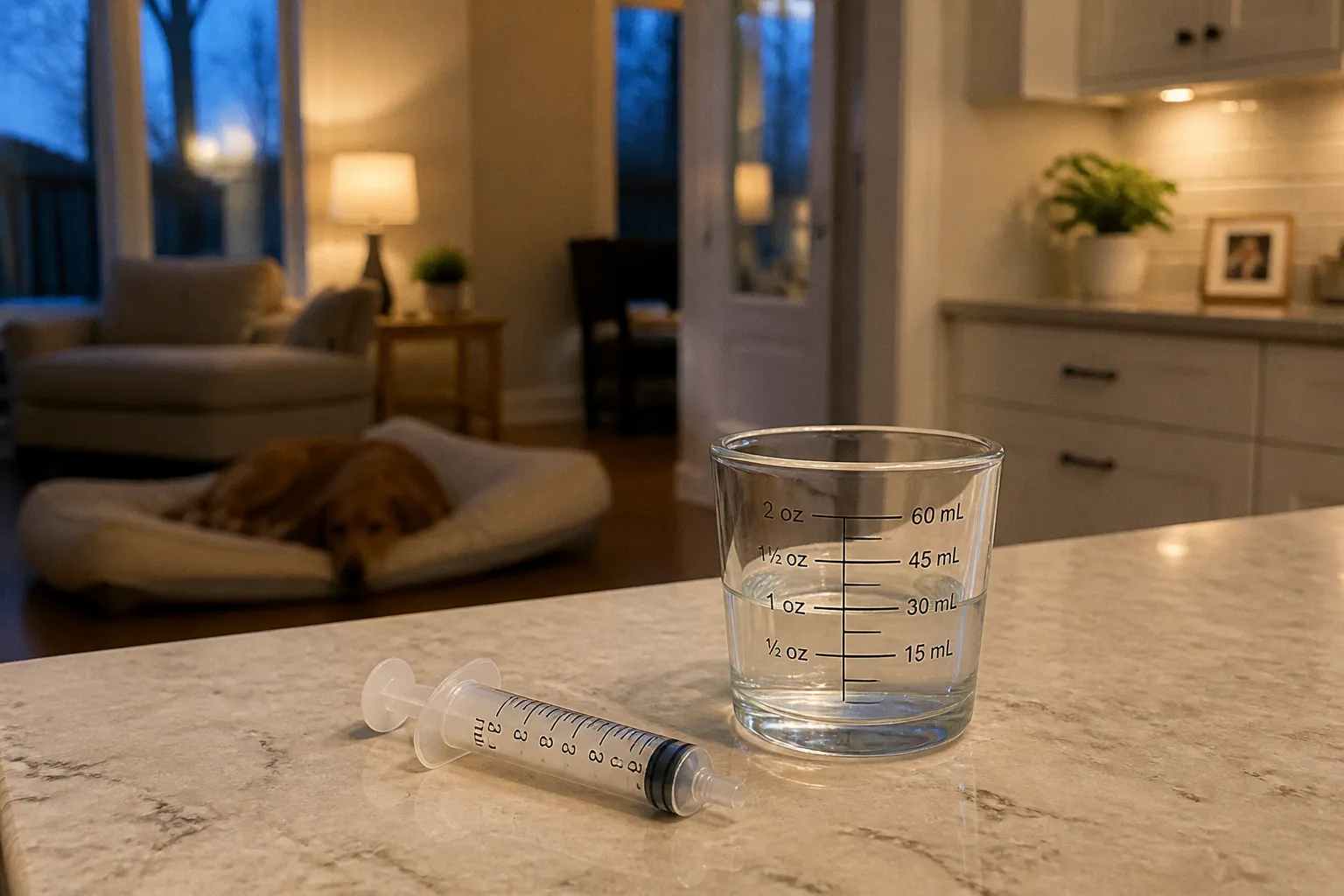
If a professional gives the instruction to administer peroxide, it should be given orally exactly as directed. A dosing syringe is easier to measure accurately than a household spoon. The liquid should not be forced directly down the throat. The dog must be able to swallow safely, and the person administering it must be able to do so without wrestling the dog into a position that encourages aspiration.
Do not mix peroxide with food, oil, salt, mustard, or other improvised emetics. Do not add more because the first dose did not produce an immediate response. Do not substitute a stronger product. If the product, dose, or dog’s weight is uncertain, stop and call back.
The professional may also tell you not to give food or water for a period of time, or may direct you to transport the dog immediately instead. Those instructions take priority over general internet guidance.
Critical Contraindications: When Inducing Vomiting Causes More Harm
Inducing vomiting is not automatically safer than allowing the substance to remain in the stomach. Some materials cause additional damage when they pass back through the esophagus and mouth. Others are more likely to enter the lungs during vomiting.
Do not induce vomiting unless a veterinarian or poison-control professional has assessed the ingestion. In particular, professional guidance is essential — and home induction may be contraindicated — when a dog has swallowed:
- Corrosive chemicals: Drain cleaner, oven cleaner, strong acids, concentrated alkalis, and similar products can burn tissue on the way down. Vomiting exposes the mouth and esophagus to the substance again.
- Petroleum-based products: Gasoline, kerosene, paint thinner, and some oils carry a significant aspiration risk. If they enter the lungs, they can cause chemical injury that requires urgent veterinary treatment.
- Sharp or pointed objects: Glass, needles, metal fragments, bone splinters, and similar items can tear the esophagus or other tissues on the way back up.
- Batteries: Button batteries and other batteries can cause ongoing chemical or electrical injury. A veterinarian should determine the safest method of removal.
- Certain foods or toxins that affect the nervous system: Moldy food, compost, and other tremorgenic substances may cause tremors, seizures, incoordination, or overheating. Once neurological signs are present, attempting to make the dog vomit at home can be especially dangerous.
- Any unknown substance: If you cannot identify what the dog swallowed, guessing at an emetic protocol is not a safe substitute for assessment.
Do not attempt to induce vomiting if the dog is already vomiting repeatedly, is very sleepy or unresponsive, is having seizures, is struggling to breathe, is collapsing, or cannot swallow normally. A dog with a compromised airway can inhale peroxide or stomach contents. That is an emergency requiring transport, not a dosing problem.
A bloated abdomen, repeated unproductive retching, severe weakness, pale or grey gums, or sudden collapse also changes the situation. These signs should prompt immediate veterinary care rather than an experiment with an emetic.
And never give hydrogen peroxide to a cat to induce vomiting. Cats have a different risk profile and can develop severe gastrointestinal injury from peroxide. There is no safe assumption that a dog protocol can be transferred to another species.
The dog who swallowed drain cleaner does not need an emetic. The dog needs a clear route to the nearest emergency clinic.
Brachycephalic dogs — including pugs, French bulldogs, English bulldogs, Boston terriers, and Shih Tzus — deserve particular caution because their airway anatomy can make breathing complications more difficult. That does not mean every brachycephalic dog must automatically be transported instead of following veterinary instructions. It means the threshold for professional assessment is not negotiable, especially if the dog is stressed, gagging, breathing noisily, or showing any respiratory change.
The Two-Hour Window and Managing Failed Attempts
Timing affects whether vomiting can retrieve material from the stomach, but there is no universal countdown that makes a home intervention appropriate. Some substances are absorbed quickly. Some move through the gastrointestinal tract at different rates. Some cause injury immediately. If you did not see the ingestion, the time may be an estimate rather than a fact.
Tell the veterinarian or poison-control professional:
- The earliest and latest possible time of ingestion
- The product name and active ingredients, if known
- The amount that may be missing
- The dog’s weight and age
- Any medications or important medical conditions
- Whether the dog has already vomited or received anything else
Veterinary professionals often discuss a roughly two-hour window for considering decontamination in suitable cases, but that is a clinical judgment, not a household rule. A dog should not receive peroxide simply because the event occurred recently. Conversely, a dog should not be denied urgent care because someone believes the “two-hour window” has passed.
If a professional directs you to give a first dose, follow the timing and repeat-dose instructions they provide. In some protocols, one repeat dose may be considered if vomiting does not occur after a specified interval. That decision belongs to the professional who knows what was ingested and has assessed the dog. Do not create a third or fourth attempt because the first two failed.
A failed attempt is information. It may mean the substance is no longer in the stomach, the dog has not responded, the dose was not retained, or the original situation requires a different treatment. It also means the stomach has been exposed to an irritant. Continuing to add peroxide can increase the risk of gastritis, ulceration, and aspiration without solving the original problem.
If vomiting does occur, do not assume the emergency is over. Save a sample or photograph the material if a veterinarian asks for it, and keep the product packaging. A dog may bring up part of an object while another part remains in the stomach or intestine. Vomiting also does not reverse toxin that has already been absorbed.
Seek urgent care for:
- Repeated retching or attempts to vomit without producing anything
- Persistent coughing, gagging, or noisy breathing
- Excessive drooling or foam that continues beyond the immediate event
- Weakness, wobbliness, confusion, collapse, or seizures
- Pale, white, grey, or blue-tinged gums
- Blood in vomit, including red streaks or dark material resembling coffee grounds
- A painful or distended abdomen
- Refusal or inability to swallow
- Black, tarry stool or worsening lethargy
The person who gave the peroxide should tell the clinic exactly what was administered, in what concentration, how much, and when. “We gave it some peroxide” is not enough for a treatment decision.
Recognizing the Risks: Gastritis, Ulcers, and Aspiration Pneumonia
Hydrogen peroxide triggers vomiting because it irritates the gastrointestinal tract. That irritation is the mechanism, not an incidental side effect. The same process can become harmful when the product is too concentrated, the amount is too high, the dog is vulnerable, or the intervention is repeated.
Gastritis and gastric ulceration
After peroxide, a dog may drool, lip-smack, vomit, or appear uncomfortable. Mild, short-lived irritation may resolve, but persistent or worsening signs require veterinary advice. Repeated vomiting can inflame the stomach and esophagus. In more serious cases, ulceration and bleeding may develop.
Watch for vomiting that continues, abdominal pain, marked loss of appetite, weakness, dark vomit, or black stools. Dogs receiving nonsteroidal anti-inflammatory drugs, dogs with a history of gastrointestinal disease, and dogs with other health problems may need especially careful assessment. Do not give human stomach medicines unless a veterinarian directs you to do so.
Aspiration pneumonia
Vomiting is not a clean, controlled event. Fluid, foam, and stomach contents can enter the airway, particularly when a dog is weak, sedated, neurologically affected, breathing abnormally, or unable to swallow properly. Aspiration pneumonia may not be obvious immediately.
Coughing, rapid or difficult breathing, fever, unusual tiredness, reduced appetite, or a worsening general condition after the event should be treated as warning signs. Brachycephalic dogs may have less respiratory reserve, but any dog can aspirate.
Esophagitis and bleeding
The esophagus is exposed both when a substance is swallowed and when it comes back up. A corrosive product can cause injury twice. Peroxide itself can irritate the upper digestive tract, especially when a dog receives repeated doses or a product stronger than 3%.
Blood in vomit is not something to monitor casually at home. Pink foam, red streaks, or dark granular material should be reported to a veterinarian promptly, along with the exact product and dose.
Vulnerable dogs
There is no single “average dog” for emergency decisions. A puppy, senior dog, dog with respiratory disease, dog recovering from surgery, dog taking regular medication, and dog with kidney, liver, cardiac, or gastrointestinal disease may not tolerate vomiting or dehydration in the same way as a healthy adult.
That does not mean hydrogen peroxide is automatically forbidden in every medically complicated dog. It means the decision must be individualized. A professional needs the full picture before recommending it.
The point is not to frighten people away from a protocol that may occasionally be appropriate. The point is to stop calling the protocol a home remedy. “Appropriate” depends on the substance, the dog, the dose, the concentration, and the timing. Those variables have to be assessed together.
What the Emergency Protocol Actually Looks Like for Dog Walkers and Pet Sitters
A pet sitter emergency dog poisoning protocol should be written before there is an emergency, not assembled from memory while a client’s dog is vomiting on the kitchen floor.
1. Secure the scene. Remove the dog from the substance and prevent other animals from reaching it. Do not clean up the packaging before photographing it.
2. Collect evidence. Keep the container, label, medication blister pack, plant material, or food wrapper. Estimate what may be missing without pretending the estimate is exact.
3. Assess, do not diagnose. Note whether the dog is alert, breathing normally, swallowing normally, walking normally, vomiting, trembling, or seizing.
4. Call the owner and a professional. Contact the regular veterinarian first if available. If not, call an animal poison-control service or the nearest emergency veterinary clinic. Do not wait for a text reply before seeking urgent advice if the dog is symptomatic.
5. Ask before giving anything. No peroxide, milk, oil, salt, food, medication, or other improvised treatment unless a qualified professional specifically instructs you.
6. If vomiting is recommended, repeat the instructions back. Confirm the product concentration, amount, route, timing, and what to do if there is no response.
7. Transport when directed. Bring the product packaging and a written record of what happened. Call the clinic while traveling if possible, but never delay transport to continue troubleshooting at home.
8. Document the handoff. Record the time of ingestion, calls made, instructions received, anything administered, vomiting episodes, and changes in the dog’s condition. Give the same information to the owner and veterinary team.
For dog walkers, the practical preparation is simple but specific. At intake, ask the owner for the dog’s current weight, regular veterinarian, preferred emergency clinic, medication list, and permission to seek emergency care if the owner cannot be reached. Ask where the dog’s records are kept. Save the emergency contacts in your phone under names that will be easy to find while stressed.
A written authorization can help with logistics, but it does not authorize a walker to improvise medical treatment. The permission to seek care and the decision to induce vomiting are separate issues. One is a caregiving arrangement. The other is a veterinary judgment.
Preparing Without Turning Peroxide Into a Reflex
Keeping 3% hydrogen peroxide available may be reasonable if a veterinarian has advised that it belongs in your emergency supplies. It should be labeled, unexpired, and stored where it cannot be mistaken for a stronger product. But the bottle should live beside the phone numbers and transport plan, not in a mental category called “give this whenever a dog eats something.”
The most useful preparation is not memorizing a formula. It is reducing the number of decisions you have to make under pressure.
Save the ASPCA Animal Poison Control Center at 888-426-4435 and Pet Poison Helpline at 855-764-7661. Identify the nearest emergency clinic and know how you will get there. Keep a dosing syringe, a flashlight, disposable gloves, and a way to photograph labels in your kit. If you care for several dogs, maintain separate records so you do not confuse one animal’s weight or medication with another’s.
Ask clients what foods, medications, chemicals, and objects are accessible in their homes. Check fences, bins, counters, handbags, garages, and guest bathrooms. Prevention does more work than any bottle after ingestion has already happened.
Most of all, replace the reflex with a sequence: identify, assess, call, follow instructions, monitor, document. That is canine first aid involving possible poisoning. It is not a challenge to solve from a search result.
Hydrogen peroxide can cause serious complications, including gastrointestinal injury and aspiration. In selected cases, a veterinarian may still decide that it is appropriate. The safe decision is not whether the bottle is in the cupboard. The safe decision is whether a professional has evaluated this dog, this substance, and this moment — and told you what to do next.