Foster dog home preparation: essential safety checklist
The hard truth: a foster dog does not arrive as a grateful houseguest. They arrive as a dog whose whole map has been erased—kennel, transport van, intake room, stranger’s car, then your front door.
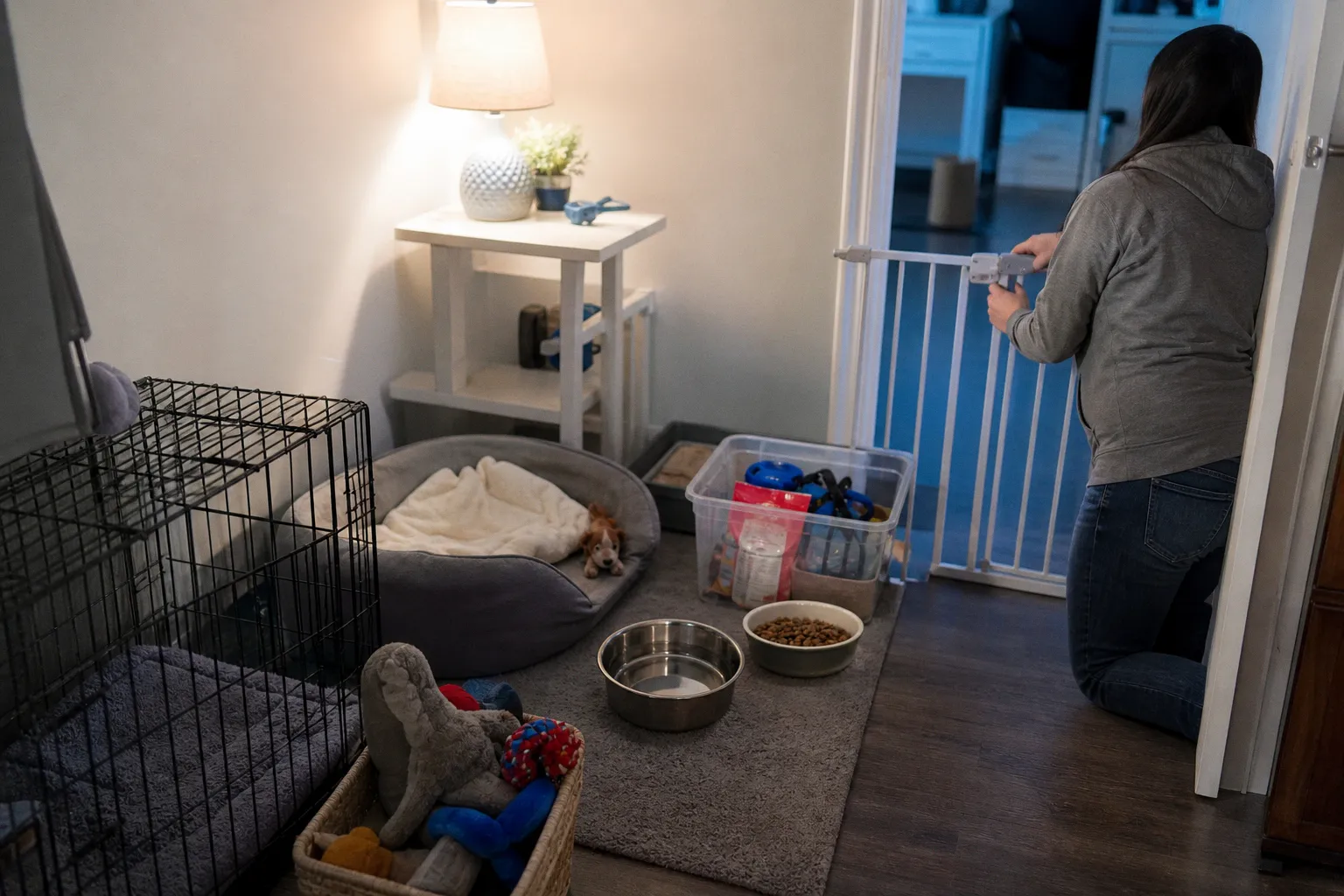
Even the friendly ones can be shut down, frantic, sick, unable to sleep, or suddenly possessive of a food bowl they ignored yesterday.
That is why a foster dog home safety requirements checklist is not a decorative part of a foster application. It is the line between giving a dog a usable landing zone and manufacturing behavioral fallout that the rescue will have to clean up later.
A fenced yard, a soft bed, and good intentions are not a setup. They are ingredients. The setup is containment, routine, controlled exposure, and a clear plan for the moment something goes sideways.
A foster dog needs less freedom than people think and more predictability than most homes naturally offer.
Build decompression space before the dog arrives
Every rescue dog needs a place that is theirs before they need the whole house. The first mistake in rescue dog foster home setup is opening every room, inviting every neighbor over, and calling it “socialization.” That is not socialization. It is sensory overload with a cheerful soundtrack.
Start with one indoor area: a spare bedroom, a gated kitchen section, an office, or another low-traffic space with a door or reliable barrier. Best Friends Animal Society and the ASPCA both recommend a dedicated room, crate, bed, or contained area for a foster’s early decompression. The exact layout will differ by dog, but the principle does not.
Your decompression area should have:
- A bed or washable bedding placed away from household traffic.
- Fresh water that cannot be easily tipped.
- A crate or covered resting spot, left open unless you are actively using it for safe confinement.
- A leash and slip lead stored within reach of the exit.
- A baby gate if visual access to the household is useful but physical access is not.
- Durable, size-appropriate chew items—not a pile of random toys.
- No loose shoes, cords, laundry, trash, food, medication, or small objects the dog can swallow.
This area is not punishment and it should not become an isolation cell. It is a pressure-release valve. A dog who can retreat is less likely to practice pacing, door rushing, barking at windows, resource guarding, or picking fights with resident animals.
Keep the first days boring on purpose. Predictable feeding. Predictable potty trips. Short, low-pressure walks. Sleep. A lot of sleep.
Many foster programs advise minimizing new people and animal introductions during the first couple of weeks. That is not because every rescue dog is dangerous. It is because you do not know who this dog is yet. A shelter profile can tell you what staff saw in a compressed, artificial environment. It cannot guarantee how a dog will handle your cat walking past a food bowl on day four.
For a foster puppy, this rule still applies. Preparing a home for a foster puppy does not mean throwing it into a parade of visitors before it has learned where the door is, where it sleeps, and what happens when it needs to go outside.
Dog-proof the interior like the dog has no sense—which, under stress, they may not
Dogs do not need to be “bad” to chew a phone charger, raid a cabinet, eat a sock, or test the latch on a front door. Stress changes behavior. So does boredom. So does the stomach upset that follows a food change, transport, and a sudden new household routine.
The interior safety work is unglamorous. Do it anyway.
Secure exits, not just the obvious front door
Rescue dogs can slip out of a door in a fraction of a second. Some have no reliable recall. Some have never worn a leash properly. Some will panic if a truck backfires three houses away.
Before arrival:
1. Check every exterior door and screen door for latching problems. A door that “usually catches” is not a door that catches.
2. Decide which door the dog will use for potty breaks and keep that route clear.
3. Tell everyone in the home that the dog is not to be let in or out without a leash until the rescue says otherwise—and often longer.
4. Put a reminder sign near the most-used exit if visitors, children, or contractors are likely to come through.
5. Keep windows secured. Window screens are not dog containment equipment.
6. Store the dog’s leash at the exit, not somewhere convenient in theory but unreachable during a real escape attempt.
Indoor housing is the baseline. Best Friends’ foster guidance is explicit that garages, backyards, and outdoor runs are not appropriate foster accommodation. A backyard is an exercise area, not a housing plan. Even a fenced yard does not remove the need for supervision: dogs climb, dig, squeeze through gaps, panic, and sometimes simply discover that the gate was not latched.
Remove the ordinary hazards people stop seeing
A foster dog does not know your house rules. It also does not know that the chicken bones in the covered trash can are a bad idea.
Do a floor-level sweep, then a cabinet-level sweep. The common hazards are not exotic:
- Food, especially chocolate, grapes and raisins, xylitol-containing products, onions, and anything within counter-surfing range.
- Human medications, vitamins, cosmetics, nicotine products, and cleaning chemicals.
- Trash, recycling, compost, and bathroom bins.
- Electrical cords, chargers, remote controls, earbuds, and batteries.
- Children’s toys, socks, underwear, sewing supplies, hair ties, and small chewable objects.
- Open toilet lids and accessible laundry machines.
- Houseplants you cannot identify as pet-safe.
- Candles, essential-oil diffusers, and anything hot enough to burn a curious dog.
- Loose gates, unstable furniture, and clutter that blocks a fast exit path.
There is a fashionable idea that “a well-enriched dog won’t destroy things.” That is half a sentence pretending to be a full one. Enrichment helps. It does not make a newly displaced dog medically clear, house-trained, non-anxious, or immune to scavenging. Management comes first.
Assemble the foster dog supply list—and get the crate right
Do not wait until the dog is standing in your hallway to discover that the only collar in the house is three sizes too small and your “crate” is a decorative wire cube from the basement.
A solid foster dog supply list begins with boring equipment:
| Item | What it needs to do | Common failure |
|---|---|---|
| Collar with visible ID | Stay on securely and carry current contact information | Using an old collar that slips over the dog’s head |
| Leash and backup slip lead | Control the dog at doors, on walks, and during transfers | Assuming a retractable leash is safe for an unknown dog |
| Crate | Provide safe rest and short-term containment | Choosing one so large it becomes a toilet-and-bedroom suite |
| Baby gate | Create separation without constant closed-door isolation | Using pressure-mounted gates where a strong dog can knock them down |
| Food and water bowls | Be stable, easy to clean, and available from day one | Changing food abruptly because the foster “seems picky” |
| Bedding | Give the dog a washable resting surface | Offering expensive blankets to a dog actively shredding fabric |
| Durable chews and treats | Redirect chewing and support calm routines | Leaving high-value items around resident animals |
| Poop bags, enzyme cleaner, grooming supplies | Deal with ordinary foster life quickly | Treating accidents as a training failure instead of useful information |
Best Friends advises that a crate should allow a dog to stand up and turn around, but not be much larger. That is the useful rule. The crate should fit the dog’s body, not your idea of generosity. An oversized crate can encourage a dog to toilet at one end and sleep at the other; an undersized crate creates physical stress and can turn confinement into a fight.
Crate use must also match the dog in front of you. A dog who settles with a chew and sleeps is different from a dog who slams into the door, bites wire, or escalates into panic. Do not force a “crate training” project onto a dog in the first 24 hours because a social media trainer told you crates solve everything. Contact the rescue if the dog cannot be safely contained without distress. You may need a gated room, an exercise pen, different equipment, or a behavior plan.
Ask the rescue what they actually provide. Foster pet application requirements often mention supplies, veterinary authorization, and emergency contacts, but the terms vary wildly. Some programs supply food and medication. Some reimburse approved purchases. Some expect the foster to handle transport. Some do not cover damage to your home. “The rescue will take care of it” is not a policy. Read the agreement before you bring the dog home.
Separate first, then introduce with a plan
The owner expectation is usually: “My dog is friendly, so they’ll work it out.”
The shelter reality: friendly dogs can still guard food, become overwhelmed by staring, react to tight spaces, or struggle when another dog approaches their person. And “good with dogs” is not a universal setting. A dog may be fine with one calm adult dog on a walk and very much not fine sharing a hallway, toy basket, or couch.
Start with physical separation. No direct contact through a cracked door. No “just one quick sniff” in the kitchen. No leaving dogs together because the first five minutes looked cute.
A Michigan Humane foster protocol hosted by Petfinder recommends separating new foster animals from resident animals of the same species for 7–10 days, partly because apparently healthy animals can still be incubating illness. That is a program-specific protocol, not a universal legal or veterinary rule. Your rescue may require a different period, especially if the dog has medical concerns or a known exposure history. Follow the stricter instruction you have been given.
During separation, keep resident pets current on their veterinary care and watch the foster for coughing, diarrhea, vomiting, appetite changes, parasites, skin issues, or unusual lethargy. Do not diagnose from a Facebook group. Report observations to the rescue’s assigned contact.
Introduce resident dogs outside and one at a time
When the rescue clears you to start introductions, use neutral or low-conflict ground where possible. Best Friends recommends initial dog meetings outdoors, one resident dog at a time, with leashes, room to move, and enough distance to avoid forcing a face-to-face encounter.
A workable sequence looks like this:
1. Start with parallel walking at a distance where both dogs can notice each other without freezing, lunging, or obsessing.
2. Reduce distance gradually if body language stays loose: curved movement, sniffing the ground, soft bodies, ability to disengage.
3. Keep leashes loose. Tension travels down the leash and turns ordinary interest into pressure.
4. Allow brief sniffing only if both dogs are calm, then move apart again. The goal is not a long greeting; it is a low-drama one.
5. Bring dogs indoors only after several uneventful outdoor sessions, using gates and active supervision.
6. Remove food, chews, toys, and other high-value items during early shared time.
Do not confuse stillness with calm. A dog standing rigidly, staring, closing its mouth, hovering over a person, or blocking access to furniture is giving you data. Growling is also data. Punishing a growl does not solve the discomfort beneath it; it just teaches the dog that warning is unsafe.
The goal is not instant friendship. The goal is no rehearsals of conflict.
Cats require slower math
For homes with cats, start with total separation. Best Friends advises scent exchange through a closed door over roughly one to two weeks before a controlled face-to-face meeting, with the dog on leash. Again, that is guidance, not a guarantee or a timer that magically makes a dog cat-safe.
Let the cat keep escape routes and vertical space. Never hold a cat in your arms for an introduction. Never corner the cat to “see what happens.” A dog’s intense stare, stiff posture, silent stalking, or explosive pursuit response is not curiosity you can train through with optimism.
Even a foster described as “cat tested” needs management in your home. Testing conditions vary. The cat’s behavior varies. Your hallway, stairwell, and furniture layout vary. That is the whole point.
Handle outdoor time and transport as escape-risk operations
The first walk is not a bonding montage. It is a security task.
Use a properly fitted collar or harness as directed by the rescue, plus a leash that you can grip securely. Some organizations require double-leashing or a martingale collar for flight-risk dogs. Do not improvise if the rescue has an equipment protocol; there is usually a reason it exists.
Best Friends requires leash control for foster dogs on walks and hikes and does not allow off-leash dog parks or other off-leash areas. That is sensible. Dog parks are chaotic even for stable, well-known dogs. For a rescue dog still decompressing, they offer too many dogs, too few exits, and too much opportunity for a bad interaction to become a label.
For the first outings:
- Choose quiet routes rather than busy parks.
- Keep walks short enough that the dog can recover, especially after transport or shelter stress.
- Plan for three to six potty breaks daily at first, depending on age and the dog’s physical needs.
- Do not force greetings with strangers, children, or other dogs.
- Carry treats only if you can safely manage them around resident dogs and the foster does not show food-related tension.
- Check equipment before every exit, not just the first one.
- Do not hand the leash to a child or an unprepared visitor.
Transport matters too. The dog rides inside the vehicle, secured according to the rescue’s protocol—not loose in an open pickup bed, not held on someone’s lap, and not given access to the driver’s footwell. Keep doors closed until the dog is clipped to the leash. Then check the clip. Then check it again. This is not paranoia. It is what prevents a rescue coordinator from spending six hours posting lost-dog alerts after one sloppy handoff.
Prepare for the emergency you hope stays hypothetical
Every foster arrangement needs an emergency plan before the first emergency. You need to know who approves veterinary care, where the dog should go after hours, what number to call, and what spending authority you have. If those answers are vague, get them clarified in writing.
Build a grab-and-go kit. A Michigan Humane foster manual recommends keeping visible collar-and-ID identification, current photos, copies of foster records, a carrier for each foster animal, and one to two weeks of food and water among evacuation supplies. For a dog, add a leash, bowls, cleaning supplies, medications, and a pet first-aid kit.
Your version should include:
- Printed and phone-saved photos showing the dog’s current appearance.
- The rescue’s emergency contact and backup contact.
- Veterinary records or whatever documentation the rescue has supplied.
- Feeding instructions and medication details.
- A crate or secure transport option that fits the dog.
- Food, water, bowls, leash, waste bags, and basic cleaning materials.
- A written note on behavior risks: escape risk, bite history if disclosed, handling restrictions, resource guarding, triggers, or medical limits.
- A plan for where resident animals go if separation becomes necessary during an evacuation.
The ugly part of foster care is that disasters do not wait for a convenient time. A storm, apartment fire alarm, HVAC repair, sudden diarrhea at midnight, or a dog fight can happen in week one. If the rescue has an emergency protocol, use it. If you are unsure whether a symptom is urgent, contact the rescue rather than crowdsource the answer from strangers.
What the first two weeks are really for
They are not a test of whether the dog loves you. They are not a deadline for house training. They are not a referendum on whether you are “meant” to foster.
They are observation.
Track what the dog does around food, doors, handling, sleep, other animals, vehicles, visitors, and alone time. Note patterns rather than making moral judgments. “Growled when I reached toward the bowl” is useful. “He’s aggressive” is not. “Had diarrhea after a food switch and a long car ride” is useful. “She’s being difficult” is not.
Send the rescue honest updates. A good foster report makes the eventual adoption safer because it describes the dog in a real home, not in a kennel. But honesty only works if you stop trying to present the foster as a polished success story.
Fostering is advocacy with chores, gates, laundry, leash clips, and inconvenient limits. Do the homework: set up the room, secure the exits, separate the animals, read the agreement, and make the emergency call list before you need it. The dog does not need a hero. It needs a home that is boringly safe long enough for its actual behavior to emerge.