Dog walking gear: essential checklist for professional walkers
Most professional dog-walking gear lists are written by people who have never had a leash snap on a reactive shepherd or watched a dog slip a poorly-fitted harness at a busy intersection.
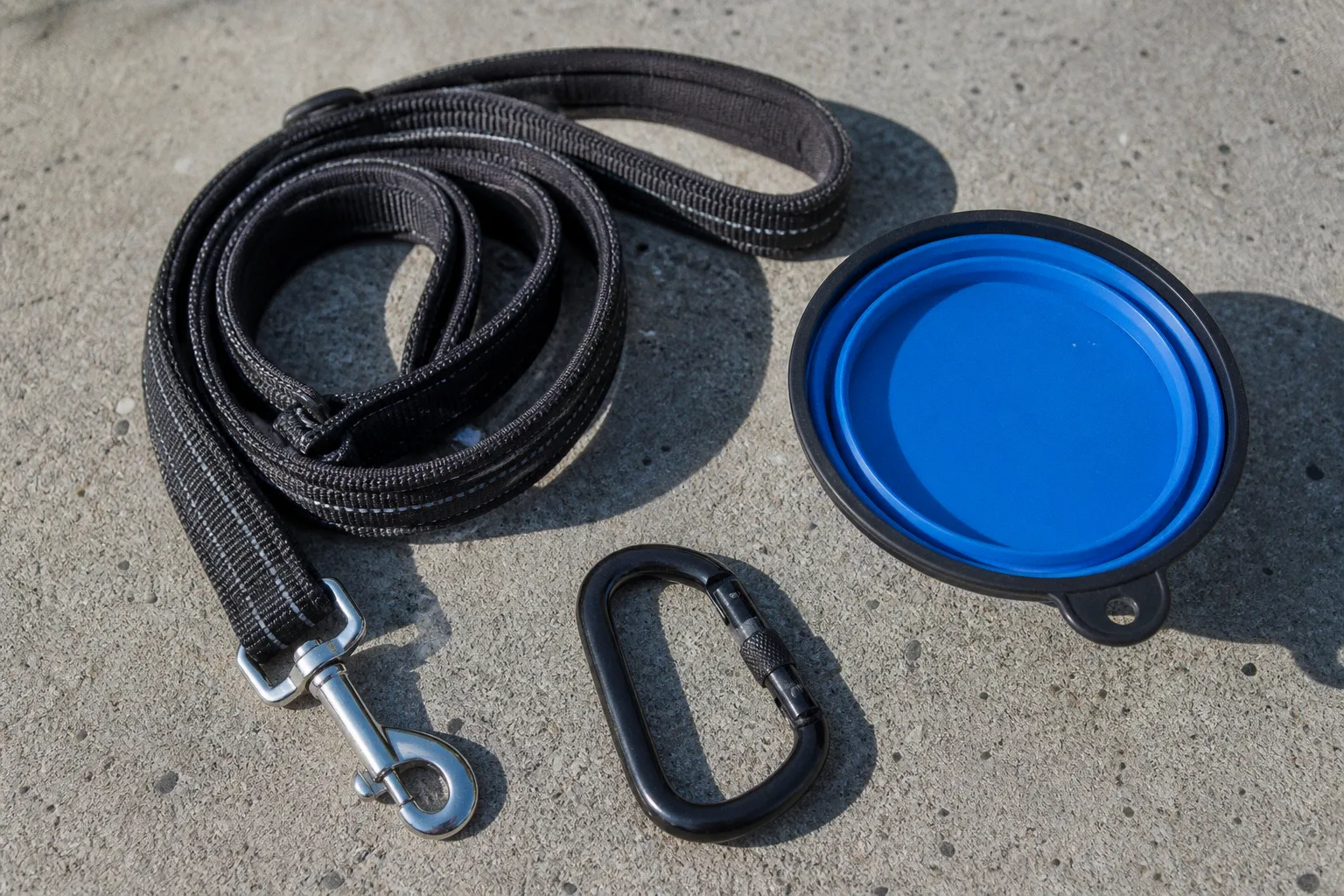
The marketing tells you to buy the prettiest ergonomic waist belt and call it a day. The reality is that your gear either holds a 70-pound stressed rescue when something goes sideways, or it doesn't, and that distinction is not aesthetic. I've watched walkers in this industry cut corners on harnesses because the boutique option "looks better on Instagram." I've also watched those same walkers get dragged into a chain-link fence by a dog who outweighed them. Gear is not a fashion statement. It's a set of redundant systems designed for the moment your primary system fails.
Restraint systems and individualized control
The single biggest mistake I see new professional walkers make is treating restraint as a one-size-fits-all purchase. The American Kennel Club is unambiguous on this: a waist leash can free your hands when walking more than one dog, but couplers and splitters should only be used with highly reliable dogs that already know each other and walk at a similar pace. That last clause eliminates most of the group-walk population. Most dogs on a paid route haven't met the other dogs on the route, and even if they have, they aren't pulling in matched stride.
| Restraint type | When it actually works | When it fails you |
|---|---|---|
| Standard 4–6 ft fixed leash | Solo walks, trained dogs, controlled urban routes | Reactive dogs, two-handed handling needs |
| Waist leash (hands-free) | Multi-dog handling with reliable, calm dogs | Sudden reactive outbursts, bolt situations |
| Coupler / splitter | Highly familiar dogs with matched pace and size | Any dog with mismatched pace, reactivity, or training gaps |
| Front-clip no-pull harness | Dogs that pull, multi-dog situations | Dogs that back out of loose harnesses, ill-fitted straps |
| Head collar (Gentle Leader style) | Strong pullers, controlled-leash practice | Brachycephalic breeds, dogs that paw them off, ill-fitted application |
Pick restraint to the dog, not the marketing photo. A front-clip harness that looks "gentle" in a product shot does nothing if the dog can reverse out of it. A head collar that "stops pulling" in a demo is useless on a flat-faced bulldog who can't breathe comfortably through it. The behavioral fallout from a poor gear fit is real: a dog who gets yanked sideways by a head collar learns to hate the walk. A dog who escapes a loose harness learns that escape is an option. Both problems are downstream of gear decisions, not training failures.
What control really means on a paid walk
You're not a dog parent doing enrichment. You're a paid handler moving animals through public space under liability. That means your restraint needs to fail in the direction of safety, not escape. A properly fitted harness should be the kind of restraint that, if it comes off, has done so deliberately, not because the dog backed out of an ill-adjusted chest strap on a Tuesday morning. Hardware matters. Cheap plastic snap hooks on leashes marketed to casual walkers fail at the worst possible moment. Look for metal bolt snaps rated for the dog's weight, with a backup closure if you can get it. And practice the release before you need it. A panicked jerk to "free" a tangled dog can rip a dewclaw or worse.
Gear is not a fashion statement. It's a set of redundant systems designed for the moment your primary system fails.
Emergency backup and identification protocols
Every professional walker should carry backup for the things that matter most. The federal pet-preparedness guidance is built around disasters, but the logic applies directly to mobile pet care: backup collar with an ID tag, harness or leash, first-aid supplies, sanitation items, copies of registration. Treat your walk bag like a kit that has to keep working when something goes wrong, because it will.
The trap most walkers fall into is treating ID and contact info as a client-onboarding task and never thinking about it again. The trap bites back when the collar breaks on a Sunday walk, the dog is now wearing a flat nylon slip, and you have no record of the owner's cell number. I've seen it happen. The owner of a known resource guarder, with a dog who had bitten a child six months earlier, ended up at a different vet's office with a walker who had no contact card. That walker is no longer in business.
What lives in the backup layer:
- A spare collar with the dog's ID tag pre-attached. If you walk the same dogs regularly, keep it pre-assembled. If not, carry a roll of ID tape and a Sharpie.
- A backup leash of the same restraint type you're using, not a downgrade, because you shouldn't need it unless the primary has failed.
- Printed or phone-stored copies of client contact, emergency contact, vet's number, current vaccination records, and any behavioral notes worth knowing: resource-guarding triggers, decompression cues, hard "no" commands the dog responds to.
- A printed waiver or service-agreement reference, because the day you need it, you'll need it on paper.
This is not bureaucracy. It's the difference between a contained incident and a call to animal control.
Hygiene and waste management standards
Public-health guidance on dog waste is plain: dog waste carries germs that can affect people and other animals. Picking it up and disposing of it properly is the baseline. Running out of poop bags on a group walk is not a "we'll grab some next time" problem. It's a public-health failure and a client-relations failure at the same time, and the client will be the one watching you fumble for an empty pocket on their sidewalk.
Carry more bags than you think you need. A solid baseline is double what you'd ration for the walk length. If you walk four dogs for 45 minutes, leave the bag with at least eight bags still in it. You'll need one for a mess that isn't yours (someone else's dog, picked up because a client is watching), and because the laws of group-walk logistics are undefeated.
Hand hygiene is not optional
Hand hygiene guidance is direct: wash with soap and running water after contact with dogs, dog supplies, saliva, or waste. When that's not available, and it usually isn't mid-route, an alcohol-based hand sanitizer with at least 60% alcohol is the substitute. Anything below that threshold is essentially scented water. A working hygiene kit in the bag:
1. Hand sanitizer, 60%+ alcohol, in a hard-case bottle that won't leak in a hot car.
2. A pack of disposable gloves for handling waste, injured animals, or unknown substances on the route.
3. Disinfecting wipes for leash handles, your car crate, and shared surfaces.
4. A small trash bag to seal used waste bags until you can dispose of them properly, in a park bin, in your own trash, never on the trail.
Skimp on this section and you'll end up explaining to a client why their dog sitter came back with a stomach bug — yours — and you'll lose the contract.
Carry more bags than you think you need. The laws of group-walk logistics are undefeated.
First-aid kits for on-the-go medical support
This is the section where most gear lists get romantic. They list 47 items and call it "comprehensive." The most useful guidance is closer to the bone: medical gauze, a soft muzzle, a spare leash and collar, and a portable bowl. That's the working baseline. The muzzle isn't there because your dog is aggressive. It's there because an injured dog may become frantic, and any dog can bite when scared, in pain, or being handled in a way it doesn't understand. Don't carry a muzzle to "fix" a dog. Carry one because if a dog slices a pad on broken glass, you may need to stabilize it before you can load it into a vehicle, and that dog may not thank you for it.
What goes in a working on-the-go kit:
- Gauze rolls and gauze pads for wrapping pads, covering wounds, and improvised muzzles in a real pinch.
- A soft fabric muzzle sized appropriately for the dogs you regularly walk, not a basket muzzle for routine use, but a soft one for emergencies.
- Saline solution for flushing wounds or eyes.
- A digital thermometer, because heat-stroke recognition starts with an actual reading.
- A tick remover or fine-point tweezers.
- A spare leash and collar, because the original may be compromised.
- A portable water bowl, collapsible silicone works.
- A clean towel or two.
- An emergency contact card: client's vet, nearest emergency vet, animal poison control.
Critical caveat: a first-aid kit is not a vet. If the dog is bleeding through the bandage, is limp, or has been hit by a car, you are loading and going. The kit buys you the time to get there.
Environmental adaptation and heat-safety gear
Outdoor-heat guidance written for construction workers applies directly to dog walkers, because the physiology doesn't care whether you're swinging a hammer or holding a leash. The recommendations are water, rest, and shade, with cool potable water for short jobs and access to electrolyte-containing beverages for work lasting more than two hours. That two-hour threshold is conservative; any sustained summer route meets it. The walker is the most overlooked piece of equipment in any dog-walking business, and a heat-exhausted walker is a liability: slower reactions, poorer judgment, worse handling. If you're working a four-hour summer block with eight dogs, you need at least a liter of water per active hour plus electrolytes, a cooling towel or vest, shade as a planned rest stop (not an aspirational one), and a schedule that bakes in acclimatization. New or returning workers need one to two weeks of increased precautions, including more frequent breaks and closer monitoring, before they're operating at full summer capacity.
Dogs in heat: a different math
The dog's heat math is not the walker's. Dogs cool through panting and limited sweat (paw pads only), which means humidity matters as much as temperature. A 78°F day at 80% humidity is harder on a dog than a 90°F dry afternoon. Practical gear considerations: a collapsible water bowl in the bag, always; a plan for shade on every route with a specific spot, not "we'll find one"; a spray bottle with cool (not cold) water for the chest, paws, and belly on hot days; and explicit recognition of elevated-risk categories. Brachycephalic breeds (pugs, bulldogs, Frenchies, Boston terriers) do not tolerate heat the way a Labrador does. Senior dogs, dark-coated dogs, and obese dogs are also elevated risk. Walking a flat-faced breed at 2 p.m. in July is not experience. It's a code waiting to be called.
The homework
Your gear list is a contract with every dog on your route. It says: I have thought about what could go wrong, and I have something in the bag to handle it. If your current bag can't pass that test, here's what to do this week, not next month:
1. Audit your current bag against the categories above. Be honest. If you're missing a backup restraint, fix it now.
2. Match your restraint gear to each dog on your roster individually. Stop buying "the harness" and buy the harness that fits the dog.
3. Build the walker into the kit. Water, electrolytes, cooling, shade. You are part of the equipment list.
4. Run a "primary system fails" drill with a friendly dog: practice the backup-restraint switch and the release technique before you need them under stress.
The hard truth about professional dog-walking gear is that the fanciest harness on the market is worthless if the human holding it doesn't know how to use it the moment the leash goes slack at the wrong time. Buy the gear. Train with it. Carry redundancies. Skip the influencer list and skip the savior complex; your job is risk management, and that starts in the bag.