Cat Sitting Visits: How Much Enrichment Is Enough?
The pet-sitting industry still carries a quiet assumption: cats are low-maintenance. Feed them, scoop the litter, refresh the water, and the visit is complete.
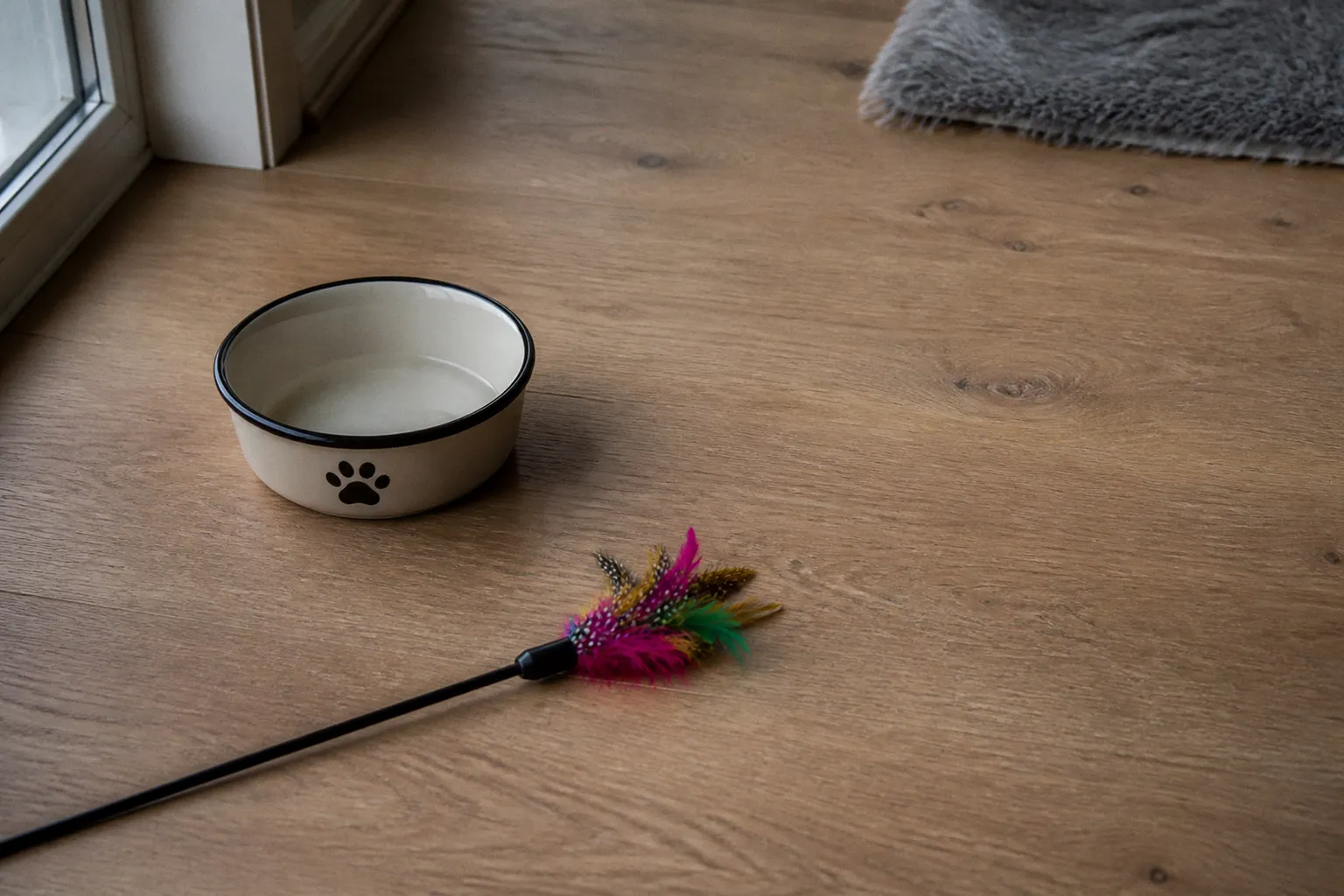
A fifteen-minute drop-in is often treated as the default cat service — something to fit between dog walks, priced as a cheaper alternative to a longer home visit.
That approach confuses basic maintenance with care.
A cat can survive a short visit without play, exploration, or meaningful contact. That does not mean the visit supported the cat’s welfare. Indoor cats still need opportunities to move, investigate, make choices, hunt in a controlled way, retreat when they feel uncertain, and interact with people on terms they can tolerate. The amount varies by age, temperament, health, household, and routine. There is no universal enrichment quota that applies to every cat.
There is, however, a clear difference between a sitter who only completes a checklist and one who understands what the animal needs during the owner’s absence.
A cat visit should be timed around the cat’s welfare, not just the sitter’s route.
The part of enrichment that happens before the toy comes out
Environmental enrichment is often reduced to play. Play matters, but it is only one part of a well-managed indoor environment. A cat may have a basket full of toys and still spend the day stressed because the litter box is in a noisy location, the food is placed beside a washing machine, or there is nowhere to retreat when a stranger enters.
For professional sitters, the practical meaning of enrichment is broader. It includes the way the home is arranged, the predictability of the visit, the quality of human contact, and whether the cat can choose between activity and withdrawal.
Several conditions deserve attention.
Places to hide and climb
A hiding place is not a sign that the cat is unhappy or being antisocial. It is a coping resource. A covered bed, a quiet room, an open carrier, a space beneath furniture, or a high perch can allow a cat to observe without being approached.
The sitter should never remove those options in order to force an interaction. Reaching under a bed, dragging out a frightened cat, or blocking the usual hiding place may produce a photograph of the cat, but it does not produce trust.
Vertical space is useful for many cats because it expands their territory without requiring more floor area. A shelf, cat tree, or stable piece of furniture can offer distance from dogs, children, other cats, or an unfamiliar visitor. The sitter’s job is not to redesign the home during a booking. It is to notice whether the cat’s established retreat remains accessible and safe.
A high perch should also be genuinely safe. An unstable stack of boxes, a narrow shelf beside a breakable object, or an open window without secure screening is not enrichment. It is an avoidable risk. Sitters should preserve approved access to elevated areas while reporting anything that appears loose, damaged, or newly hazardous.
Separated resources
Food, water, litter, resting places, and scratching areas should not all be treated as one station. Cats often prefer resources to be distributed so they can eat, drink, toilet, rest, and observe without feeling trapped or watched.
The familiar guideline of one litter box per cat plus one extra can be useful, especially in a multi-cat home, but the number alone is not the whole issue. Location matters. A box that is technically available but surrounded by noise, blocked by another animal, or difficult for an older cat to reach is not functioning well.
During a sitting assignment, the sitter should preserve the existing arrangement rather than casually moving bowls or boxes. If something has to be changed — for example, a box is leaking or a water fountain has failed — the owner should be told exactly what happened and where the replacement was placed.
Resource placement is part of environmental enrichment because it affects choice. A cat that can move between resting, scratching, eating, and observing areas has more control over its surroundings. A cat whose food is guarded by another animal or whose litter box can only be reached by crossing a noisy room has fewer workable options, even if every resource is technically present.
Predatory play and investigation
A toy on the floor is not the same thing as an opportunity to hunt. Some cats will chase a wand, stalk a toy around a doorway, or search for treats hidden in a puzzle feeder. Others prefer batting objects from a safe distance or watching movement from a perch.
Good play is responsive. The sitter changes speed, direction, and distance according to the cat’s behavior. The toy may disappear behind a chair, pause near a corner, or move slowly enough for the cat to track it. The cat should sometimes be allowed to catch it. Constantly keeping the prey out of reach can create frustration rather than satisfying play.
Not every cat wants a high-energy session. A senior cat with painful joints, an anxious cat in a new situation, or a cat recovering from illness may benefit more from a quiet sniffing game, food puzzle, gentle grooming if requested, or simply a calm presence.
Investigation does not have to mean introducing something unfamiliar. A sitter can leave a familiar cardboard box in an approved location, open access to a safe window perch, scatter a few owner-approved treats for searching, or allow the cat to inspect the sitter’s movements from a distance. The point is to create opportunities for agency without turning the home into an experiment.
Predictable human contact
The most valuable part of a visit may be interaction, but interaction does not always mean touching. Some cats want a brief greeting, a few strokes, and then space. Some will follow the sitter from room to room without accepting handling. Others will play but refuse to be picked up.
The professional standard is consent and observation. Look for a relaxed body, normal movement, interest in the toy or food, and the ability to disengage. A cat that turns away, crouches, flattens its ears, flicks its tail sharply, or retreats is communicating. The correct response is to reduce pressure, not to label the cat difficult.
Scent matters as well. Strong air fresheners, freshly moved furniture, unfamiliar cleaning products, or a sitter who handles several animals before arriving can change the sensory character of the home. This does not mean a sitter must sterilize every object or avoid all normal household smells. It means that unnecessary changes should be avoided, especially for a cat already unsettled by the owner’s absence.
How a visit actually works
The phrase “thirty-minute visit” hides several different jobs. A sitter may spend part of that time entering safely, checking the cat’s condition, preparing food, giving medication, cleaning the litter box, securing doors and windows, documenting the visit, and communicating with the owner.
That work is not wasted time. Welfare checks and hygiene are essential. But they should not be described as enrichment.
The sitter needs to know what the booking includes and what can realistically be delivered within the allotted time. A visit that contains medication, a full litter clean, special food preparation, and a nervous cat who will not approach may have little time left for interactive play. That is not a failure if the expectations were clear. It becomes a problem when the service is sold as an enriched, interactive visit and the cat receives only maintenance.
A useful way to plan the visit is to separate the tasks into three groups:
1. Care that cannot be skipped. This includes checking the cat, providing prescribed food or medication, refreshing water, cleaning the litter area, and making sure the home is secure.
2. Enrichment that fits the cat. This may be wand play, treat searching, a food puzzle, grooming, window access, a calm conversation, or observation from a safe distance.
3. Information that changes the next visit. The sitter should record what the cat ate, whether the litter box was used normally, what activity the cat accepted, and anything unusual in behavior or the home.
This distinction prevents a common mistake: treating every minute spent in the home as interchangeable. Five minutes of careful medication administration is not five minutes of play. Ten minutes spent waiting quietly for a frightened cat to emerge is not “nothing,” either. For that cat, a sitter who does not force contact may be providing the most appropriate form of enrichment available.
A realistic service comparison
| Visit pattern | What it can usually support | Where it becomes inadequate |
|---|---|---|
| Short maintenance drop-in | Food, water, litter, visual check, brief greeting | Cats needing medication, active play, extended observation, or a slower approach |
| Standard interactive visit | Maintenance plus one meaningful activity and time to observe behavior | Very active cats, kittens, complex households, or homes with several care tasks |
| Longer visit | Maintenance, unhurried interaction, play or food enrichment, and better behavioral observation | Still requires a tailored plan; extra time alone does not guarantee useful enrichment |
| Two visits in a day | More frequent meals, medication, play opportunities, and social contact | May still be insufficient for kittens, highly social cats, or cats whose routine depends on several daily activities |
| Visits for a multi-cat home | Individual attention can be built into the schedule | One shared toy session may not meet the needs of cats with different temperaments or tension between them |
The correct recommendation depends on the cat’s normal routine. A quiet adult who sleeps through much of the day may cope comfortably with one well-executed visit. A young, social, highly active cat may need more frequent contact. A cat that hides from visitors may need fewer demands but more time, because the sitter has to work slowly rather than trying to compress the entire interaction into a hurried burst.
That is the practical meaning of cat sitting environmental enrichment requirements: not a fixed number of minutes, but a service plan that matches the animal’s normal behavior and the responsibilities of the booking.
Why play often fails during pet sitting
Many sitters know they should “play with the cat,” but the instruction is too vague to be useful. The cat may ignore the toy because it is the wrong type, because the toy is moved too predictably, because the sitter is standing too close, or because the cat is not ready to interact with a new person.
The solution is not to wave the toy harder.
Follow the cat’s preferred distance
Some cats play close to the floor. Some want the toy to move around furniture. Some will only engage when the sitter sits quietly and moves the lure in short, irregular bursts. The cat should be allowed to approach, pause, retreat, and try again.
A sitter can also offer choices:
- a wand toy for stalking and chasing;
- a soft kicker toy for biting and grabbing;
- a few treats hidden in easy-to-find places;
- a cardboard box or paper bag, if the owner has approved it;
- a puzzle feeder that the cat already knows how to use;
- a window or perch from which the cat can watch the outside environment.
Novelty helps, but novelty is not a license to leave random objects around the home. The sitter should use only safe, owner-approved items and remove anything that could be swallowed, tangled, or pulled apart. Wand toys should not be left unattended unless the owner has specifically approved a safe arrangement.
The cat’s response should determine the pace. Dilated pupils, a fixed stare, a lowered stalking posture, weight shifting toward the toy, and a controlled pounce may indicate engagement. Turning away, hiding, rapid tail movement, or repeated avoidance suggests that the activity needs to be softened or stopped. These observations are more useful than reporting that the sitter “played for ten minutes.”
End the session in a way that supports settling
The familiar hunt–catch–play–eat–groom–sleep sequence is a useful framework for understanding predatory behavior. It is not a rigid script that every cat must perform perfectly, but effective predatory play should generally culminate in an owner-approved meal or treat when that fits the cat’s care plan.
Allowing the cat to catch the toy is part of that process. After an energetic session, the sitter may offer the cat’s scheduled meal, a permitted portion of food, or a small approved treat. If the owner has authorized it, a few treats can be used in a simple search game. This gives the activity a clear ending and may help the cat transition toward grooming and rest.
The qualification matters. A cat may have dietary restrictions, medication requirements, allergies, a weight-management plan, or a feeding schedule that does not permit an extra reward. In those cases, the sitter should follow the care instructions rather than improvise. The general principle remains: predatory play should usually lead to an owner-approved meal or treat, subject to the cat’s individual plan.
If food cannot be offered at that moment, the sitter can still end the interaction deliberately. The toy can be slowed, the cat can be allowed to disengage, and the room can return to its familiar, quiet arrangement. What should be avoided is an abrupt, frustrated ending in which the cat is repeatedly denied the chance to catch the toy or is left aroused with no appropriate next step.
Rotate access rather than flooding the room
A pile of toys is not automatically a stimulating environment. Cats can ignore familiar objects, especially when nothing about the object changes. A sitter may get better results by offering a small selection and changing it according to the owner’s rotation plan.
That rotation can be simple: one interactive toy for the visit, one familiar object left accessible, and additional toys stored safely until another day. Puzzle feeders should be introduced only if the cat already understands them or the owner has given clear instructions. A confused or frustrated cat does not benefit from a toy that is technically enriching but practically unusable.
Life stage, temperament, and health change the plan
The phrase “one cat visit” describes a booking length. It says almost nothing about the animal’s needs.
Kittens
Kittens are often the clearest case for more frequent contact. They are still learning how to play, settle, use their resources, and interact with people. They may need several short periods of activity rather than one long session. They also require closer supervision because ordinary household objects can become hazards when explored by a small, energetic animal.
A sitter should ask about feeding frequency, access to unsafe rooms, climbing behavior, litter habits, and whether the kitten is comfortable being handled. A single visit may be acceptable for a short absence only when the owner has carefully arranged the environment and the kitten’s needs are modest. For longer absences, a more frequent schedule is usually easier to justify.
The key is not to exhaust the kitten. Overstimulation can look like frantic biting, sudden zooming, or an inability to settle. A good visit includes a transition from activity to food, quiet exploration, or rest.
Adult cats
Adult cats vary more than service menus suggest. A calm cat with an established routine may need little direct play while the owner is away. Another adult cat may become distressed without regular interaction, particularly if it is used to a person being home during the day.
Breed can be relevant, but it is not a substitute for observing the individual. A breed associated with high activity may be relaxed, while a domestic shorthair may have an intense need for play and social contact. The intake should focus on behavior: how often the cat normally plays, what happens when play is missed, how the cat responds to strangers, and whether there are existing concerns around food, grooming, sleep, or the litter box.
For active cats, cat sitting visit duration matters because a rushed visit can create a false sense of completion. The sitter may technically provide play, but not enough time remains to let the cat approach, engage, catch the toy, and settle afterward.
Senior cats
Older cats may still enjoy play, but the form and intensity often need to change. Shorter movements, floor-level toys, gentle brushing, food searches that do not require climbing, and easy access to water and litter can be more useful than vigorous chasing.
Pain and illness can be subtle. A senior cat that suddenly stops jumping, avoids stairs, hides more, or changes litter habits may not simply be “slowing down.” The sitter should document the change and contact the owner according to the agreed emergency plan. The sitter is not there to diagnose arthritis, dental disease, cognitive decline, or any other condition, but the sitter may be the person who notices that the cat is no longer moving normally.
Cats with medical or behavioral needs
Medication, urinary history, diabetes, recent surgery, chronic pain, and previous litter box problems all affect the visit plan. So do fear, inter-cat conflict, compulsive grooming, and separation-related changes.
In these homes, enrichment must be subordinate to safety and the care plan. A cat that has been instructed to rest should not be encouraged into vigorous play. A cat with a urinary condition may require closer monitoring of litter use and water intake. A cat that guards a resource may need the sitter to separate animals during feeding rather than trying to create a shared activity.
This is where professional boundaries matter. A sitter can provide environmental support and report observations. The sitter should not promise that enrichment will resolve a medical or serious behavioral problem.
The intake conversation is part of the service
The quality of a cat-sitting visit is often determined before the sitter enters the home. A useful intake does more than collect the alarm code and feeding instructions. It establishes what the cat considers normal and what the owner considers a meaningful change.
The conversation should cover the cat’s ordinary rhythm, not just emergency information:
- When does the cat usually eat, sleep, play, and use the litter box?
- What kind of play does the cat initiate, and how does the cat show that it is finished?
- Does the cat prefer touch, conversation, parallel presence, or no direct interaction?
- Where does the cat hide when uncertain?
- Which rooms, windows, shelves, and toys are approved for access?
- Are treats, puzzle feeders, brushing, or food searches part of the normal routine?
- What food, medication, or weight-control instructions limit enrichment choices?
- How should the sitter respond if the cat does not come out?
- What changes require a message to the owner, a phone call, or veterinary advice?
Owners should also be specific about what the sitter must not do. Some cats should not be picked up. Some should not be allowed outdoors, even briefly. Some become distressed when doors are closed or when food is moved. A professional does not have to guess at these boundaries.
The owner’s description should still be treated as a starting point rather than a guarantee. Cats can behave differently when their person is away. The sitter should compare the cat’s behavior with the baseline while allowing room for variation. A cat that normally greets the owner at the door may remain under the bed for a new sitter. That is not automatically an emergency, but the sitter should check for normal eating, drinking, elimination, movement, and signs of illness.
What the sitter should document
Enrichment is difficult to evaluate if the only record says that the visit was completed. A useful update gives the owner a picture of the cat’s condition and choices without turning every visit into a performance report.
The sitter can note:
- whether the cat was seen and where;
- food and water intake, within the limits of what can reasonably be observed;
- litter box use and any unusual waste or accidents;
- the type of activity offered;
- whether the cat approached, watched, played, searched, groomed, or withdrew;
- any change in movement, posture, vocalization, or social behavior;
- whether the planned meal, treat, or medication was given;
- any change to the home, such as a failed fountain or damaged toy.
This record helps the next visit become more informed. If the cat ignored a feather toy but searched enthusiastically for approved treats, the sitter can adjust the plan. If the cat became agitated after a long play session and did not settle, the next interaction may need to be shorter and followed by the scheduled meal. If the cat remained hidden but ate normally and used the litter box, the sitter may continue with low-pressure contact rather than escalating the approach.
Photos can be useful, but they are not proof of enrichment. A picture of a cat beside a toy says little about whether the cat was relaxed, engaged, or simply waiting for the sitter to leave. The quality of the visit is reflected in the care decisions and observations behind the image.
Choosing a service that matches the cat
Owners comparing professional services should look beyond the advertised visit length. A longer booking is not automatically better, and a short booking is not automatically inadequate. The relevant question is what the sitter can safely and consistently do during that time.
A good service discussion should clarify:
1. What is included in the base visit. Food, litter care, medication, security checks, updates, and enrichment should not be left to assumption.
2. How the sitter handles a cat that hides. The answer should involve patience and observation, not promises to make every cat play.
3. Whether the sitter adapts activities. A cat’s response should influence the choice of toy, distance, pace, and duration.
4. How food-based enrichment is controlled. Treats and post-play meals must follow the owner’s instructions.
5. How changes are reported. The owner should know how the sitter will communicate concerns about appetite, litter use, behavior, or the home.
6. Whether the schedule suits the household. Medication, kittens, multiple cats, active cats, and long periods alone may require more than the shortest available drop-in.
For a quiet, independent adult cat with a stable routine, a well-planned maintenance visit may provide everything necessary, especially when the sitter gives the cat space and observes carefully. For a social or highly active indoor cat, the same service may be too compressed. For a fearful cat, additional time may be valuable not because it produces more physical activity, but because it allows the sitter to move slowly and avoid turning care into a confrontation.
This is also why “feline enrichment during cat sitting” cannot be reduced to a list of products. A puzzle feeder cannot compensate for an inaccessible litter box. A new toy cannot compensate for a sitter who ignores signs of fear. A longer visit cannot compensate for food being given outside the care plan. Enrichment is a relationship between the animal, the environment, the activity, and the way the visit is delivered.
The measure is not how busy the visit looks
The best cat sitter enrichment activities are not always the most visible ones. A lively chase session may look impressive, but a calm sitter who gives a frightened cat room to emerge, protects the cat’s resources, and completes the care routine without pressure may be doing more for welfare.
Likewise, stimulating indoor cats during pet sitting does not mean keeping them active for every minute. Cats need recovery, sleep, grooming, and the ability to stop. Enrichment should add meaningful choices to the day, not create a new demand that the cat must perform for the sitter.
A useful visit leaves the cat safe, fed according to plan, able to access familiar resources, and no more stressed than necessary. When the cat is willing, it may also include play, searching, climbing, grooming, social contact, or another activity the cat already understands and enjoys.
The owner-approved meal or treat at the end of effective predatory play is part of that larger picture when the care plan allows it. The sequence works because it gives the cat a chance to complete the activity rather than remaining frustrated. But it must remain individualized: the right reward, amount, timing, and frequency belong to the cat’s normal routine and health requirements.
There is no universal answer to how much enrichment a sitting visit needs. The more useful question is whether the visit gave this particular cat appropriate opportunities to move, investigate, choose contact or distance, complete safe predatory behavior, and return to rest.
That is the standard worth building into a professional service. Not a promise that every cat will play. Not a claim that every visit must be long. A thoughtful plan, carried out by a sitter who can tell the difference between an occupied cat and a supported one.