Shelter dog leash reactivity: can a professional walker help?
The first walk out of the kennel can tell shelter staff more than several days of kennel-card notes ever will.
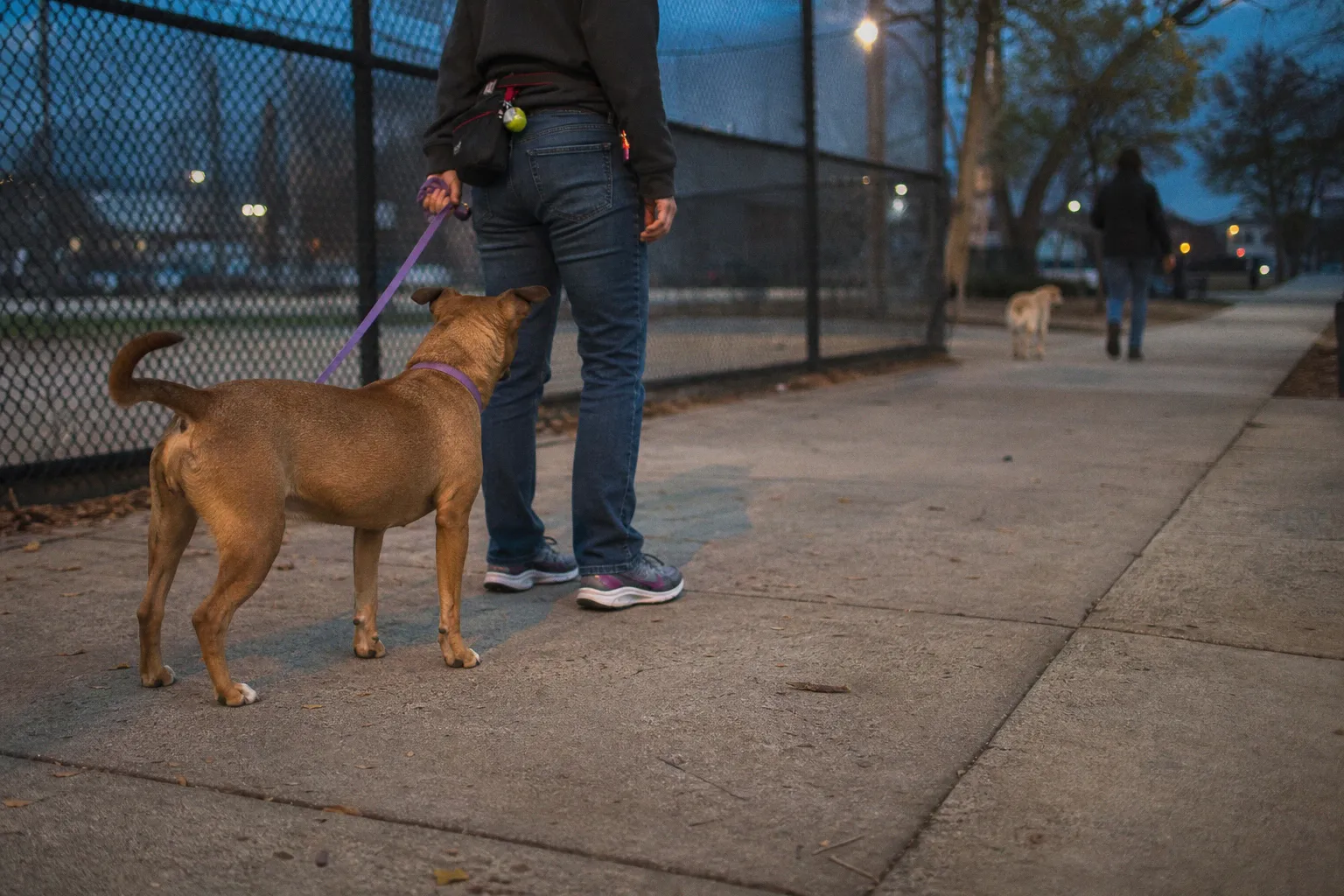
In one 120-dog shelter study, dogs that grabbed the leash or harness during their first outdoor outing stayed an average of 47.3 days before adoption. Dogs that did not grab equipment averaged 24.7 days. Pulling and barking did not move that needle. Equipment-grabbing did.
That is not a therapy result. It is a data point. And it sits at the center of the shelter dog leash reactivity professional walker role: a skilled walker may not “fix” reactivity on the sidewalk, but they can make the dog safer, more legible, and easier for a shelter team to help.
Beyond the Walk: Professional Handlers as Field Observers for Shelters
Most adopters picture a dog walker as a pair of legs and a treat pouch. In a shelter setting, the useful version of the job is closer to field observation with a leash clipped to the belt loop.
A walk shows what a kennel cannot. It reveals how a dog reacts to another dog appearing around a corner, whether a stroller changes their body posture, whether a passing cyclist causes freezing or forward motion, and what happens after the trigger is gone. Does the dog recover? Can they eat? Can they orient back to the handler? Or do they remain wound tight for the rest of the outing?
None of that is reliably captured in a brief behavior assessment in a small room with an unfamiliar person. Assessments have a role, but they are snapshots. A walk is repeated information from the environment the dog will eventually have to navigate.
That distinction matters because a concerning response in one setting should not become a permanent label. Shelter behavior is context-heavy. Kennel stress, sleep disruption, unfamiliar handling, pain, noise, nearby dogs, and the simple absence of control can all change what a dog does on leash. A dog who lunges at a fence line may be overwhelmed. A dog who grabs the lead may be frustrated, frightened, over-aroused, uncomfortable in the gear, or attempting to create distance from the person holding it. The behavior is real; the conclusion requires more care.
| What a walk can capture | What a brief kennel assessment may miss |
|---|---|
| Triggers that appear in ordinary life: dogs, bikes, strollers, joggers | The complexity and unpredictability of the outside environment |
| The distance at which the dog begins to change | Whether that threshold shifts from one outing to the next |
| Recovery after barking, lunging, freezing, or grabbing | The quality of recovery in a familiar route with a consistent handler |
| Responses to harnesses, leashes, doors, and transitions | Whether equipment itself is contributing to distress |
| Handler-dog communication under mild stress | How the dog responds after a calm retreat, food, or a pause |
A professional walker who records those details over multiple sessions is giving the shelter something far more useful than “walked well” or “reactive.” The notes can identify a pattern: dogs are the issue, but only at close range; bicycles trigger a startle, but the dog recovers quickly; the harness is tolerated, while leash attachment predicts grabbing; mornings are easier than the crowded late afternoon route.
That information can follow the dog to foster, adoption, training, or a clinical referral. It also gives a potential adopter a more honest picture than a single label on a kennel card.
A walker who treats the outing as exercise only — thirty minutes of motion, no observations, no adjustments — leaves the most valuable part of the job on the sidewalk.
Strategic Management and the AVSAB Standard for Reward-Based Handling
This is where the romantic version of “fixing” a reactive dog falls apart. There is no technique that makes a dog’s fear, frustration, or defensive behavior disappear because someone delivered it confidently at the end of a leash.
AVSAB’s humane-training position is clear: reward-based methods should be used for training and behavior modification. That rules out the tools and tactics still marketed as decisive answers to leash aggression in shelter pets: electronic collars, prong collars, choke chains, leash corrections, intimidation, forced exposure, and punishment dressed up as “communication.”
If a walker’s plan depends on making the dog afraid to react, the dog is in the wrong hands. So is the adopter.
What replaces punishment is less cinematic and much more effective: management plus reinforcement. Management means reducing the dog’s exposure to situations they cannot currently handle. That can look like quieter routes, lower-traffic times, a longer path that preserves distance, turning before the approaching dog closes in, or using parked cars and hedges as visual barriers.
The goal is not to suppress the warning. It is to stop rehearsing the explosion.
Every lunge, bark, growl, or leash-grab that happens at full intensity is practice. The dog is learning that this is what they do when the world gets too close. A professional dog walker for reactive rescues should be paid, in part, to prevent that rehearsal where possible — not to march the dog into it for the sake of a more impressive route.
The training piece begins under threshold: at enough distance that the dog can still notice, eat, move, and think. A dog may see another dog, then turn toward the handler for food. They may hear a skateboard and choose to step behind the walker rather than launch forward. They may need a treat scatter in the grass and a quiet U-turn. Those are not small victories. They are the raw material of shelter dog behavior modification.
Progress does not follow a calendar. It varies with the individual dog, the triggers involved, physical health, the walking environment, the seriousness of the safety risk, and how consistently every person around the dog follows the same management plan. Some dogs make useful changes quickly in the right setting; others need a slower pace, different supports, or a clinical evaluation before meaningful training can take hold. Any walker promising a standard timetable is selling certainty they do not have.
A reactive dog that gets to rehearse a blowup on every walk is in training. Just not the kind the walker was hired to provide.
Equipment Grabbing and the Hidden Cost of Prolonged Shelter Stays
The 120-dog shelter study deserves more attention than it usually gets. Researchers recorded what dogs actually did during their first walk: pulling on the leash, vocalizing, and grabbing the equipment. Only one of those behaviors correlated with a longer shelter stay, and it was not the one most visitors complain about.
Equipment-grabbers stayed nearly twice as long as non-grabbers — 47.3 days versus 24.7 days by model estimate. Pulling and vocalizing, the behaviors most readily described as “reactive” by someone walking past the kennels, did not predict length of stay in that data set.
That is an uncomfortable distinction. The dog barking at the fence may look dramatic. The dog who bites the leash, clamps onto the harness, or redirects onto equipment is often harder to move safely through a busy shelter, harder to hand off to a volunteer, harder to photograph outside, and harder for a first-time adopter to imagine managing.
Equipment grabbing is not a cosmetic issue. It is a functional one. It can also be a clue.
A thoughtful handler does not answer every grab with a sharper correction. They ask what happened just before it:
- Did the dog see another dog, person, vehicle, or unfamiliar object?
- Did the leash tighten as the dog reached the end of their range?
- Did the harness shift, pinch, or restrict movement?
- Did the behavior occur during transitions through doors, gates, or kennel aisles?
- Was the dog already too aroused to take food or respond to simple cues?
- Did the dog settle when distance and pressure were restored?
The answers determine the next move. A different harness fit may matter. So may a longer lead in an appropriate open space, a quieter exit route, a second handler for safety, or a shorter decompression outing rather than an ambitious neighborhood lap. In more serious cases, the right intervention is not another walk at all. It is a behavior referral.
For a shelter dog, this is not a footnote. Length of stay is a welfare issue. More kennel time can mean more noise, more unpredictable social exposure, less rest, fewer choices, and fewer chances to show the quiet, affiliative behavior that helps a dog get adopted.
A walker can flag the issue early: not “bad on leash,” but “grabs the lead after visual contact with dogs at close distance; recovers with space; does not grab during quiet sniffing.” That is the kind of observation a behavior team can use.
When Reactivity Requires a Clinical Lens: The Veterinary Behaviorist Link
A walker is not a diagnostician. There is a line where the leash ends and the clinic begins, and crossing that line without noticing can leave both dog and handler in a worse position.
Medical issues can influence behavior in ways that look, at first glance, like disobedience or aggression. Pain, sensory changes, illness, neurological concerns, and medication effects can alter a dog’s tolerance for handling and proximity. A dog who snaps when touched near the back may be painful. A dog who startles hard at approaching people may be struggling with more than poor socialization. A walker can notice patterns. They cannot determine the cause.
A veterinary behaviorist can assess the medical and behavioral picture together, recommend diagnostics where needed, and prescribe medication when it is appropriate. Medication is not a surrender flag. For some dogs, lowering baseline arousal is what makes learning possible in the first place. It can create enough room between trigger and reaction for management and reward-based training to land.
A good referral is not evidence that the walker failed. It is evidence that the walker understands the limits of the role.
The cases that deserve prompt escalation are not hard to identify, even if the exact diagnosis is not yet clear:
1. Escalation in intensity. Barking becomes snapping, lunging becomes contact, or recovery becomes slower and less reliable.
2. A known bite history or new injury risk. This requires a safety plan, not optimism.
3. Sudden behavioral change. A dog who was previously comfortable being handled and is now defensive needs veterinary attention.
4. Persistent inability to recover. If the dog remains hypervigilant long after the trigger has passed, a longer walk may simply add more stress.
5. Handling that cannot be done safely. Harnessing, leashing, entering or exiting the kennel, and transferring the dog should not become daily conflict rehearsals.
The walker can document what they see, reduce exposure, reward safer choices, and protect the dog’s threshold. They cannot prescribe, diagnose, or turn a high-risk case into a routine walking client by force of personality.
A dog walker is frontline support. A veterinary behaviorist is a clinician. Those are different jobs on purpose, and a vulnerable dog may need both.
Human Interaction as a Buffer Against Fear-Related Aggression
A walk is one form of human contact. It is not the only one, and the form matters as much as the duration.
A University of Florida summary of a 2019 study described an intervention in which fearful shelter dogs received daily human interaction in a quiet room during their first days in the shelter. The question was not whether human contact magically cured fear-related aggression. It was whether structured, calm contact could improve welfare during a period when dogs are especially vulnerable to stress.
That framing is useful. The question is rarely, “Can walks rehabilitate this dog?” The better question is, “Does this interaction lower stress, preserve trust, and give the dog a safer experience of people and the outside world?”
A professional walker can contribute to that answer. A low-stimulation decompression walk may include slow sniffing, generous distance from other dogs, no pressure to greet strangers, and pauses when the dog needs to look, process, or turn away. The handler’s pace matters. So does their ability to recognize that a dog who stops is not necessarily being stubborn; they may be overwhelmed.
The opposite approach is still common: taking the dog past every other dog on the block to “socialize” them, insisting on greetings, tightening the leash before a trigger, or treating a flood of stimulation as exposure therapy. It is not. It is exposure without consent, without control, and often without a plan for recovery.
Same profession. Completely different protocol.
What an Adopter Owes the Dog Before the Walker Shows Up
If you have adopted a reactive shelter dog and are hiring a professional walker, the work starts before the first handoff. The walker needs a real operating picture, not a vague warning that the dog is “a little reactive.”
- Start with veterinary input. Rule out pain and other medical contributors before framing every difficult response as a training problem. This is especially important if the behavior is sudden, touch-related, or changing in intensity.
- Provide an honest trigger history. Note what the dog sees, what happens next, how close the trigger was, whether food was possible, and how the dog recovered. A short log is more useful than the word “aggressive.”
- Agree on handling rules in advance. Reward-based methods only. No prong collar, choke chain, shock collar, leash pop, forced greeting, or punishment for growling. A growl is information. Punishing it may remove the warning while leaving the fear intact.
- Make safety part of the arrangement. The walker should know bite history, equipment needs, exit routines, routes to avoid, emergency contacts, and who has authority to pause services if the dog’s behavior changes.
- Let the route fit the dog, not the invoice. A reactive dog does not need to cover the maximum distance available in a booking. A shorter walk with sniffing, distance, and successful choices may be far more useful than a long route packed with rehearsed distress.
Rehabilitating reactive rescue dogs is not a project for a stranger with treats and a polished social-media feed. It is a structured commitment involving veterinary care when needed, environmental management, reliable handling, careful records, and a willingness to adjust when the dog says the current plan is too much.
A professional walker can be one of the most valuable outside pairs of hands in that plan. They can spot patterns, protect thresholds, reduce daily conflict, and turn an ordinary walk into usable information for the people responsible for the dog’s future.
They cannot be the whole plan. The dog deserves better than that — and, in the right hands, better is exactly what a walk can become.