Hands-free leashes: are they safe for professional walkers?
Between 2001 and 2018, U.S. emergency departments logged an estimated 356,746 dog-leash-related injuries. The annual rate rose from 25.4 per million people in 2001 to 105.5 per million in 2018.
That is a hard number to read if your workday begins with clipping a dog to a line and stepping into public space.
It is not, however, a verdict on waist belts, shoulder rigs, bungee lines, or any other attachment configuration. The available injury research does not identify how the leash was attached to the handler, and it does not establish that one configuration carries more or less risk than another. It tells us something more basic and still useful: a leash is not a minor piece of fabric between a person and a dog. Under surprise force, it can be part of a serious injury event.
The pitch for hands-free gear is simple: freer hands, smoother logistics, fewer handles to juggle when a dog needs a treat, a gate opened, or a mess bagged. Those are real conveniences. But convenience is not the same thing as a safety finding. A hands-free leash reroutes the connection between dog and handler; it does not make the dog’s momentum disappear.
The leash does not get weaker because you moved it from your hand to your waist. It simply gives force a different route through the walk.
Quantifying the Rise in Leash-Related Physical Trauma
The emergency-department analysis covering 2001–2018 is the closest thing the profession has to a broad national baseline for leash-related injury. Across that period, it estimated 356,746 emergency visits, averaging roughly 63.4 per million people per year. The rate rose from 25.4 per million in 2001 to 105.5 per million in 2018.
That increase deserves attention without being turned into a product-category story the research cannot support. The study does not tell us whether a person was using a conventional handheld leash, a waist-worn dog leash, a retractable line, a coupler, a shoulder attachment, or something improvised from whatever was in the car. It also does not establish why the rate changed over time.
What it does show is an injury landscape with two familiar routes into trouble: force from a pulling dog, and loss of footing or entanglement around a leash. The estimated totals included 193,483 pull-related injuries and 136,767 trip- or tangle-related injuries. Fractures made up 26.8% of cases; strains and sprains, 26.0%; contusions and abrasions, 17.7%.
Those categories matter to a professional dog walker because they describe ordinary moments, not dramatic failures. A dog sees another dog across a narrow sidewalk. A leash crosses behind the knees while someone turns to answer a client message. A dog hits the end of the line just as the walker steps off a curb. None of those moments needs bad intentions, defective equipment, or an unruly “problem dog.” They need only timing, force, and a human body that cannot instantly reorient itself.
A professional should resist two easy conclusions. The first is that all hands-free systems are inherently reckless. The evidence does not say that. The second is that hands-free systems are safe because they are sold as ergonomic or active-walking gear. The evidence does not say that either.
The useful position is narrower: leash injury is common enough, and often serious enough, that the attachment point should be treated as a handling decision rather than a lifestyle accessory.
Comparing Pulling Force and the High Cost of Trip Injuries
Pull-related injuries were more common in the emergency-department dataset, but trip and tangle injuries carried a higher hospital-admission rate. That distinction is worth sitting with.
| Mechanism | Estimated ED visits, 2001–2018 | Hospital admission rate |
|---|---|---|
| Pull-related | 193,483 | 3.7% |
| Trip or tangle | 136,767 | 8.4% |
| All leash injuries | 356,746 | — |
Trip and tangle incidents were associated with an 8.4% admission rate, compared with 3.7% for pull-related injuries. The study does not tell us which leash attachment setup produced those incidents, so it cannot prove that a waist belt is more hazardous than a handheld line. But it does put a professional obligation on anyone choosing gear that changes where leash slack, loops, and line crossings live during a walk.
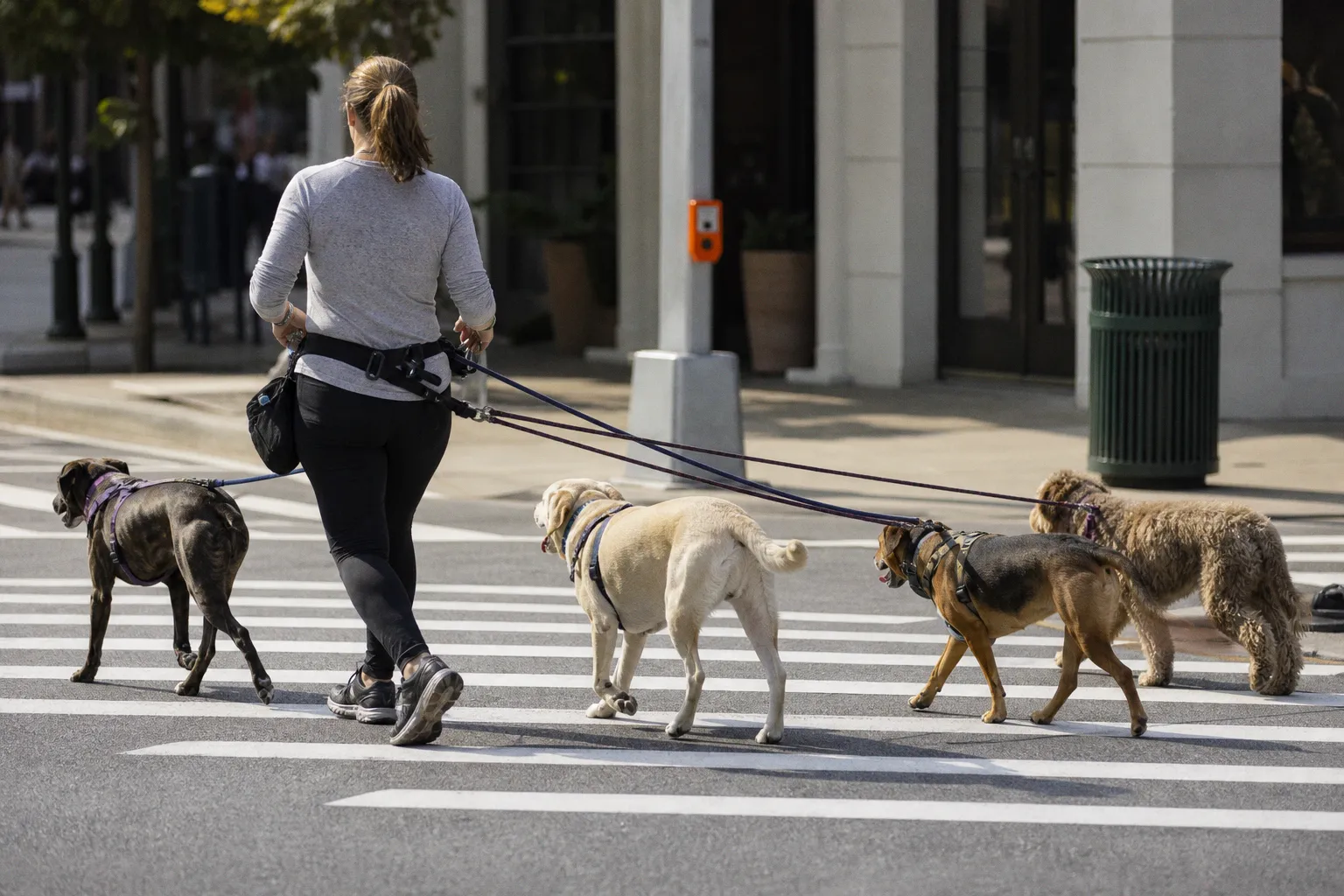
That is where the waist worn dog leash pros and cons become less abstract. A waist setup can leave both hands available for doors, treats, poop bags, traffic awareness, and a second line. It can also create a longer interval before a handler gets a hand directly onto the leash. Depending on the belt position, leash length, dog’s path, and the walker’s footing, the line may travel across the front of the body, behind a leg, or toward another dog in the group.
None of this means a handheld leash automatically prevents a tangle. It plainly does not. The 2024 single-practice review of 443 dog-leash-related hand and wrist injuries makes that clear. In that sample, 75.9% of injuries occurred when an extremity became caught in the leash while the dog pulled. Surgery was required in 96 cases, or 21.6%.
The point is not to transfer every risk to the hands. It is to understand the trade. A handheld leash gives the walker direct line control, but it also creates opportunities for wrapping, gripping too tightly, or trying to catch a moving leash with fingers. A hands-free rig can reduce some hand involvement, but it places more importance on belt fit, line management, body position, dog selection, and the ability to disconnect or regain control without fumbling.
For a hands-free leash for multiple dogs, that equation gets more demanding. More dogs do not merely mean more combined pulling power. They mean more changing angles, more opportunities for one dog to pass behind another, more leash hardware, more stimulus conflicts, and fewer clean options when one dog suddenly needs individual handling.
A professional does not need to dramatize that reality. They just need to stop calling it “hands-free” as though it means “risk-free.”
Trip and tangle injuries are not the most common leash injuries in the available data. They are, however, associated with a substantially higher rate of hospital admission.
The J-Shape Standard as a Prerequisite for Hands-Free Gear
The behavioral question is where most conversations about gear get too forgiving. The American Kennel Club’s leash-training guidance describes the desired walking picture as a loose leash hanging in a visible J-shape between dog and handler. That J is not decorative. It is a simple visual measure of whether the leash is currently transmitting meaningful forward tension.
A leash with slack allows a handler to make choices. They can shorten the line before a pinch point, create distance from another dog, change direction, reward a check-in, or pause before the dog rehearses a lunge. A tight leash means the dog and handler are already negotiating force.
For hands-free gear, that difference is decisive. A dog that can walk calmly on a standard handheld leash is not automatically ready to be clipped to a belt. The handler has changed their access to the line, their ability to shorten it quickly, and the way the dog’s force reaches the body. A dog that pulls intermittently may be manageable in one setup and inappropriate in another.
There is no published universal threshold that says a dog must complete a certain number of flawless days before going hands-free. Any rule that pretends otherwise is making up precision. But professionals can still use a disciplined gate before changing equipment:
- The dog should regularly maintain a loose leash in the real environments where the service occurs, not only in a quiet training session.
- The walker should know the dog’s predictable triggers: other dogs, moving wheels, wildlife, doorways, food debris, sudden noise, or proximity to people.
- The dog should recover from ordinary excitement without dragging the handler toward the trigger or requiring a physical contest at the end of the line.
- The walker should be able to interrupt, redirect, and safely secure the dog using the actual hands-free setup, not merely a familiar handheld leash.
- The first uses should happen with one dog, on a route with room to step aside, not as the debut of a full pack configuration.
This is not a purity test for dogs. Plenty of excellent client dogs have moments of enthusiasm, frustration, or surprise. It is a recognition that a professional dog walker equipment safety decision should reflect the individual dog’s behavior on that route, with that handler, at that time of day.
The J-shape standard is especially useful because it cuts through marketing language. “No-pull,” “active,” “running,” “shock-absorbing,” and “balanced” are product descriptions. A loose line is an observable handling condition. If the line cannot routinely hang loose, a hands-free belt has not solved the underlying problem. It has merely moved the anchor point.
Anatomical Considerations for Collars and Harnesses Under Tension
The gear on the dog matters as much as the gear on the walker. Veterinary guidance commonly favors a properly fitted harness over a collar for ordinary leash walking, particularly for dogs vulnerable to neck and airway concerns. Pressure on the neck can be a meaningful welfare issue for brachycephalic dogs, including bulldogs, pugs, and French bulldogs, and for small dogs with tracheal problems.
That does not turn every harness into a hands-free safety device.
A front-clip harness may help some handlers redirect a dog’s body when the dog pulls. A back-clip harness may be comfortable and appropriate for dogs that already walk politely, while offering little leverage against a determined forward drive. A head halter changes the point of control again and requires careful fitting and acclimation. Each tool can have a place. None erases the need to assess how much force the dog can generate, where that force will go, and what happens when the dog changes direction.
The dog-side choice and the handler-side choice should be considered separately:
| Equipment question | What it can help address | What it does not establish |
|---|---|---|
| Collar versus harness | Neck comfort, airway protection, fit for the individual dog | Whether a handler can safely absorb or redirect a sudden pull |
| Front clip versus back clip | Directional control and pulling mechanics for some dogs | A universal reduction in injury risk |
| Waist belt versus handheld leash | Hands availability and the handler’s connection to the line | A proven safer attachment configuration |
| Bungee section | A softer-feeling change in load for some moments | Protection from falls, tangles, or a dog’s full momentum |
The literature on dog-worn equipment remains limited in important ways. A peer-reviewed review in Frontiers in Veterinary Science noted the need for more structured investigation into the uses, benefits, risks, and best practices of dog equipment. That gap matters. There is no universal published pulling-force threshold, no reliable dog-weight cutoff, no official maximum number of dogs for a belt, and no single leash length that makes hands-free work defensible by itself.
That absence does not excuse careless choices. It means the professional has to make better documented ones.
For running with dogs gear, the standard should be even tighter. Running reduces reaction time. Surface changes matter more. A dog’s sudden sideways movement can become a fall rather than an awkward step. The appropriate running partner is not simply a fit dog with energy to burn; it is a dog with predictable pace, responsive cues, sound movement, and a demonstrated ability to work around ordinary distractions without surging into the line.
Professional Liability and the Absence of Universal Safety Ratings
The professional layer is the part consumer advice often skips. A client is not only trusting a walker to get their dog exercised. They are trusting that walker to choose equipment and routes that fit the dog in front of them.
Pet Sitters International’s Global Standards identify safe leash skills, body-language recognition, and safe-handling protocols as professional competencies. They do not endorse a particular hands-free product. Nor is there a universal safety rating that certifies a waist belt as appropriate for a given dog, route, or pack size.
That leaves room for judgment, which is both necessary and uncomfortable. Judgment is harder to market than a belt with a padded lumbar panel. It is also what will matter if something goes wrong.
A defensible hands-free practice is not built from a brand promise. It is built from records, handling habits, and honest limits:
- Read the commercial liability policy you actually carry. If equipment exclusions or multi-dog provisions are unclear, ask the carrier or broker for clarification in writing rather than assuming a belt setup is covered.
- Keep client notes that describe the dog’s walking behavior, known triggers, escape risks, equipment fit, and changes in behavior over time.
- Introduce a waist attachment one dog at a time, on a familiar route, before treating it as part of normal pack-walk logistics.
- Carry a practical backup option for transitions: entering buildings, crossing crowded areas, passing a known trigger zone, or separating dogs that should not remain coupled.
- Reassess rather than grandfathering a dog into the setup. A dog recovering from injury, entering adolescence, responding to a new neighborhood dog, or becoming stressed by a crowded route may need a different handling plan.
The phrase “professional liability” can sound grander than the day-to-day reality. Usually it means smaller, plainer questions. Did you notice that this dog had started lunging at scooters? Did you use the equipment that gave you sufficient control in that location? Did you have a way to create distance when the walk changed? Did you keep walking because the route was scheduled, or did you change the plan because the dog in front of you needed one?
The law, insurance language, and local regulations will vary. The duty to exercise sound judgment does not.
The Bottom Line for Working Walkers
Hands-free leashes are not categorically unsafe. They are categorically conditional.
The current injury research shows that leash-related harm is real, often preventable in its immediate circumstances, and sometimes serious. It does not tell us that waist belts are the cause of the increase in emergency visits. It does not compare attachment configurations. It does not give professionals a clean chart saying that one dog, one belt, one leash length, and one harness style equal safety.
So the decision has to be more disciplined than the packaging.
Use hands-free gear with dogs that have demonstrated loose-leash skills in the environments where you work. Start with routes that leave room for handling rather than routes that demand perfect handling. Treat a multi-dog belt setup as a higher-complexity arrangement, not an efficiency upgrade you can add because your hands are busy. And if the dog is likely to put sustained tension into the line, return to the setup that gives you the clearest, quickest, safest control.
In rescue and shelter work, every tool comes with the same quiet standard: if you cannot explain why you chose it for this dog, in this place, on this day, you have not finished making the decision.
That is the missing standard in most hands-free leash conversations. Use the rig where the dog has earned it, the route can support it, and your handling plan still works when the walk stops being easy. Everywhere else, hold the leash like a professional.