Multi-pet mealtime safety: how should sitters manage feeding?
The hard truth: animals that nap in a pile, share a couch, and politely ignore each other all day can still start a fight over one bowl of kibble. Owners routinely mistake household peace for mealtime safety.
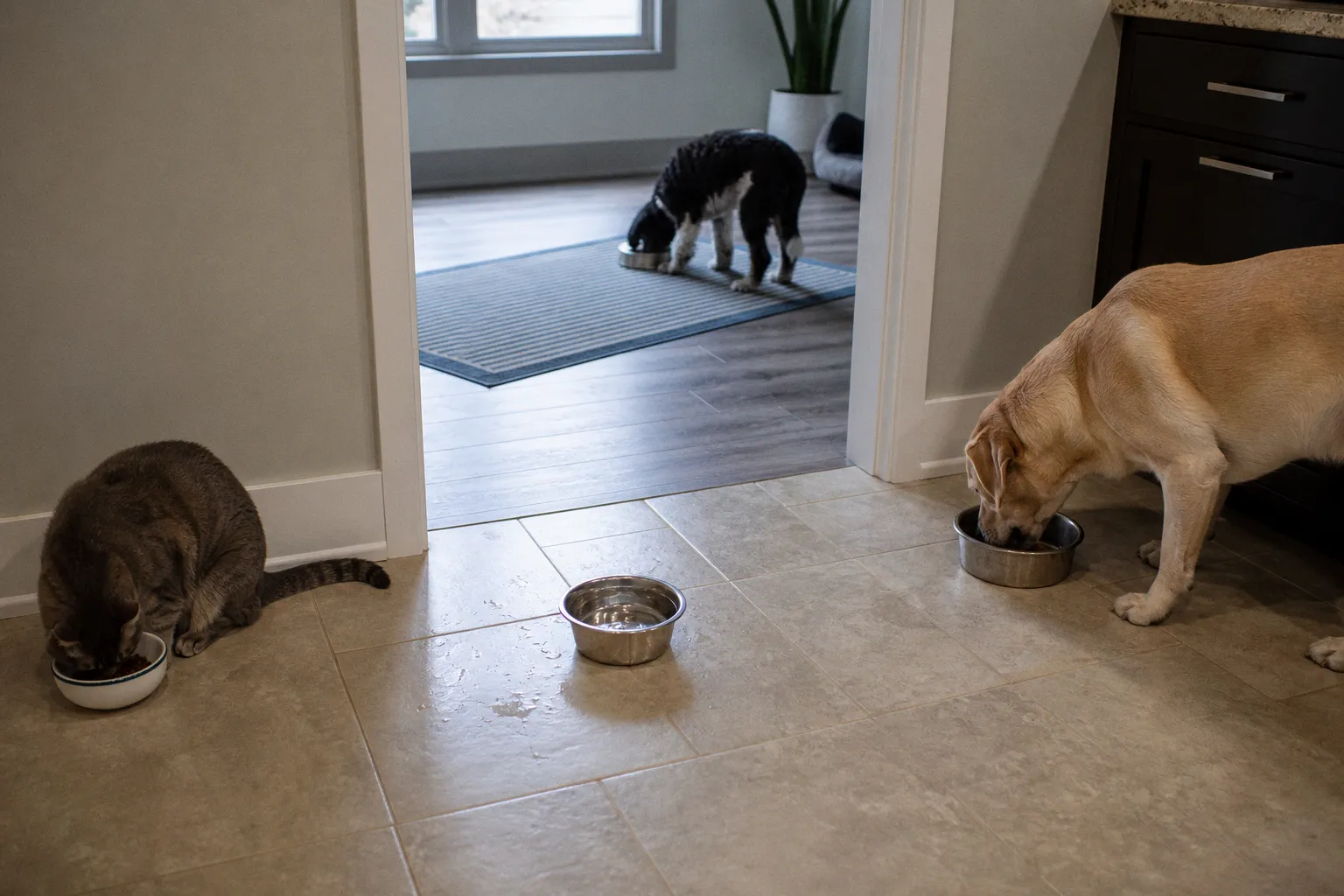
They are not the same thing.
For a professional sitter, feeding is not a cute add-on between walks and photos. It is one of the highest-consequence parts of a visit. A missed veterinary diet, a dog that raids the cat’s bowl, a puppy that gets pushed away from food, or a guarded chew left on the floor can create medical problems and behavioral fallout fast. The sitter’s job is not to test whether the pets “can work it out.” The job is to run a boring, repeatable system that gives every animal access to its own food, water, and space.
Multi-pet household feeding safety for sitters starts with management. Gates, closed doors, crates, measured portions, written instructions, and actual observation beat optimism every time.
Physical separation is not overkill
“Feed them together” is not a protocol. It is an owner preference until someone has documented how it works under real conditions: with a stranger in the house, at an unusual time, during a storm, after a missed walk, or when one pet is feeling unwell.
Dogs should not be fed shoulder to shoulder simply because they live together. Cats should not be expected to negotiate access to one communal feeding station because they are supposedly “low drama.” In multi-animal homes, separate feeding areas for dogs and cats are the low-tech foundation of safe care.
That can mean:
- Dogs eating in different rooms with doors closed.
- One dog eating behind a baby gate while another eats in a crate.
- Cats receiving meals in separate rooms, on different levels of the home, or in areas that a dog cannot access.
- A senior pet, puppy, kitten, or medically managed animal getting a protected feeding zone with no traffic through it.
- Removing bowls once the animals have finished, rather than leaving food around for the fastest eater to patrol.
There is no universal rule saying bowls must be a certain number of feet apart. Anyone giving you a magic distance is selling confidence, not safety. Layout matters. So do door latches, gate height, crate conditioning, the animals’ mobility, and whether one pet can clear a barrier in half a second.
A useful setup is one the sitter can operate alone without rushing, wrestling, or improvising. If feeding Dog A requires holding a door shut with a knee while Dog B circles the sitter’s legs and Cat C slips underfoot, the setup is bad. It may have worked for the owner, who knows the house and the animals’ tells. That does not make it suitable for a visiting professional.
If the feeding plan depends on every pet behaving perfectly, it is not a feeding plan. It is a gamble.
The owner’s “they’ve never fought” versus the sitter’s reality
Shelter work teaches this lesson early: “never” usually means “not while I was looking.” It may also mean the household has avoided the trigger by accident. The owner feeds at one exact time, in one exact rhythm, wearing one familiar set of clothes. Then a sitter arrives, the schedule shifts, a delivery truck passes, and the social contract falls apart.
Ask owners for specifics before accepting the assignment:
1. Where does each pet eat, exactly? “Kitchen” is not enough. Identify the room, the barrier, the bowl location, and the order in which animals are released.
2. Who finishes first? The fast eater is often the problem, but the slow eater may be the one under pressure.
3. Has any animal ever hovered, stared, blocked access, rushed a bowl, stiffened, growled, snapped, or stolen food? Do not let an owner rename these behaviors “being bossy.”
4. What happens to unfinished food? It should not become a free-for-all unless that is a deliberate, safe plan for every animal in the home.
5. Can the sitter safely enter each feeding area after the meal? If not, bowl pickup and release procedures need to be thought through before the first visit.
The best answer is usually mundane: feed separately, wait, remove bowls, release animals one at a time. Mundane is good. Mundane keeps skin intact and diets on track.
Dietary integrity: the bowl is part of the medical record
Multi-pet homes often contain wildly different nutritional needs under one roof. A puppy may eat several meals. A senior dog may have a prescription diet. One cat may need controlled calories while another is underweight. Then there is the dog that considers cat food a career opportunity.
A sitter should never assume foods are interchangeable. Cats require nutrients, including taurine and arachidonic acid, that dog food does not supply in the right way for a complete feline diet. Dogs should not live on cat food either; it is typically more calorie-dense and can drive unhealthy weight gain when fed as the regular diet.
Measured portions and individual bowls are not fussy professional theater. They are how a sitter knows who ate what.
| Household situation | Unsafe shortcut | Safer sitter protocol |
|---|---|---|
| Two dogs eat the same kibble | Pour food into one large bowl | Measure each dog’s portion into its own labeled bowl and feed behind separation |
| Dog and cat share a kitchen | Leave cat food on the floor all day | Feed the cat in a dog-proof location or use an owner-approved access-control setup |
| Senior pet on a veterinary diet | “A little of the other food won’t matter” | Follow written feeding instructions exactly; keep all other animals away |
| Free-fed cats with one overweight cat | Refill the shared bowl and leave | Use the owner’s established individual-access plan and record what was added or observed |
| Puppy gets training treats | Treats handed out casually to calm everyone down | Give only documented treats, in the documented amount, while animals are separated if needed |
Treats, snacks, and table food should generally make up no more than 10% of daily calories for dogs and cats. That does not give a sitter permission to calculate a new menu. It means “just one extra” can matter more than owners think, especially for a pet on weight management or a therapeutic diet.
Do not change portions because a pet looks hungry. Do not substitute foods because the usual container is low. Do not add toppers, broth, supplements, or a handful of treats to make a meal more appealing unless the owner has left explicit written instructions. If a prescribed food runs out, that is an escalation issue, not a chance for creative problem-solving.
Labels beat memory
A multi-pet feeding station should have labels that survive a tired sitter on a rainy evening. Names alone are not enough when two animals look alike or when a client has several bags of similar food.
A practical setup includes:
- Each pet’s name and species.
- The exact food name or a clear identifier supplied by the owner.
- Portion amount and measuring tool.
- Meal times or visit-specific feeding instructions.
- Medication directions, if applicable, including whether it must be given with food.
- The feeding location and barrier procedure.
- What to do if food is refused, vomited, spilled, or stolen.
- The owner’s veterinarian and emergency contact plan.
This is individual pet diet tracking in its useful form: not a fancy spreadsheet for its own sake, but a record that prevents the wrong animal from getting the wrong thing.
Food guarding is a management problem, not a sitter training project
Resource guarding can look loud: growling, snapping, lunging, or a full fight. It can also look quiet: freezing over a bowl, eating faster when another pet approaches, hard staring, hovering near another animal’s food, body-blocking, or repeatedly checking where the sitter is moving.
The quiet version is where people make mistakes. They see a dog standing still and decide it is “fine.” The dog is not fine. The dog is broadcasting discomfort in a language humans keep ignoring.
Pet sitter food aggression management is not about proving you can handle the dog. Do not take a bowl away while the dog is eating to show who is in charge. Do not reach into the bowl. Do not scold a growl. Do not corner the dog, stare it down, or attempt a correction because a client casually said, “He can be a little protective.”
Those moves can make guarding worse and can put the sitter in the bite zone. A growl is information. Punishing the warning does not remove the discomfort; it may simply remove the warning.
For a dog with a known or suspected guarding history:
1. Set up separation before food appears. Use closed doors, a secure gate, crate, pen, or another barrier the dog already knows.
2. Place the meal and step away. The dog should be left alone while eating unless the client’s documented plan requires distant observation for a medical reason.
3. Keep other animals out of the area. This includes cats, who are very capable of wandering into the wrong room at exactly the wrong moment.
4. Do not attempt bowl retrieval until the dog is secured elsewhere. If that cannot be done safely, clarify the procedure with the owner before the assignment begins.
5. Document the behavior factually. “Dog froze and stared when the cat approached the gate” is useful. “Dog was jealous” is not.
6. Escalate according to the agreed plan. A new growl, snap, refusal to leave a feeding area, or barrier failure deserves an owner update and may require changing the visit protocol.
There is a difference between routine care and behavior modification. A sitter can reduce risk through clean management. A sitter should not use a visit to test thresholds, run trading exercises, or introduce desensitization work. That belongs in a properly designed plan with the owner and, where needed, a qualified behavior professional.
The sitter who “tests” a guarding dog is not being brave. They are manufacturing risk in someone else’s home.
Intake and water: observe the animal, not just the empty bowl
An empty bowl does not prove the right pet ate the meal. In a busy household, it may prove only that the fastest animal had a productive two minutes.
The sitter needs enough direct observation to confirm reasonable intake for each animal. That does not mean hovering over a nervous pet or turning dinner into surveillance. It means knowing whether the assigned animal approached the food, ate some or all of the documented amount, avoided the bowl, vomited afterward, or lost access to another pet.
A clean visit note should capture:
- Food offered and amount, using the owner’s established measure.
- Approximate amount eaten: all, most, some, none, or unknown.
- Whether another pet attempted to access the food.
- Any unusual behavior: hesitation, gulping, pacing, guarding, vomiting, diarrhea, coughing, or obvious discomfort.
- Water refreshed and water bowls checked.
- Any medication given with food, following the owner’s instructions.
Skipped meals are not automatically stubbornness or separation anxiety. Appetite changes can be behavioral, environmental, or medical. The sitter does not diagnose. The sitter records what happened and follows the client’s escalation plan.
Water deserves the same unglamorous attention. Fresh, clean water should be available in more than one location in a multi-pet home. A useful veterinary rule of thumb is one water source per pet, placed in different areas. Four animals means four water options, not one bowl that gets slimy by noon and guarded by the biggest dog.
For cats, keep food away from litter boxes. That sounds obvious until you see the number of homes where a litter tray and food dish are crammed into the same utility corner. Cats need separated resources: feeding areas, resting spots, water, litter access, and routes away from each other. A cat that skips meals may not be “picky.” It may be avoiding a social bottleneck.
Food puzzles, automatic feeders, and other gadgets that do not replace a plan
The pet-care industry loves a gadget because gadgets photograph well. A microchip feeder can be useful. A timed feeder can support a cat’s routine. A food puzzle can give an animal something constructive to do. None of these devices magically make a multi-pet household safe.
Microchip-controlled feeders can cost roughly $55 to $300. Commercial food puzzles often run around $10 to $50. Those are product ranges, not standards of care, and they are not a substitute for a sitter understanding the household.
Automatic feeders fail in predictable ways:
- The wrong pet camps beside the feeder and steals access when the authorized animal steps away.
- Batteries die, outlets get bumped, lids jam, or a pet learns how to defeat the mechanism.
- One animal becomes fixated on the sound of the feeder and begins guarding the area.
- A timed device dispenses food, but nobody confirms the intended pet actually ate it.
- A sitter assumes the machine worked because the owner uses it successfully under normal conditions.
Food puzzles and stuffed toys have their own risk profile. They can be valuable enrichment, but in multi-pet homes they can trigger guarding, especially when the item is new or unusually high-value. The sensible approach is supervision or physical separation, based on the individual animals and the owner’s written instructions.
Do not introduce a new enrichment device during a sitting job because it seems like a good idea. That is how a simple dinner visit turns into a dog guarding a frozen treat behind a sofa. The household’s established routine is the starting point. Novelty is not a professional service standard.
Build the plan before the first meal
A serious sitter should complete a mealtime walkthrough during the consultation, not discover the system while holding three bowls and reading a handwritten note taped to the fridge.
Walk the route. Test the gates. Confirm which door closes fully. Ask whether a cat can slip through a gap. Find the backup food. Locate the measuring cup. Identify what “normal eating” looks like for each animal. Get written authorization for what to do if a meal is missed or a pet gets into another animal’s diet.
If the home cannot support safe separation with its current equipment, say so plainly. The options may be different visit timing, owner-provided crates or gates, a modified care arrangement, or a boarding environment that can safely manage the animals. Pretending the setup is workable helps nobody.
The standard is controlled access, not a charming group dinner
Professional feeding does not need to look warm and communal. It needs to be safe, accurate, and repeatable.
That means every animal has a defined meal, a defined space, and a documented outcome. It means a sitter treats a growl as data, not disrespect. It means no one relies on the biggest dog’s manners, the cat’s athleticism, or an owner’s assurance that “they usually share.”
The homework for owners is not glamorous: write the feeding instructions down, label the food, provide functioning barriers, disclose every past incident of stealing or guarding, and create an emergency plan before a sitter needs one. The homework for sitters is equally plain: follow the protocol exactly, document deviations, and walk away from jobs where the only safety strategy is hope.
That is not cold. It is what responsible care looks like when dinner is more than dinner.