Pet emergency alerts: notification options for owners
The right pet emergency alert system does more than send a notification. It closes a specific gap in the care plan: who will know if you cannot respond, how will they know where your pet is, and what…
Pet emergency alert systems: notification options for owners
The right pet emergency alert system does more than send a notification. It closes a specific gap in the care plan: who will know if you cannot respond, how will they know where your pet is, and what information will help them act before a routine problem becomes a medical or relocation emergency?
Compare car rental deals in United Kingdom
See available offersPartner link — DiscoverCars comparisonFor most households, there is no single device that covers every stage of that process. An automated check-in service may identify that an owner is incapacitated, while a GPS collar may locate a dog after an escape. A pet rescue window decal can alert responders that animals may be inside the home, but it cannot provide live medical information or confirm that someone has received the message. The most reliable approach is therefore a layered one, built around your household, your pet’s health profile, and the people who can realistically respond.
The following comparison maps the main pet emergency alert system options, from low-maintenance digital check-ins to smart wearables, interactive home devices, and traditional physical alerts.
Start with the emergency you are trying to detect
The phrase “pet emergency” covers several very different scenarios. A useful alert system begins by identifying the trigger rather than choosing the most sophisticated technology available.
There are four common notification problems:
1. The owner cannot respond.
A solo pet owner may be injured, hospitalized, involved in a vehicle collision, or otherwise unable to return home. In this case, the system needs to detect a missed check-in or a crash and notify designated contacts.
2. The pet has left a safe area.
A dog may escape through an open gate, slip a lead, or leave the property during a stressful event. Here, live location tracking and virtual fence alerts are more useful than a home camera.
3. The pet is inside a property during an external emergency.
Fire, smoke, temperature changes, or a household evacuation can create risk even when the animal is not visibly ill. Physical alerts and home environmental alarms are designed for this stage.
4. The pet is showing a possible health anomaly.
Changes in resting heart rate, breathing rate, movement, or routine can justify a call to a veterinarian or an in-person welfare check. This requires a health-monitoring wearable or another device capable of collecting relevant data.
These triggers can overlap, but they should not be treated as interchangeable. A GPS collar does not replace a care instruction card. A microchip does not send a live escape notification. A camera does not automatically arrange a veterinary visit.
The strongest emergency plan is not the one with the most technology; it is the one that connects the right alert to a person who can act.
Automated check-ins for owners who live alone
For a solo pet owner, an automated check-in service is often the most direct way to protect a pet against an owner incapacitation event. The service sends a prompt by SMS, email, or phone call at a scheduled time. If the owner does not respond, the system escalates the alert to a primary emergency contact and then to backup contacts according to the preset plan.
This model is useful because it addresses a problem that pet trackers cannot solve: the pet may be safe at home, but nobody knows that the owner is unable to provide care.
A practical check-in plan should define:
- The check-in frequency. Daily prompts may be suitable for someone living alone with a healthy adult dog, while a person managing a senior pet or a medication schedule may choose a tighter interval.
- The escalation window. A missed prompt should not immediately trigger unnecessary panic if the owner is in a meeting or has a dead phone battery, but the delay must also be short enough to protect animals that depend on daily medication, outdoor access, or temperature-controlled housing.
- The primary responder. This should be someone who can reach the home, access the property, and transport the pet if necessary.
- The backup responder. A second person is essential because the primary contact may be traveling, ill, or unavailable at the same time.
- The care packet. Contacts need more than a name and phone number. They should have the pet’s feeding instructions, medications, veterinarian details, microchip information, behavior notes, and the location of keys or access codes.
The check-in service is only as effective as its escalation list. A contact who lives several hours away may be emotionally dependable but operationally unsuitable for a same-day welfare check. In a well-organized plan, the primary contact is usually local, while the backup contact can coordinate veterinary care, boarding, or transport if the local responder cannot continue.
A manageable setup sequence
The transition phase is easier when the plan is built in stages rather than configured all at once.
1. Write the care instructions before selecting the contacts.
This reveals what kind of response is actually required. A dog that needs insulin, for example, requires a different level of readiness from a healthy dog that can tolerate a delayed meal.
2. Choose a primary and backup person who have agreed to the role.
Do not rely on an unconfirmed assumption that a relative, neighbor, or dog walker will notice an alert and take responsibility.
3. Test the escalation chain.
Confirm that notifications arrive by the intended channels, that the contacts recognize the message, and that they know how to enter the home.
4. Review the plan after any household change.
A move, new pet, change in medication, new veterinarian, or change in work schedule can make an old emergency protocol inaccurate.
Automated check-ins are relatively simple, but they still depend on current contact information and an agreed response protocol. They also work best when paired with a visible emergency contact card inside the home and a second copy in the owner’s wallet or phone.
Smart wearables: location, health data, and virtual boundaries
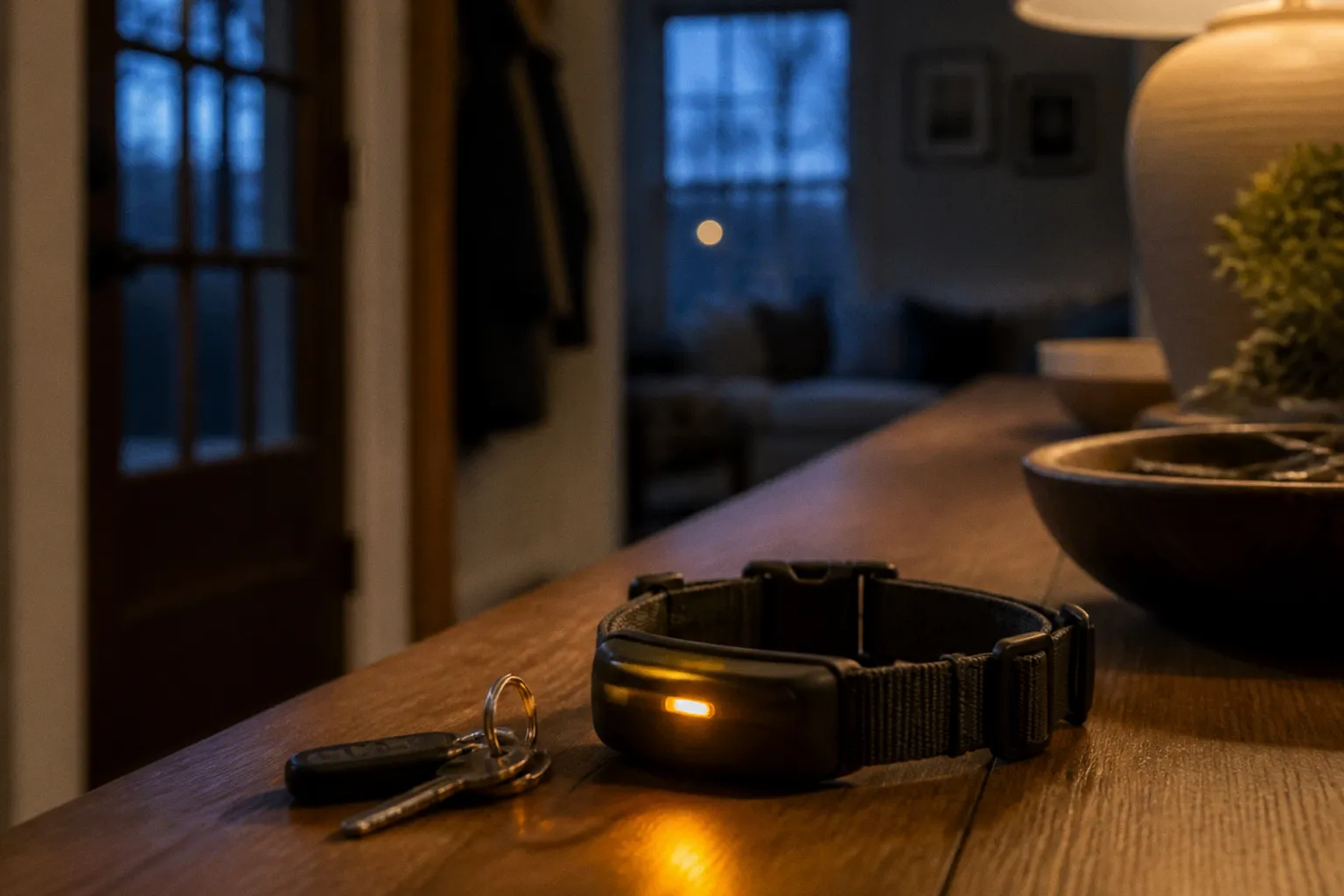
Smart pet wearables combine several functions that previously required separate tools. Devices such as the DocuPet HomeSafe Smart Tracker and PetPace use cellular connectivity, including 4G LTE-M integration, to support live GPS location, virtual fence alerts, and selected health measurements.
For a dog that spends time outdoors, travels frequently, or is prone to bolting, the location function may be the primary value. A virtual fence can notify the owner when the dog leaves a defined area, while live tracking can help narrow the search. For an older dog or one with a chronic condition, resting heart rate and breathing-rate anomalies may provide an additional prompt to observe the pet closely or contact a veterinarian.
These systems require a more careful interpretation than a simple “normal” or “abnormal” label. A health alert is not a diagnosis. Activity, heat, excitement, stress, and poor sensor contact can all affect readings. The useful role of the wearable is to create an earlier signal that something has changed from the pet’s baseline comfort and routine.
What smart wearables can and cannot provide
| Capability | Smart wearable | Practical limitation |
|---|---|---|
| Live location | GPS tracking through a cellular network such as 4G LTE-M | Requires sufficient network coverage, battery power, and a properly fitted device |
| Escape notification | Virtual fence or geofence breach alert | The alert depends on the boundary being configured realistically and the device transmitting |
| Health monitoring | Measurements such as resting heart rate or breathing rate | An anomaly should prompt observation or veterinary advice, not be treated as a diagnosis |
| Owner incapacitation detection | Usually limited or indirect | A wearable on the pet may show location, but it does not necessarily know that the owner cannot respond |
| Lost-pet identification | May include digital profile information | It should supplement, not replace, a registered microchip and visible identification |
| Remote care coordination | Location and selected data can be shared with contacts | The backup caregiver still needs access instructions and authority to act |
Battery management is part of the safety protocol. A tracker that is left charging on a counter is not protecting a dog during the hours when an escape is most likely. The device should have a charging routine connected to an existing care task, such as the weekly medication check or grooming schedule.
Fit is equally important. A collar-mounted tracker must be secure without causing rubbing, pressure, or interference with the dog’s normal movement. For dogs that swim, pull strongly, or wear different collars for walking and boarding, the owner should confirm how the device transfers between equipment and whether the emergency contact knows where it is attached.
The 2024 CES Innovation Award associated with the DocuPet HomeSafe Smart Tracker reflects the broader direction of the category: pet safety equipment is increasingly combining location, connectivity, and health-related data. That does not remove the need for human judgment. It makes the human response more informed.
Interactive home devices for real-time communication
Interactive pet alert devices occupy a different position in the system. A product such as iPupPee combines a pressable button with a Wi-Fi camera and two-way audio, allowing a pet to send an alert to an owner, family member, or pet sitter.
This type of setup can be useful for pets that are trained to press a button, for households where a caregiver needs to check in remotely, or for owners who want a direct way to observe what is happening at home. A camera can help distinguish between a dog waiting by the door, a pet caught behind furniture, and a genuine change in behavior. Two-way audio may help a familiar person settle a pet while another responder is on the way.
The central limitation is that the pet must be able to interact with the device, and the device must be connected to power and Wi-Fi. A sick, frightened, very young, or mobility-impaired animal may not be able to press the button. A power outage or internet interruption can also stop the communication pathway.
Some Wi-Fi pet alert buttons are designed for a setup that takes approximately five minutes, but the installation time is not the same as the training time. The pet needs a calm learning period, repeated reinforcement, and a clear distinction between pressing for attention and pressing during a genuine need. The button should be placed where the pet can reach it without climbing, stretching awkwardly, or navigating a slippery surface.
A responsible deployment plan includes:
- testing the camera view from the location where the device is installed;
- confirming that two-way audio does not frighten the pet;
- identifying which person receives the alert first;
- creating a backup response if the primary recipient does not answer;
- checking the device after router, password, or power changes;
- keeping a second communication route available for a caregiver who is already at the property.
Interactive devices are especially helpful as a support layer for pet sitters and family members, but they should not be the only emergency notification for pets that have medical needs. The device can report that something is happening; it cannot administer treatment or guarantee access to veterinary care.
Physical alerts for first responders and neighbors
Digital systems are valuable when the right people are connected and reachable. Physical notification still matters when the people responding to an emergency are not part of the owner’s contact circle.
Pet rescue window decals are designed to notify first responders that animals may be inside a property. The ASPCA provides emergency pet alert stickers for home windows, with delivery typically taking six to eight weeks. That lead time makes placement part of the preparation phase rather than a last-minute purchase before travel or a move.
A decal should be positioned where it can be seen quickly from the most likely entry point, without being obscured by curtains, landscaping, seasonal decorations, or a security gate. The information needs to remain current. A home that once held two dogs should not continue displaying a count that is no longer accurate, and a sticker should not imply that a pet is present when the animal has been relocated.
The decal is an alert, not a legal guarantee. There is no universal standard requiring every municipal emergency responder to scan or act on a pet notice in the same way. It should therefore be paired with clear digital records and an accessible contact route.
Other physical tools remain useful:
- an emergency contact card near the main entrance;
- a card inside the owner’s wallet identifying pets at home;
- a printed veterinary contact sheet;
- a key or access-code protocol shared with authorized responders;
- a visible medication and feeding summary for a pet sitter;
- a carrier, leash, and basic first-aid supplies stored in a known location.
A home alarm system may also detect smoke, fire, temperature changes, or other environmental risks. Pet-immune motion settings can reduce false alarms, but the configuration must match the animal. Standard motion sensors should not be assumed to distinguish pets over 50 pounds without specialized configuration. A large dog moving through a hallway can trigger a system designed around smaller-animal thresholds.
Microchips, digital identification, and the missing-link problem
Microchips are a foundational identification layer, but they are often misunderstood. A standard microchip does not provide active GPS tracking, live location, or automatic owner notifications. It becomes useful when a found pet is scanned and the registry information is current.
Industry estimates place microchip reunification at approximately 52%, which is meaningful protection but not a complete recovery plan. Digital tags and automated notification services can add a faster communication route when a pet escapes, particularly if a finder has a smartphone and the animal is wearing a visible tag.
The most resilient identification arrangement combines:
1. A registered microchip with current contact details.
2. A physical tag with a phone number that is still monitored.
3. A digital profile containing the pet’s medical and behavioral information.
4. A GPS wearable when the pet’s escape risk or environment justifies it.
5. A response plan that states who will search, who will contact shelters, and who will notify the veterinarian.
This is a good example of why layered safety is more reliable than a single premium device. The microchip works if the collar is lost. The visible tag works when a finder does not have a scanner. GPS works while the device has battery and cellular access. None of these layers should be expected to perform every role.
A microchip identifies a recovered pet; it does not tell you where the pet is. That distinction should shape the entire notification plan.
Matching alert options to common household situations
Different households need different levels of coverage. The goal is not to build a complex system for its own sake, but to establish a baseline that fits the actual risk.
| Household situation | Useful primary layer | Strong supporting layers |
|---|---|---|
| Solo owner with a healthy indoor dog | Automated owner check-in | Local primary contact, backup contact, care card, window decal |
| Dog with a history of escaping | GPS wearable with virtual fence alerts | Registered microchip, visible tag, local search contact |
| Senior dog with changing mobility or health | Health-monitoring wearable | Veterinary protocol, medication sheet, in-person backup caregiver |
| Pet that stays home during long work shifts | Automated check-in or interactive camera device | Scheduled sitter, environmental alarms, written care instructions |
| Multiple pets in a fire-prone or evacuation-sensitive area | Physical rescue decal and home environmental alarms | Carriers, transport plan, emergency contact card |
| Pet receiving time-sensitive medication | Human escalation plan with short response window | Written dosing instructions, veterinarian access, trained caregiver |
| Frequently boarded or transported dog | Digital identification and GPS wearable | Boarding authorization, vaccination records, emergency veterinary approval |
The table is a planning tool, not a substitute for a professional assessment. A dog’s age, temperament, medical history, housing type, and access to outdoor space can change the appropriate configuration.
For boarding and travel, the key issue is transfer of responsibility. The sitter or boarding facility should know which alerts they are expected to receive, which information they can access, and who has authority to approve veterinary care. An owner may have a highly capable home system, but that system does not automatically follow the dog into a boarding facility or another household.
Building the notification protocol in phases
A reliable emergency system can be assembled without purchasing every category at once. A staged approach reduces setup fatigue and makes it easier to see which gaps remain.
Phase one: establish human response
Begin with the people rather than the hardware. Select a primary and backup responder, confirm their availability, and give them a current care packet. Include:
- pet names, species, age, and identifying features;
- veterinarian and emergency veterinary hospital information;
- medication names, doses, and timing;
- feeding and exercise instructions;
- known triggers, handling concerns, and escape behavior;
- microchip registry information;
- authorization details for veterinary treatment;
- home access instructions;
- boarding or transport preferences.
If the emergency is an owner incapacitation event, this phase is the most important one. Technology can deliver the alert, but a prepared person carries out the care.
Phase two: add visible and passive protection
Next, install the physical alerts that work even when phones, apps, or Wi-Fi do not. Order the pet rescue window decal early, place emergency contact information where a responder can find it, and organize carriers, leashes, food, and medication.
Review home alarm settings with the pet’s size and movement in mind. A motion sensor that is not properly configured may create nuisance alerts, while a system that is too restrictive may fail to detect an unusual movement pattern.
Phase three: add active digital notification
Choose an automated check-in service if the main risk is that nobody will know the owner is unavailable. Add an interactive home device if remote observation or communication would help. Select a GPS or health wearable when location, escape, or medical trend monitoring is the principal concern.
At this stage, avoid creating overlapping alerts that nobody understands. Each notification should have a clear meaning and a clear next step. For example:
- missed owner check-in: contact the owner, then perform a welfare check if there is no response;
- geofence breach: open the tracking map and notify the local search contact;
- health anomaly: observe the pet, review the baseline, and contact the veterinarian if the change persists or is accompanied by symptoms;
- environmental alarm: follow the home evacuation and responder protocol.
Phase four: test during a calm period
Testing should happen before the system is needed. Run a missed check-in test, confirm that the backup contact receives the escalation, check the wearable’s battery and location transmission, and verify that the physical care card is readable.
Review the plan after:
- moving home;
- changing phone numbers or email addresses;
- replacing a router;
- changing veterinarians;
- adding or losing a pet;
- starting a new medication;
- changing a dog walker, sitter, or boarding provider;
- replacing a collar or harness;
- changing the household’s travel schedule.
This maintenance is not administrative excess. It is what keeps a theoretically complete protocol usable during the transition phase when stress is already high.
The practical balance between alerts and response
A pet emergency alert system should reduce uncertainty, not create a stream of unprioritized messages. Owners sometimes focus on whether a device can detect an event and overlook what happens in the ten minutes afterward. Who receives the notification? Who can enter the home? Who can transport the pet? Who knows the difference between a mild activity change and a sign of pain? Who can reach veterinary care outside normal hours?
Those questions define the real safety value of the system.
For a small household, a sensible baseline may include an automated owner check-in, two confirmed emergency contacts, current microchip and tag details, a physical home alert, and a printed care packet. A GPS wearable becomes more valuable when escape risk is high. A health-monitoring device may be appropriate when a veterinarian is already tracking a chronic condition or a senior pet’s changing baseline. An interactive button and camera can support communication, but they are most effective when the animal and caregiver have practiced using them.
No system removes every risk, and no device replaces veterinary judgment or a capable human responder. The aim is more practical: shorten the time between an abnormal event and an informed action, while preserving enough information for the caregiver to make a safe decision.
With that structure in place, pet emergency notification becomes a manageable protocol rather than a collection of disconnected gadgets. The owner knows which alert applies, the responder knows what to do, and the pet’s care instructions remain available even when the usual routine has been interrupted.