Canine first aid kits: the hidden cost of pre-made bundles
A 48-piece canine first aid kit can still leave a handler without the one item needed at the point of injury: current emergency contacts, an oral syringe, a dog-specific medication plan, or a usable pair of gloves. Piece count is packaging data.
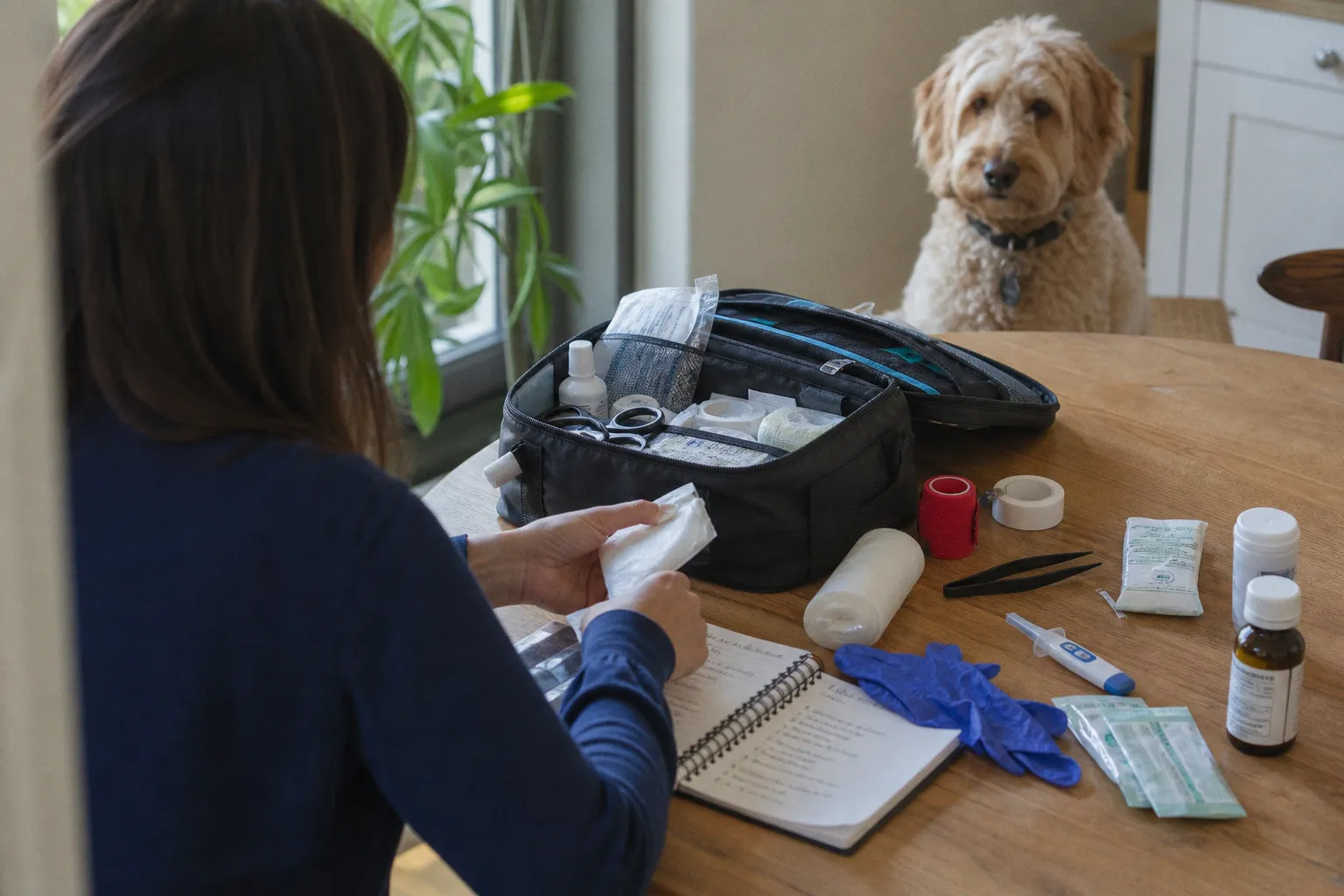
It is not a readiness metric.
Compare car rental deals in United Kingdom
See available offersPartner link — DiscoverCars comparisonThe comparison between canine first aid kit assembly vs pre-made bundles is often framed as convenience against price. That is incomplete. The operational question is whether the kit supports stabilization, transport, and a clean veterinary handover for the specific dog in front of you. Most commercial kits provide a portable base. Few arrive mission-ready.
For a pet sitter first aid bag, the gap is wider. One bag may need to serve dogs with different body sizes, medications, allergy histories, bite risks, and veterinary providers. A generic pouch cannot solve that problem by itself.
The piece-count paradox: more items, less capability
Commercial pet medical kits are marketed through quantity. Thirty-eight pieces. Forty-eight pieces. Fifty pieces. The number creates a false impression of coverage because it does not identify what those pieces do, whether they remain usable, or whether they fit the dog’s risk profile.
A kit can reach a high count through multiple small wound pads, alcohol wipes, cotton swabs, or adhesive strips. Those supplies are not useless. They are simply not equivalent to a complete emergency response system.
The practical value of a canine first aid kit depends on four functions:
1. Control: Limit bleeding, protect a wound, reduce contamination, or prevent further mechanical damage.
2. Assessment: Take temperature, inspect a paw, identify an embedded tick, observe gum color, or document symptoms for the clinic.
3. Transport: Maintain thermal regulation, create temporary padding, restrain safely, and move the dog without worsening the kinetic chain injury.
4. Handover: Give the veterinary team the dog’s identity, current medication list, vaccination information, timeline, and exposure details.
A bundle focused on minor wound care may perform the first function reasonably well. It may fail at the other three.
The American Animal Hospital Association’s baseline inventory is more useful than package quantity. It includes gauze, vet wrap, medical tape, pet-safe wound supplies, a thermometer, scissors, tweezers, gloves, saline, a flashlight, an oral syringe or eyedropper, a blanket or towel, an instant cold pack, emergency contact details, and medical records. That is a functional system, not a marketing number.
| Operational requirement | Typical pre-made bundle strength | Common failure point |
|---|---|---|
| Minor wound coverage | Usually adequate | Bandage materials may be too limited for repeated use |
| Tick or splinter removal | Often included | Tool quality and visibility in low light vary |
| Temperature assessment | Inconsistent | A thermometer is frequently absent or unverified |
| Poisoning response | Usually weak | No current poison-control plan or veterinary instruction |
| Allergy or chronic-condition response | Generic at best | No veterinarian-approved dog-specific medication plan |
| Veterinary handover | Usually absent | No records, medication list, or clinic directions |
| Multi-dog sitter use | Poor without modification | No labeling or dog-specific intake packet |
A retail listing once showed a 48-piece PacKit Large canine kit at $24.99 and a 38-piece medium version at the same price. That alone demonstrates why count is a weak comparison tool. Ten additional “pieces” do not automatically produce greater wound-control capacity, better thermal regulation, or safer transport capability.
A higher-priced option does not resolve the problem. An Adventure Medical Kits Me & My Dog bundle was listed at $58.99 against a displayed $74.99 list price and included human and canine first-aid supplies, an emergency blanket, and a cold pack. That can be a credible base kit. It still cannot contain the dog’s current medical record, the nearest emergency hospital’s route, or prescription medication appropriate to that animal.
A first aid kit is not complete when the pouch is full. It is complete when the handler can stabilize the dog and transfer accurate information to a veterinary team.
The missing layer: personalization cannot be factory-packed
The hidden cost of pre-made bundles is not necessarily a higher purchase price. No reliable comparison establishes that every pre-made kit costs more than assembling an equivalent kit from scratch. The cost appears after purchase, when the handler has to convert a generic inventory into a dog-specific emergency resource.
That conversion is mandatory.
A dog with a bee-sting allergy requires a veterinarian-directed response plan. A senior dog with impaired gait may require a larger towel or support sling strategy for load distribution during transport. A dog with a history of gastrointestinal obstruction needs clear notes about prior surgery, current medications, and the clinic that holds its records. A brachycephalic dog has a narrower margin for heat stress and respiratory compromise.
None of this can be standardized by a retail kit.
For each dog, add a sealed information packet containing:
- The dog’s legal name, age, weight, microchip number, and current photo.
- Primary veterinarian contact details and the closest 24-hour emergency clinic.
- Known allergies, chronic conditions, prior surgeries, and current medications.
- Feeding restrictions and relevant toxic-food exposures.
- Vaccination and medical record copies.
- Owner authorization and emergency spending instructions for professional care providers.
- A veterinarian-approved instruction sheet for any prescribed or approved emergency medication.
The medication issue requires discipline. A kit may include a slot labeled “antihistamine” or “poison control.” That label is not a treatment protocol. The correct medication, formulation, dosage, contraindications, and timing depend on the dog and the event. The AAHA recommends discussing medication selection and dosage with a veterinarian. The AVMA advises against giving medication or inducing vomiting unless directed by a veterinarian or poison-control professional.
This restriction matters because pet first aid errors are often procedural rather than supply-related. The handler sees a product in the bag and treats its presence as permission to use it. It is not.
Hydrogen peroxide is a clear example. ASPCA materials specify fresh 3% hydrogen peroxide as a possible kit supply, but only after consultation with a veterinarian or animal poison-control expert. The bottle is equipment. It is not standing authorization.
Build the kit around failure modes, not shopping categories
A useful DIY pet emergency supplies kit begins with likely incidents. This approach also exposes where a pre-made bag is adequate and where it needs reinforcement.
1. Paw, pad, and nail injuries
Dogs on regular walks encounter broken nails, lacerated pads, torn dewclaws, burrs, glass, and abrasive pavement damage. These injuries can alter gait quickly. A dog may unload one limb, overload the opposite forelimb, and shift stress through the shoulder and lumbar spine. The first priority is not a cosmetically neat bandage. It is controlled movement.
The kit should support:
- Gauze for direct pressure and padding.
- Vet wrap used with controlled tension.
- Medical tape.
- Blunt-end scissors.
- Tweezers.
- Saline for flushing superficial debris.
- Gloves.
- A towel for traction, restraint, or limb support.
- A light source for inspection under the paw.
Vet wrap is a frequent misuse point. Applied too tightly, it can compromise circulation. Applied directly over a dirty wound without assessment, it can trap contamination. Applied to an anxious dog without addressing bite risk, it can create a second casualty.
2. Suspected poisoning or ingestion
The primary tool is communication, not a bottle of medication.
For a suspected toxic exposure, secure the substance container, estimate timing and amount if possible, prevent further access, and contact a veterinarian, emergency hospital, or poison-control expert. The FDA notes that two U.S. animal poison control services operate 24 hours a day, 365 days a year, and charge a fee. Their availability does not remove the need to reach the dog’s veterinary provider when directed.
The kit supports this process with:
- Current contact numbers.
- An oral syringe for use only under professional direction.
- Gloves.
- Paper or a waterproof card for documenting time, substance, amount, and symptoms.
- A flashlight for inspection.
- Towels for containment and transport.
Do not force vomiting. Do not administer activated charcoal, antihistamines, hydrogen peroxide, or human medications without direct instruction. A generic bundle that contains these items may increase risk if the handler lacks a decision boundary.
3. Heat exposure and thermal dysregulation
Thermal regulation is a field problem, especially for dog walkers. Pavement temperature, humidity, coat density, body condition, pace, hydration status, and muzzle anatomy all affect heat load. A cold pack in a kit is useful, but it is not heatstroke management.
A response bag should contain an instant cold pack and absorbent towels. More importantly, the walker needs a route plan, water access, weather thresholds, and a transport decision point. Once a dog shows concerning heat-related signs, the route is over. Continuing toward the scheduled destination is not efficient. It is a delay in escalation.
4. Trauma requiring controlled transport
A blanket or large towel is often undervalued because it is not “medical.” In field use, it can provide insulation, traction, shielding, temporary containment, or a two-person carry surface. For a dog with suspected spinal, pelvic, or limb trauma, reducing unnecessary movement is part of the intervention.
Do not attempt field diagnosis through aggressive range-of-motion testing. Gait analysis can identify asymmetry, non-weight-bearing, shortened stride, knuckling, or reluctance to turn. It cannot rule out fracture, ligament damage, neurological injury, or internal trauma.
The correct endpoint is veterinary assessment.
The six-month trap: every kit degrades into a random pouch
The next hidden cost is maintenance. A pre-made kit is not a one-time purchase. It is an inventory that starts degrading on the day it is packed.
The AAHA recommends inspecting pet first aid kits approximately every six months. That cycle should include expiration checks, restocking used items, inspection for damage, replacement of dried-out wipes, battery checks, and updates to records.
Most neglected kits fail in predictable ways:
- Wipes dry out after prolonged heat exposure in a vehicle.
- Adhesive products lose performance.
- Batteries corrode or flashlight output drops.
- Gauze packaging tears.
- Instant cold packs are used and not replaced.
- Vet wrap disappears into routine household use.
- Records become outdated after a medication change, vaccine visit, or change of address.
- The emergency clinic listed in the pouch is no longer the closest viable option.
- The bag is moved between vehicles and no one knows where it is.
A walker’s kit faces additional stress. It is exposed to rain, temperature cycling, dog hair, dirt, compression, and repeated opening. A hard-shell container offers more crush resistance but less portability. A soft zip pouch fits a field bag but requires water-resistant internal organization.
Use a two-tier layout:
| Layer | Purpose | Contents |
|---|---|---|
| Immediate-access layer | Supplies needed in the first minute | Gloves, gauze, vet wrap, saline, scissors, tweezers, flashlight |
| Information and transport layer | Supplies needed after initial control | Records, emergency contacts, towels, cold pack, oral syringe, spare batteries, dog-specific instructions |
Labeling matters in multi-dog operations. A shared kit can carry universal equipment. It should not become a shared medication cabinet. Individual dog records and veterinarian-directed supplies need separate, clearly marked compartments or sealed packets.
The maintenance interval is part of the purchase price. If the kit is not inspected, its listed contents are historical data.
Economic reality: buy a base, then budget for readiness
The emergency pet kit cost comparison changes once the right categories are compared.
A pre-made kit may save assembly time. It can also provide a compact case, basic wound-care components, a cold pack, and specialty tools such as tick removers. Those are real benefits. For a new pet owner or a sitter building an initial field bag, a competent bundle can be the fastest way to establish a baseline.
The error is treating the bundle as the finished system.
A DIY build allows a handler to select larger gauze rolls, better lighting, a more durable case, a thermometer, or transport materials suited to the dog’s size. It also allows supplies to be acquired gradually. But DIY assembly has its own failure pattern: people buy individual products without a storage plan, omit documentation, forget replacement cycles, or select medicines without veterinary direction.
The comparison is therefore not “cheap DIY versus overpriced pet medical kits.” It is “generic base inventory versus controlled, maintained readiness.”
Use this decision sequence:
1. Start with the operating environment. A kit stored in a home cabinet has different needs from one carried through urban walking routes, trails, or multi-dog boarding settings.
2. Identify the dog’s specific modifiers. Allergies, age, mobility limitations, breed-related respiratory concerns, medication requirements, and prior emergencies change the kit.
3. Audit the pre-made contents line by line. Ignore the item count. Determine whether it contains gauze, wrap, tape, gloves, saline, thermometer, scissors, tweezers, light source, cold pack, towel or blanket, and usable storage.
4. Add the non-retail layer. Insert current contacts, clinic directions, medical records, owner authorization, and veterinarian-approved instructions.
5. Assign a maintenance date. Put the next six-month inspection date on the bag and in a calendar.
6. Train the handler on limits. Every person with access to the kit must know that first aid stabilizes. It does not replace diagnosis or treatment.
For professional pet sitters, duplicate low-cost universal supplies rather than constantly moving one partially depleted pouch between clients. The cost of an extra roll of gauze is lower than the operational cost of discovering the only roll was used last week. Keep dog-specific records separate and current. This is more reliable than trying to create a single universal emergency profile.
Stabilization is only the first half of the protocol
A field kit is designed to buy time. It is not designed to resolve the event.
Merck Veterinary Manual guidance is direct: emergency first aid should be followed by veterinary evaluation as soon as possible. The ASPCA makes the same distinction. Most emergencies require immediate veterinary care; first aid may stabilize the animal for transport.
The veterinary handover should be treated as a formal step. Record:
- Time the injury or exposure was noticed.
- Observable signs: limping, vomiting, collapse, bleeding, respiratory effort, altered behavior, loss of coordination.
- What the dog may have eaten, contacted, or inhaled.
- Any first aid applied.
- Any product administered under veterinary or poison-control direction.
- Changes during transport.
- The dog’s current medications and known allergies.
This information reduces reconstruction time at the clinic. It also prevents a common failure in pet sitter care: the owner receives a vague message, the emergency team receives incomplete details, and the timeline becomes unreliable.
A well-designed canine kit does not make the handler more willing to treat complex cases in the field. It makes the handler faster at recognizing the threshold for escalation.
The standard to use before carrying any kit
The right kit is not defined by its price, color, or piece count. It is defined by whether it can meet a short set of safety parameters under real conditions.
- It contains wound-control and basic assessment supplies in usable condition.
- It includes a thermometer, light source, gloves, scissors, tweezers, saline, gauze, wrap, tape, towel or blanket, and cold pack.
- It carries current emergency contact information and medical records.
- It has dog-specific additions only when approved and documented by a veterinarian.
- It is organized for immediate access during a walk, drive, or home emergency.
- It is inspected at least every six months and after every use.
- Its handler understands that poisoning, breathing distress, collapse, uncontrolled bleeding, trauma, and severe pain require prompt professional direction and veterinary care.
Buy a pre-made bundle if it gives you a durable, portable starting point. Build from scratch if the dog’s risk profile or working environment requires more control. In either case, the finished system begins after the purchase.