Beyond Boredom: Expert Strategies for Meaningful Canine Enrichment
Five certified dog behavior professionals consulted by The Guardian converge on a practical toolkit that prioritizes training mechanics, sensory engagement, and handler efficiency.
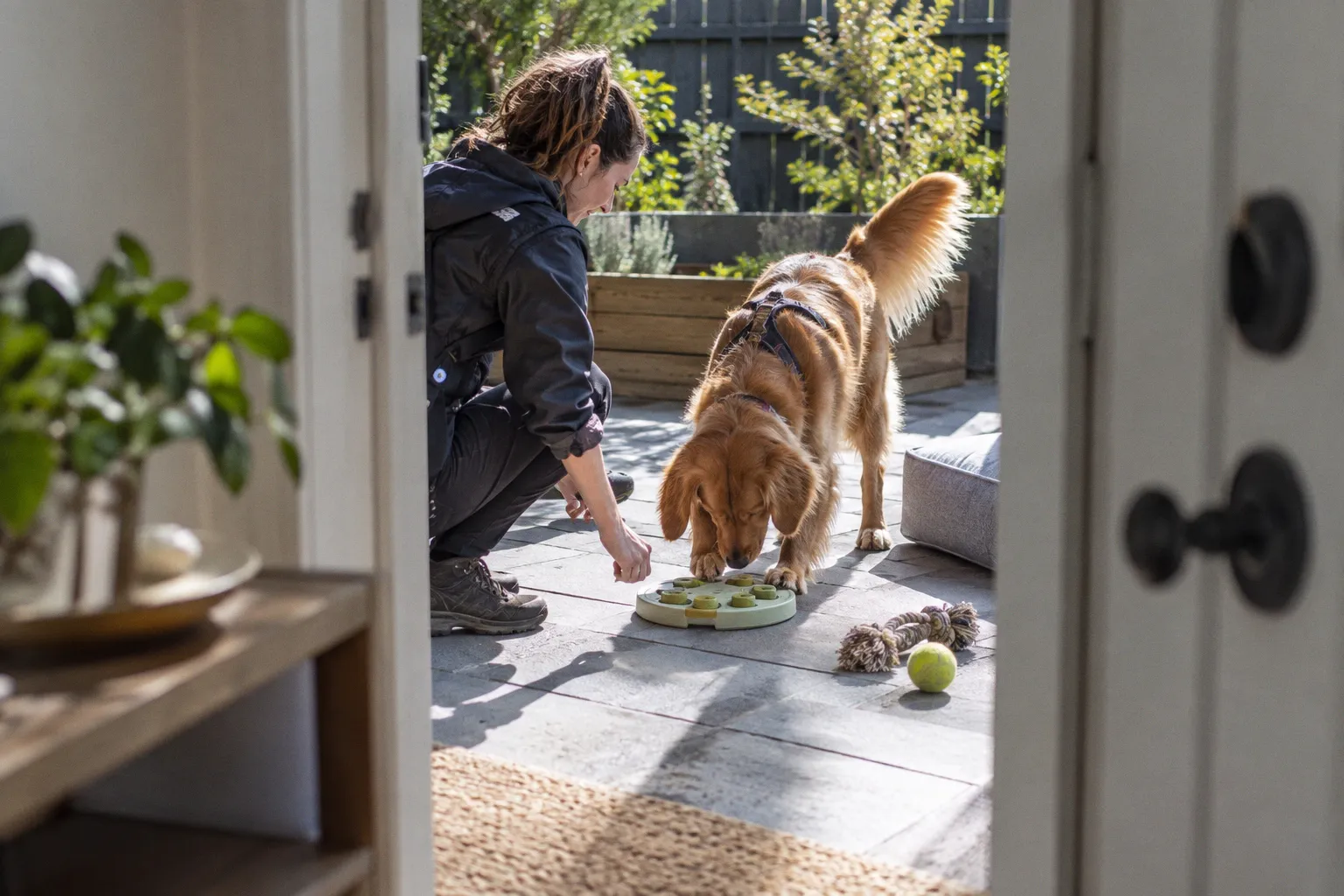
Behavioral Noise Signals Enrichment Deficit
A dog that cannot settle during low-stimulation household activities — television viewing, reading, meal preparation — is displaying a measurable enrichment deficit. Certified trainer and author Suzanne Clothier frames the diagnostic in operational terms: if the handler cannot maintain focus on a static task, the animal is communicating unmet cognitive or physical load requirements. The symptom set — destructive behavior, restlessness, failure to self-occupy — maps to under-engagement rather than a breed-specific trait. Five certified dog behavior professionals consulted by The Guardian converge on a practical toolkit that prioritizes training mechanics, sensory engagement, and handler efficiency.
Temperament Over Taxonomy
Breed labels predict energy output poorly at the individual level. Clothier points to border collies — a breed routinely cited as high-drive — to illustrate variance: some maintain reliable activation-rest cycles without external intervention. The operational takeaway is to assess the specific animal's threshold rather than applying breed-based assumptions about required stimulation volume. Over-stimulation and over-tire produce the same behavioral noise as under-stimulation. The target is calibrated load — enough cognitive and physical work to reach a settle state, without exceeding recovery capacity.
Training Mechanics and Handler Equipment
Miranda LaMorte, head trainer at Adventure Tails Training and a Training Without Conflict certified professional, states that cohabitation with a dog is continuous training. Every interaction reinforces a behavioral pattern — acceptable or unacceptable. Food drive is the most accessible reinforcement vector across most individuals. The delivery method matters: fumbling with a treat pocket converts the handler's hand motion into a competing cue, overriding the intended behavior marker.
LaMorte recommends a dedicated treat pouch that eliminates retrieval latency. The Gobeigo 4-Cup Dog Treat Pouch — cited in the source as a practical option — provides magnetic closure, a removable silicone liner for fresh food storage, and a secondary pocket for waste bags. It ships with a clicker for conditioned-marker protocols. The pouch can be worn at the waist or slung cross-body, keeping both hands available for leash management and spatial guidance.
A separate training leash — distinct from the dog's daily walking line — should also be in the handler's kit. The dedicated line stays conditioned to training context only, preventing associative bleed between routine walks and active behavior-shaping sessions.
What to Verify Before You Buy
- Assess your dog's actual threshold. Monitor settle time after enrichment activities. If the animal cannot maintain a down-stay for 10–15 minutes post-activity, load calibration is off — either insufficient or excessive.
- Audit your treat delivery system. If your hand movement toward the treat source draws the dog's gaze before the marker, your cue chain is compromised. Switch to a fixed-position pouch.
- Separate training gear from daily gear. Dedicated leash, dedicated pouch, dedicated session window. Context-specific equipment reduces noise in the behavior chain.
- Avoid breed-based enrichment prescriptions. Evaluate the individual's recovery time, arousal ceiling, and self-settle capacity through direct observation, not breed charts.
Enrichment is not a product category — it is a load-management protocol. The tools are secondary to the handler's ability to read the animal's feedback loop and adjust intensity accordingly.