How Distracted Dog Walking Threatens Wildlife and Livestock Safety
Field research from the University of Surrey links divided-attention dog walking to missed waste events, wildlife intrusion, and livestock contact during 40 hours of direct observation across four…
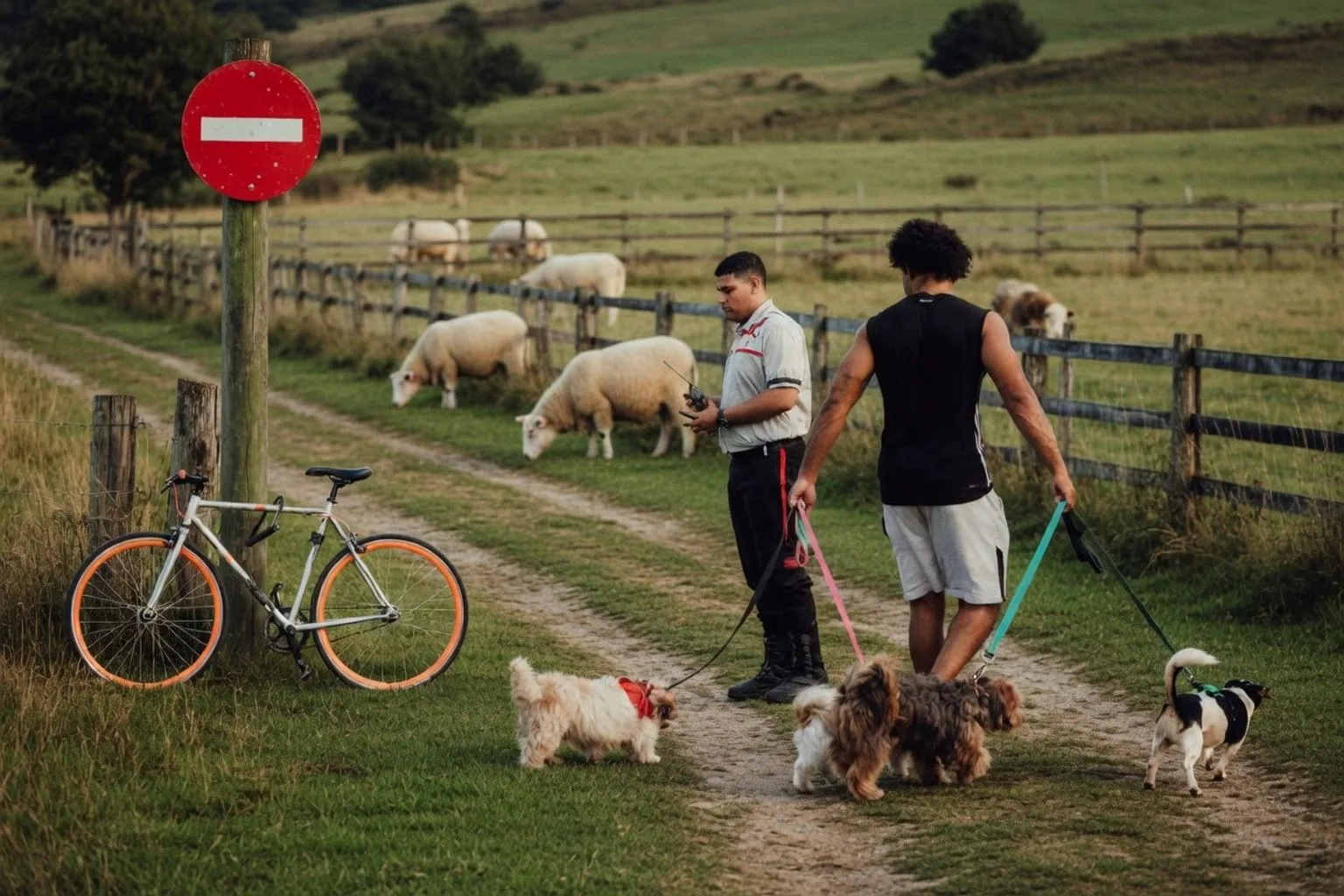
Field research from the University of Surrey links divided-attention dog walking to missed waste events, wildlife intrusion, and livestock contact during 40 hours of direct observation across four Surrey sites, including Puttenham Common, the Chantries and St. Martha's Hill, Norbury Park, and Denbies Wine Estate. The peer-reviewed paper, published in Society & Natural Resources, frames the problem as attention and infrastructure failure rather than deliberate negligence.
Observation Parameters
Researchers logged incidents across public-access land and one private estate. Site selection prioritized mixed-use terrain with overlapping footfall.
- 40 hours of field observation.
- 15-person workshop: farmers, land managers, rural business operators, conservation professionals.
- 11 recorded instances of owners failing to notice their dog defecating.
- Waste concentration measured within 50–100 meters of parking lots and along high-traffic paths.
The waste clustering near walk origins reflects canine elimination behavior at the start of the route, not mid-walk dispersion.
Failure Modes Identified
Four distraction vectors produced measurable risk.
- Mobile device use: walkers on phones or in headphones failed to register elimination events, path deviations, and habitat entries.
- Social conversation: paired or group walkers diverted visual attention from their animals.
- Multi-dog handling: professional walkers split attention across multiple animals, reducing control latency.
- Off-leash range: unsupervised dogs entered undergrowth, displaced ground-nesting birds, and closed distance on livestock.
Counter-data points require note. The majority of observed walkers retrieved waste, and a subset picked up waste left by other animals. According to Dr. Tom Roberts, senior lecturer in environmental sociology at the University of Surrey, the binary of responsible versus irresponsible walker is unsupported.
Mitigation Variables
Workshop output and researcher recommendations converge on infrastructure and message placement.
- Bin relocation: shifting waste receptacles from access points to high-fouling zones (50–100 m from parking lots) aligns disposal supply with demand.
- Off-leash zoning: dedicated exercise areas routed away from sensitive habitat reduce conflict without restricting total off-leash access.
- Signage design: seasonal notices tied to ground-nesting bird vulnerability outperformed generic leash directives; however, attention decay tracked with sign familiarity.
- Stewardship models: community-led monitoring placed at path junctions and decision points.
Haeyoung Eun, innovation lead at the University of Surrey, indicated that additional rule layering underperforms compared to facility calibration matched to walker routine.
Professional Walker Checklist
For handlers operating on shared-use land, the following parameters warrant direct control.
- Attention budget: one dog per handler maintains baseline vigilance; two-dog packs reduce reaction time and warrant leashed passage through habitat edges.
- Elimination window: assume first 100 m after parking access carries fouling risk; pre-position bagged waste retrieval at this interval.
- Device discipline: phone and headphone use deprioritized within 50 m of livestock fencing and ground-nesting zones.
- Off-leash boundary: maintain vocal contact and visual lock with the animal; reassess every 30 seconds.
- Reporting loop: log wildlife flushes and livestock approaches to the relevant land manager; aggregated field data improves zoning decisions.
The Surrey data positions distracted walking as an attention management problem solvable through infrastructure alignment, not compliance messaging. Walking professionals carry the highest mitigation load given their multi-animal load distribution requirements.