Rethinking Your Dog Walking Routine: Why Mechanics Matter More Than Mileage
According to The Guardian, canine welfare researchers identify a consistent structural error in routine outings: the leash stays taut, the cervical spine absorbs the load, and the owner assumes…
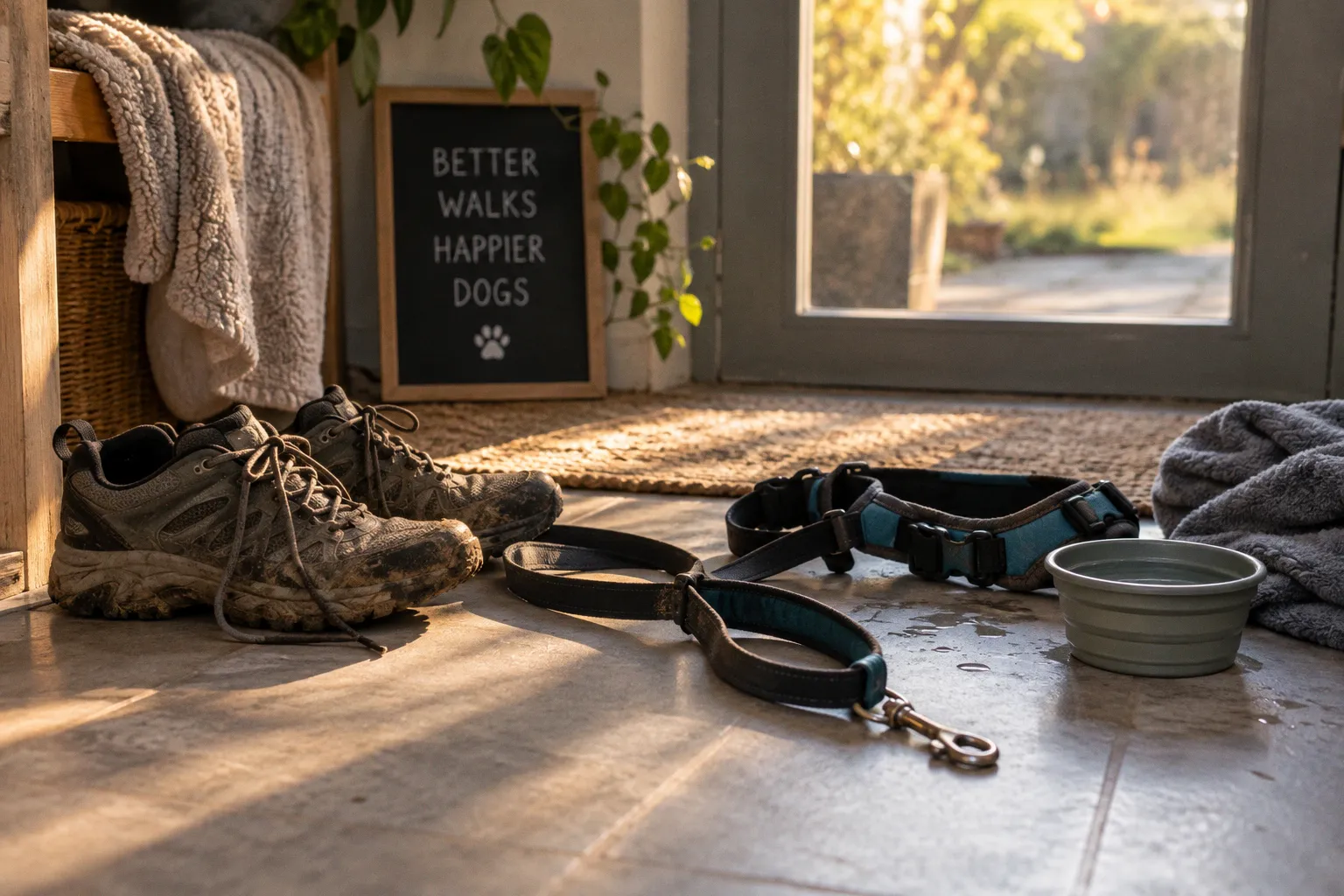
Walking mechanics fail more often than walking frequency does. According to The Guardian, canine welfare researchers identify a consistent structural error in routine outings: the leash stays taut, the cervical spine absorbs the load, and the owner assumes distance equals exercise value. Dr. Candace Croney, director of Purdue University's Center for Animal Welfare Science, addresses the issue without softening it — people put a lot of pressure on their dogs' necks. This is not good for them.
Pre-Outing Protocol
Define the objective before crossing the threshold. Each walk performs one or more of three measurable functions:
- Locomotion — sustained forward gait at controlled pace
- Cognitive engagement — olfactory mapping, environmental scanning, neighborhood data acquisition
- Elimination — pre-event relief, post-meal output, weather-related urgency
Croney identifies the primary failure pattern: owners project their own expectations onto the outing without registering what the dog actually requires. A five-mile sprint and a five-minute sniff route activate entirely different physiological and neurological systems. Neither is incorrect. The mismatch creates the problem. The walk that satisfies the handler while exhausting the dog is not the same walk as the one that satisfies the dog.
Professional trainer Jas Kelem echoes the assessment: fulfillment matters more than duration or repetition count. There is no universal benchmark for daily mileage. Individual need dictates load.
Load Distribution & Leash Mechanics
A taut leash transmits kinetic force directly into the cervical vertebrae. Repeated tension cycles increase shear load across the neck and disrupt normal gait kinematics. The correction is mechanical, not motivational: loose leash walking. Neither party pulls. The line hangs slack; the neck remains in neutral alignment.
Do not yank the dog away from the 30th mailbox. Olfactory sampling functions as information gathering, not delay tactics. Croney notes that the scent landscape is so dense and informative to the dog that stopping and checking becomes mandatory cognitive work. On walks designated for mental stimulation, route distance becomes secondary to environmental input quality.
Equipment selection reinforces the principle. A well-fitted chest harness redistributes pulling load across the sternum and shoulders, bypassing the cervical spine entirely. A flat collar under tension concentrates force at a single anatomical point — the throat. For dogs that pull, the harness is not optional equipment.
Reinforcement Timing
Kelem advises carrying food or treats on every outing. The application window opens before misbehavior occurs, not after. Croney adds a calibration tier: reserve high-value treats exclusively for unexpected or challenging conditions encountered mid-route — traffic noise, reactive encounters, sudden environmental stressors.
The underlying principle: reinforce the gait, posture, and behavior you want in real time, not once the leash has already gone taut. Treats function as markers for correct mechanics, not as apologies for incorrect ones.
Walk Readiness Checklist
- Objective defined: locomotion, cognition, elimination, or weighted combination
- Harness or collar fit verified — no direct cervical load under simulated tension
- Standard treats loaded; high-value treats separated and reserved
- Leash length set for slack by default, not tension
- Handler expectation reset: fulfillment measured over mileage