Evaluating the New Self-Service Dog Wash at Gadebridge Park for Professional Walkers
Per Dacorum Borough Council, Polygon Pets has installed a self-service dog wash at Gadebridge Park in Hemel Hempstead, positioned for walkers finishing routes through the park.
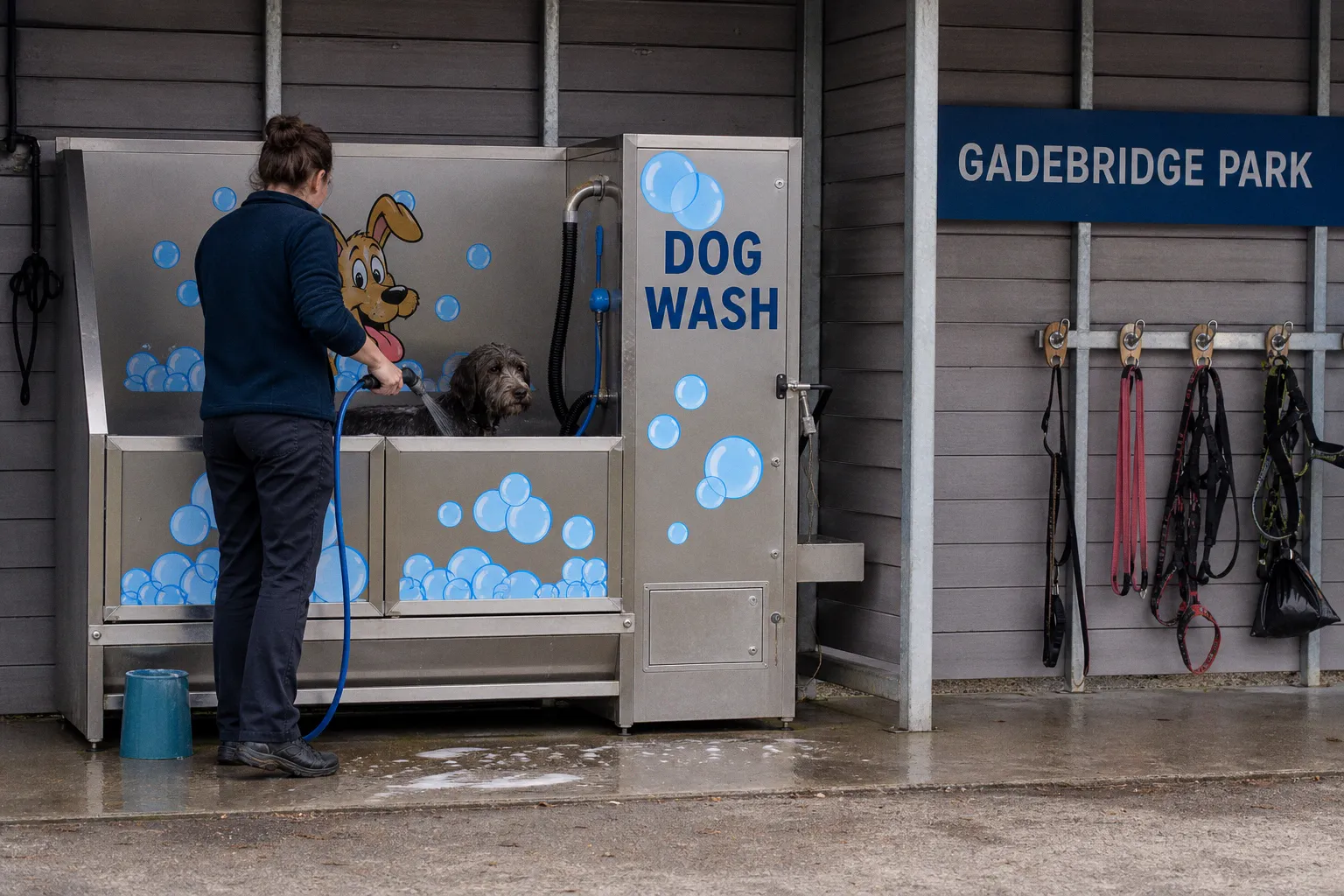
Gadebridge Park adds self-service wash to working-dog routes
The facility is framed as convenience for post-activity cleanup. Convenience is not a substitute for a post-exercise protocol. Walkers and sitters integrating this site need to verify parameters before adding it to a paid route.
Load distribution: wet coat is not free mass
A saturated medium coat holds 1.5–2 kg of water distributed across the thorax, shoulders, and proximal hindquarters. That additional load alters gait mechanics on the return walk, increases carpal and stifle compression, and forces compensatory lumbar flexion in dogs with already-compromised kinetic chains. If a wash occurs mid-route, insert a 5–10 minute low-mobility standing rest before resuming motion. Towel to damp, not dripping. A wet dog that walks a kilometre home is performing work on an unstable surface with altered center of gravity.
Thermal regulation: the underreported variable
Wet undercoat loses approximately 70% of its insulation value. Below 15°C ambient, a freshly washed dog at standard walking pace cannot maintain core temperature through passive metabolism. Monitor shivering onset, tucked abdominal posture, and reluctance to move forward. Note: cessation of shivering in a still-wet dog is a worse indicator than continued shivering — it signals thermal shutdown. For clipped, senior, juvenile, or thin-coated dogs, treat any wash below 18°C as contraindicated unless a heated dryer or vehicle cabin is the next step.
Kinetic chain: gait risks after standing in a tub
Stationary standing on a hard tub base for 8–15 minutes loads the forelimbs differently than walking does. Combined with wet paw pads and potential surfactant residue, this elevates slip risk at exit. Confirm flooring material and drainage flow before first use. Standing water at the exit point compounds the hazard.
Facility verification checklist
Run through these before treating the site as standard equipment:
- Water temperature control present — unregulated scald risk on heated taps
- Non-slip surface at tub base and exit platform — verify dry traction, not just wet traction
- Restraint design — fixed overhead loop versus slip lead. Fixed loop prevents escape but can suspend a panicking dog; slip lead permits controlled release but requires handler presence
- Drainage flow rate — standing water at exit is a slip hazard
- Chemical provision — confirm whether supplied product is pH-appropriate or whether you bring your own
Protocol adjustments for sitters and walkers
Log the wash as a discrete service event: time, duration, coat condition before and after, ambient temperature. A wash is not a groom. Within 24 hours, verify the ear canals are dry, the interdigital folds show no erythema, and no new matting has formed at friction points. A wash-and-go without follow-up inspection is an incomplete record.
The Gadebridge install is functional infrastructure. Treat it as equipment with operating parameters — verify those parameters, log the use, and monitor the dog on the walk home.