Dog mobility checks: is your senior client in pain?
“Getting old” is the excuse that lets a lot of dogs hurt in silence.
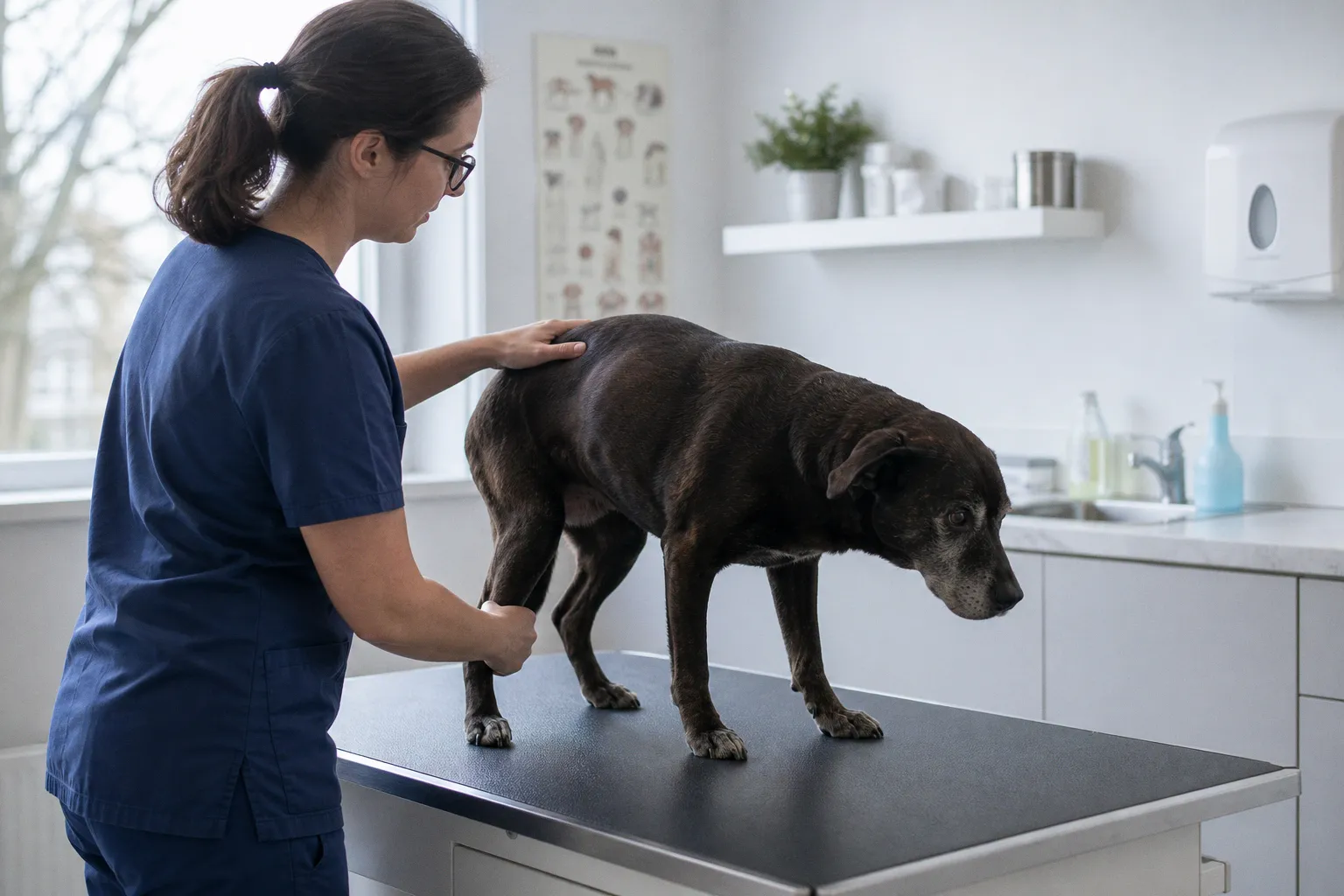
A senior dog who slows down on walks is not automatically developing arthritis. He may be sore, weak, anxious, overheated, dealing with heart or metabolic disease, or simply having a bad day. But the opposite mistake is just as common: calling every limp, hesitation, or stiff first step “normal aging” and carrying on with the usual route.
From the shelter floor, the hard truth is that dogs rarely submit a clean pain report. They adapt. They take shorter strides. They stop sitting neatly. They avoid the shiny lobby floor. They become “grumpy” when another dog crashes into their hip. Then somebody calls them stubborn, lazy, or difficult.
For a walker or sitter, the job is not to diagnose osteoarthritis from the end of a leash. It is to recognize the signs of pain in senior dogs during walks, reduce the immediate risk, document what happened, and get the information to the person who can act on it: the owner and the veterinarian.
Beyond slowing down: what a changed walk is actually telling you
“Dog slowing down on walks” is one of those phrases that sounds harmless until you watch the pattern over several visits. A dog who once trotted to the corner may now stop at the driveway. A dog who used to pull toward the park may hang back after ten minutes. A dog may start the walk stiff, then loosen up, then deteriorate again toward the end.
That is not a diagnosis. It is data.
Pain is one possible explanation, particularly pain associated with osteoarthritis. Osteoarthritis is a chronic, progressive joint disease, and it can show up as stiffness, lameness, shorter stride length, trouble rising, reluctance to climb stairs or jump, muscle loss, and irritability. It is common in older dogs, but it is not reserved for them. Weight, previous orthopedic injuries, and joint structure all matter. A young dog can have arthritis; an old dog can have something else entirely.
The useful question is not, “Does this dog look old?” It is, “Has this dog’s normal movement changed?”
A competent pet sitter mobility assessment begins with a baseline. If you have walked the dog before, you have an advantage: you know whether he normally forges ahead, sniffs for twenty minutes, pulls up stairs, or plants himself at every squirrel. If you are new to the client, ask the owner before the first walk:
- What does a normal walk look like for this dog: pace, distance, route, stairs, pulling, stopping?
- Is there a veterinary exercise plan, a diagnosed mobility issue, or a medication schedule that affects walks?
- Are there surfaces, weather conditions, hills, curbs, or stairs the dog avoids?
- Does the dog use a harness, support sling, boots, toe grips, or another mobility aid?
- What changes should trigger an immediate call, and which veterinary clinic should be contacted after hours?
That is not paperwork theatre. It prevents the classic failure: a walker assumes a dog is “fine for his age,” pushes the usual loop, and learns too late that the owner had already been told to keep outings short and level.
A senior dog does not need you to prove he can still do the old route. He needs you to notice when that route has become too expensive for his body.
The gait changes that deserve your attention
Dogs compensate. They shift weight. They alter posture. They use momentum instead of strength. If you only watch for a dramatic three-legged limp, you will miss the quieter behavioral fallout.
Watch the dog from the side and from behind when possible. Do it during the first minute of the outing, after a few minutes of walking, at turns, and when rising from a stop. One awkward step on loose gravel may mean nothing. A repeated change across multiple transitions is worth recording.
| What you see on the walk | What it may suggest | What a walker or sitter should do |
|---|---|---|
| Stiff first steps after getting up, then a somewhat freer gait | Possible joint discomfort or reduced mobility; not proof of arthritis | Keep the outing gentle, note duration and pattern, tell the owner |
| Limping, toe-touching, or refusing to bear weight on a leg | Pain, injury, paw problem, or another medical issue | Stop the walk, prevent extra strain, contact the owner promptly |
| Head held low, back arched, or an unusually guarded posture | General discomfort or pain; the source cannot be identified from observation alone | End strenuous activity, document posture and context, escalate to owner/vet guidance |
| Sitting on one hip or repeatedly shifting weight | Possible discomfort in a limb, hip, back, or other area | Avoid forcing sits or repeated curb work; report the pattern |
| Reluctance at stairs, curbs, car entry, or jumping | Mobility limitation, fear after a painful experience, weakness, or pain | Use the approved alternative route or ramp; do not drag or lift without a safe plan |
| Suddenly lagging behind after normal early enthusiasm | Reduced stamina, pain, heat stress, cardiac or metabolic issues among possibilities | Shorten the walk, seek shade and water as appropriate, inform owner |
| Snapping when handled near a shoulder, hip, or back | Pain response, fear, or resource guarding around personal space | Stop handling, give distance, use a calm safety plan, notify owner |
Canine joint stiffness indicators are not always in the legs. A dog may take wide turns because tight turns hurt. He may pivot his whole body instead of twisting his neck and shoulders. He may hesitate before relieving himself because squatting or lifting a leg is uncomfortable. He may stop offering a sit because folding the hips is difficult. He may resent a harness being pulled over his head.
And yes, a normally social dog may become less tolerant when painful. Do not turn this into a morality story about a dog “getting mean.” Pain changes the margin for nonsense. A dog who could once tolerate another dog bouncing into him may now warn first. Respect the warning. Increase distance. Do not punish it out of him.
Pay attention to transitions, not only mileage
The most revealing moments often happen outside the main walking rhythm:
1. Getting up from bedding or a floor. Does the dog need several tries? Does he brace his front end, hesitate, or rise with a stiff back?
2. Starting after a stop. A dog can look acceptable while moving but struggle every time the walk resumes.
3. Turning around. Tight U-turns expose discomfort that a straight sidewalk hides.
4. Negotiating curbs and stairs. Refusal, scrambling, bunny-hopping, or a long pause are all useful observations.
5. Returning home. Does the dog recover normally, or does he collapse, pant unusually, avoid lying down, or become reluctant to move again?
These details are more valuable than the vague message owners often get: “He was a little slow today.” Slow compared with what? At what point in the walk? On which surface? Did he still bear weight? Did he improve after warming up or worsen with distance? That is the difference between a useful handoff and a shrug.
Slippery floors and hard pavement are not minor details
Senior dogs often expose mobility trouble on surfaces that demand traction. A dog may look stable on grass and suddenly splay on polished tile. He may hesitate at the entrance to an apartment building because the floor is slick, not because he has decided the walk is over. He may move cautiously on wet leaves, ice, loose gravel, steep driveways, or metal grates.
This is where older dog exercise safety gets practical fast. The walker’s route is part of the dog’s physical load. A long flat path with good footing may be manageable; a shorter route full of steep curbs, slick lobby flooring, and stairs may not be.
Do not interpret avoidance as disobedience before looking at the ground. Dogs are not subtle about learning that a surface makes them feel unstable or hurts when they land.
Environmental support is not glamorous, and it does not cure a progressive joint problem. It can still reduce daily strain. Veterinary guidance for senior mobility commonly includes traction aids such as rugs or yoga mats, ramps, properly fitted padded support harnesses for larger dogs, and, for some dogs, toe grips, boots, or socks that improve footing.
For the pet care professional, the immediate work is simpler:
- Choose level, predictable ground over the scenic obstacle course.
- Slow down before curbs rather than asking the dog to launch after a taut leash.
- Avoid repeated stairs when there is an approved elevator, ramp, or alternate exit.
- Give the dog time to position himself; rushing a stiff dog creates falls.
- Keep the leash short enough for safety but loose enough that the dog can use his body naturally.
- Do not pull a hesitant dog across slick flooring. Create traction, change the path, or pause for owner instructions.
- Use only the mobility equipment the owner has authorized and shown you how to fit.
A badly fitted harness can rub, restrict shoulder movement, or give the handler false confidence. A support harness is not a license to haul a large dog up steps like luggage. If lifting or assisted transfers are part of the care plan, the owner needs to demonstrate the method, and the dog needs veterinary-informed handling instructions. Otherwise, somebody eventually gets hurt.
The route is not neutral. Pavement, stairs, wet tile, and a rushed handler can turn mild mobility trouble into a bad day.
Video beats memory when the veterinarian needs a clearer picture
Owners often do not see what their dog looks like at the start of a weekday walk. They see the dog after he has slept, stretched, and adjusted to the household routine. Walkers and sitters see a different slice of the day, which is useful if they document it properly.
Short videos of a senior dog moving and interacting can help veterinary teams evaluate change over time and monitor response to treatment or therapy. The key word is help. A video does not make the sitter a diagnostician, and it does not replace an examination.
If the owner consents to video documentation, capture something that a clinic can use:
- Record the dog walking in a straight line from the side and, if safely possible, from behind.
- Include the transition from standing still to moving.
- Film before the dog has been coaxed, dragged, or “warmed up” with five minutes of marching.
- Note the date, time, weather, surface, approximate point in the walk, and whether the dog had just risen from rest.
- Keep the clip short and boring. Veterinarians do not need a cinematic montage with a motivational soundtrack.
- Send the original clip promptly, without filters, speed changes, or commentary that declares the diagnosis.
A good written note might read: “At 8:10 a.m., after rising from his bed, Milo took about six stiff steps and held his right rear leg lightly for the first block. He bore weight but lagged behind after roughly seven minutes on flat sidewalk. He paused before the two front steps and needed extra time to go up. No fall or known trauma. I ended the route early.”
That gives the owner a clean report to share with the veterinary team. “Milo seemed weird” does not.
The red-flag threshold is about function, not bravado
There is no universal time limit after which every limp becomes an emergency. Context matters: sudden versus gradual onset, trauma, whether the dog can bear weight, swelling, severe distress, breathing changes, and other signs all alter urgency.
Still, a professional should have a clear escalation plan. Stop the walk and contact the owner immediately when a dog suddenly cannot bear weight, collapses, cries out repeatedly, shows obvious severe distress, has a known injury event, or develops a major abrupt change from baseline. Follow the owner’s emergency authorization and clinic instructions. If the owner cannot be reached and the dog appears to be in immediate danger, the service’s emergency protocol should already tell you what happens next.
This is why “I didn’t want to bother them” is not a defensible care standard. Owners hire professionals to notice things they cannot see. Silence is not kindness when a dog’s function changes sharply.
Do not medicate the dog because the walk looked rough
This should not need saying, but the pet care industry has enough casual advice floating around to make it necessary.
Do not give a dog aspirin, ibuprofen, naproxen, acetaminophen, leftover medication, a human pain reliever, or medication prescribed for another pet because he looked sore on your walk. Do not suggest that the owner do it, either. Human NSAIDs may not be safe or effective for dogs, and medication decisions belong with the veterinarian managing that individual dog.
The same goes for improvising dosage changes. A dog already receiving a veterinary-prescribed pain medication may still have a bad mobility day. That does not make a walker qualified to add a dose, skip a dose, combine products, or decide that the drug “isn’t working.” Long-term NSAID treatment can require baseline testing and scheduled follow-up discussions with the veterinary team. That is medical management, not a leash-side judgment call.
The boundary is clean:
| Your role in recognizing senior dog distress | Not your role |
|---|---|
| Observe gait, posture, stamina, and behavior | Diagnose arthritis, spinal disease, heart disease, or endocrine disease |
| Reduce exertion and prevent falls | Decide the dog needs a new medication or dose |
| Notify the owner with specific observations | Give human medication or another pet’s prescription |
| Capture owner-approved video and keep records | Promise that a supplement, boot, ramp, or harness will fix the problem |
| Follow the veterinary plan supplied by the owner | Override that plan because the dog seemed energetic one day |
This may sound strict. Good. Pain management gets sloppy when everyone wants to be helpful and nobody wants to be responsible.
Build the senior client’s mobility plan before the bad walk
A mobility check works best when it is part of a standing care plan, not a panicked text thread after the dog freezes halfway down the block.
Senior dogs should have at least yearly veterinary checkups, and dogs considered geriatric are commonly recommended to be seen every six months. There is no single birthday that turns every dog into a senior; size, breed, health history, and individual condition all matter. But a dog whose mobility or stamina is changing deserves a veterinary conversation sooner than the next routine appointment.
For a professional dog-walking or pet-sitting arrangement, ask the owner to provide a concise written plan. It should include the dog’s normal baseline, approved route options, mobility equipment, medication administration instructions if that is part of your service, emergency contacts, the regular veterinarian, the preferred emergency clinic, and clear escalation instructions.
Then do the unglamorous homework:
1. Track patterns across visits. One slow morning can be weather, sleep, or a stomach upset. Repeated stiffness after rest, repeated hesitation on stairs, or a gradual shortening of walks is a pattern.
2. Change the route before the dog has to fail it. If the dog starts fading at the far end of a loop, stop treating the full loop as the default achievement. Build an exit route.
3. Record triggers. Note weather, surface, stairs, time of day, harnessing, and whether the dog had just eaten or rested. Patterns live in details.
4. Protect recovery time. A senior client does not need every outing turned into conditioning. Some walks are bathroom breaks with sniffing, not fitness tests.
5. Review the plan with the owner. If the dog’s function changes, the old service instructions are obsolete. Get updated veterinary guidance rather than inventing a new program on the fly.
The romantic version of senior pet care says a loyal dog will keep going because he loves being outside. Of course he might. Dogs routinely choose activity despite discomfort, especially when the alternative is being left behind. That is precisely why handlers need judgment.
The goal is not to make every walk look normal. The goal is to keep the dog safe, preserve dignity, and make sure meaningful changes reach the veterinarian before they become the dog’s new normal.