Digital Pet Records vs Paper Binders for Emergencies
When a pet is injured away from home, the first problem is often not finding a veterinarian.
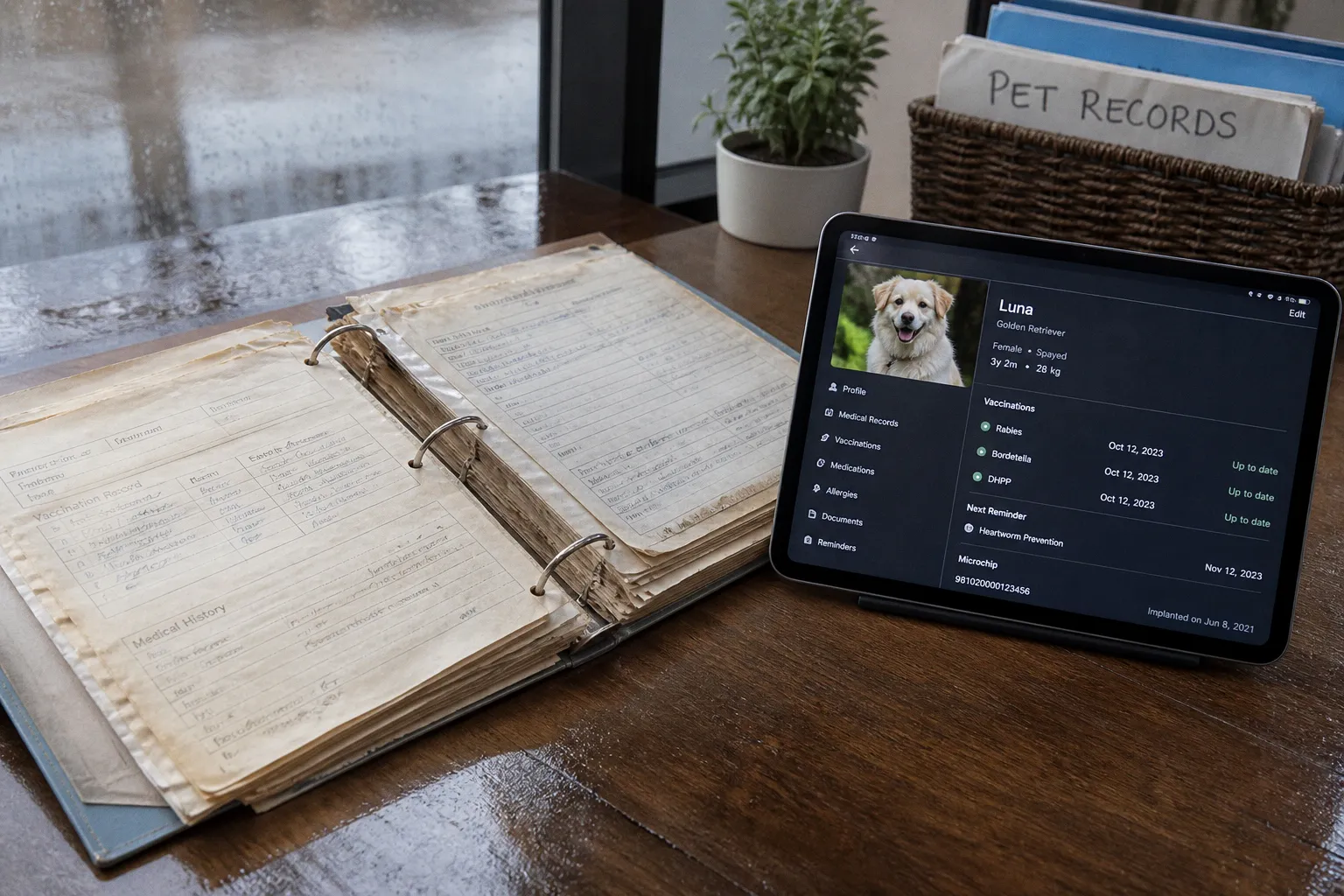
It is finding the right information quickly enough to support a safe decision: current medications, vaccine history, microchip number, known reactions, recent photographs, and the person authorized to approve treatment. That is where the debate over digital pet medical records vs paper binder becomes practical rather than theoretical.
Compare car rental deals in United Kingdom
See available offersPartner link — DiscoverCars comparisonA paper folder may be the fastest option in a clinic with poor connectivity or during a local evacuation. A digital vault may be the only realistic way to share a complete history with a new veterinarian, boarding facility, dog walker, or emergency contact at short notice. Neither format covers every failure point on its own. For most households, the more reliable system is a deliberately designed hybrid: a compact physical emergency folder for immediate local use, supported by a secure digital record containing the fuller medical history.
The reliability gap: why paper binders still matter
Paper records are often treated as outdated because they are less searchable and harder to share. That criticism is fair when a binder has become a thick archive of old invoices, duplicate vaccine certificates, and handwritten notes that no one has reviewed in years. It is less fair when the binder has been prepared as an emergency tool.
During a power outage, a road closure, a storm response, or a rushed visit to a clinic with limited internet access, a physical folder has one decisive advantage: it can be opened immediately. It does not require a password, a charged phone, a functioning app, or a clinic employee who knows how to access a shared account.
That local accessibility is especially useful for:
- A pet sitter who needs medication instructions while the owner is unreachable.
- A dog walker transporting an injured dog to a veterinary hospital.
- A family member evacuating with the animal but not familiar with its health history.
- A boarding facility operating under temporary conditions after a severe weather event.
- A clinic that needs proof of vaccination or ownership before the digital record can be retrieved.
A well-assembled binder should not attempt to carry the pet’s entire lifetime of documentation. Its job is to establish a baseline comfort and safety profile in the first few minutes of an incident. That means placing the current, decision-relevant documents at the front and moving older material into clearly labeled sections.
A practical emergency folder can include:
1. A one-page pet emergency information sheet. This should show the pet’s name, species, age, sex, weight, microchip number, identifying markings, primary veterinarian, preferred emergency hospital, and owner contact details.
2. Current medication instructions. List the medication name, strength, amount, route, timing, and the condition it treats. If the prescribing veterinarian has provided weight-based dosing, record the instruction exactly rather than rewriting it from memory.
3. Allergies and previous reactions. Include reactions to medications, anesthesia, vaccines, food, insect stings, or other known triggers.
4. Vaccination and preventive care history. Keep the most recent documentation easy to locate, particularly when boarding, transport, or shelter intake may be involved.
5. Recent photographs. Use clear images that show the face, body, and distinctive markings. These can support identification if the pet becomes separated from its handler.
6. Ownership and identification documents. Adoption papers, registration information, and microchip details can be useful when a pet is lost, transferred, or admitted by someone other than the owner.
7. Authorization and contact forms. A dog sitter emergency contact form should identify who may approve veterinary care, who can make financial decisions, and who should be called if the primary owner cannot respond.
A printed pet emergency information sheet PDF can be a useful starting point, but the template is not the system. The document must be completed, dated, and reviewed after changes in medication, weight, diagnosis, or contact information. An empty form in a drawer creates the appearance of preparedness without providing operational support.
Paper’s weaknesses are physical, not merely cosmetic
Paper binders are vulnerable to yellowing, fading ink, humidity, fire, flood, and simple loss. A folder left in a vehicle can be damaged by heat or water, while a binder stored in the home may be inaccessible if the household evacuates without it. Pages can also separate from their protective sleeves, and handwritten amendments may become difficult to interpret under stress.
This is why the physical format works best as a small emergency folder, not as the only record. Use tabbed dividers and sheet protectors, but keep the structure uncomplicated. A person who has never met the pet should be able to find medications, allergies, and veterinary contacts without reading every page.
The binder should also have a defined storage location. “Somewhere in the office” is not an emergency protocol. A more useful arrangement is to keep one copy in an agreed household location and, where appropriate, a second copy with the pet’s regular sitter or another trusted caregiver. The location should be communicated to everyone who may need to act on the pet’s behalf.
A paper binder is not obsolete; it is a local-access tool. Its value appears when the usual digital pathway is unavailable.
Digital vaults and the value of secure access
Digital pet records outperform paper in three areas that become increasingly important as a pet’s care network grows: searchability, controlled sharing, and reminders.
A digital vault can hold a comprehensive medical history without forcing a caregiver to carry a thick folder. A veterinarian may be able to search for a medication name, locate a prior lab result, or review an older diagnosis without manually scanning every page. A boarding facility can receive the relevant vaccination documents without being given unrelated financial or personal paperwork. A pet sitter can access the emergency contacts and medication schedule from a phone rather than relying on a photocopy that may already be outdated.
The best systems are not merely cloud folders filled with photographs of documents. They provide a consistent organizing method, permission controls, and a way to update records without creating multiple conflicting versions.
When evaluating a digital storage option, look for:
- Encryption at rest and in transit. AES-256 bit encryption is used by secure digital vaults and provides strong protection for stored information, although no system should be described as completely immune to outages, cyberattacks, or account compromise.
- Multi-device access. The owner should be able to retrieve the record from a phone, tablet, or computer rather than from one device that may be lost or damaged.
- Permission management. A sitter may need access to emergency contacts and medication instructions, while a veterinary clinic may need the full medical history. These do not have to be the same permission level.
- Clear update history. When a medication changes, the current instruction should be obvious, and older versions should not be mistaken for active prescriptions.
- Offline or export capability. If the platform allows a record to be downloaded securely for temporary offline use, that feature can reduce dependence on a live connection.
- Reliable recovery options. Account recovery should be possible without creating an unnecessary delay during an emergency.
- Reminder functions. Automated prompts can support vaccine renewals, parasite prevention, medication refills, and annual examinations.
Digital access is particularly helpful when care crosses geographic boundaries. A new clinic may need a history from the previous practice, a boarding facility may need proof of current vaccination, or a relocation coordinator may need to assemble records for transport and intake. Sharing one controlled file is generally more efficient than photographing individual pages and sending them through several messaging threads.
Digital does not mean automatically current
A digital vault can still contain incomplete or outdated information. Uploading a prescription does not update it when the veterinarian changes the dose. Saving a vaccine certificate does not confirm that it is still the most recent certificate. A scanned emergency contact form may contain a phone number that has not been tested in months.
A useful record has an owner and a review rhythm. After a veterinary appointment, update the diagnosis, medication list, and follow-up plan while the information is still clear. If the pet gains or loses substantial weight, ask whether weight-based dosing or equipment instructions need revision. When a sitter or family member changes, review access permissions rather than leaving old accounts active indefinitely.
Digital organization also depends on naming discipline. Files labeled “scan001,” “new vaccine,” and “final-final-record” create avoidable confusion. A consistent format such as the pet’s name, document type, and date makes the record easier to navigate:
Milo_Medication_List_2026-05Milo_Rabies_Certificate_2026-04Milo_Emergency_Contacts_2026-05Milo_Discharge_Instructions_2026-05
The purpose is not administrative neatness for its own sake. Clear file names reduce the time between recognizing a problem and delivering useful information to the person providing care.
What digitization changes at the veterinary clinic
The advantages of digital records extend beyond the owner’s phone. Veterinary practices are also moving toward electronic forms and electronic medical records because the format can reduce repetitive handling and improve information flow.
Available practice data indicates that moving to digital forms has increased appointment capacity by up to 25% to 30% in some veterinary settings and reduced consent-form errors by 40%. Those gains are operational rather than glamorous, but they matter during busy periods when staff are balancing admissions, discharges, treatment updates, and emergency calls.
Incomplete paper documentation can also contribute to missed charges and gaps in the clinical record. Some veterinary practices estimate revenue losses of 5% to 10% from charges that are not captured because paperwork is incomplete or difficult to reconcile. For the pet owner, the more important issue is that missing information can affect continuity of care: a medication may not appear in the current chart, a consent detail may need to be confirmed again, or a previous instruction may be unavailable when another clinician takes over.
There is a complication here. A fully digital clinic may be more satisfied with its system than a clinic operating in a paper-and-electronic hybrid. One survey found that 71% of veterinarians in fully digital clinics reported satisfaction with their systems, compared with 34% in clinics using a hybrid paper/electronic approach. That does not prove that every digital setup is well designed. It does show that a poorly integrated hybrid can create duplication rather than resilience.
The distinction is important for pet owners. A hybrid household system should not mean “some documents are on a phone, some are in a binder, and no one knows which one is current.” It should mean that each format has a defined role:
| Record function | Physical folder | Digital vault |
|---|---|---|
| Immediate access during a local outage | Strong | Dependent on device, power, and service access |
| Sharing with a new clinic | Slower and prone to copying errors | Fast, when permissions and connectivity work |
| Search across a long medical history | Limited | Strong |
| Protection from fire, flood, or physical loss | Weak unless duplicated | Stronger with secure cloud storage |
| Use by a sitter who is not at home | Only if the sitter has a copy | Practical through controlled access |
| Updating after a medication change | Requires reprinting and replacing pages | Usually faster, with version control |
| Proof of vaccination for travel or boarding | Useful as a local backup | Convenient for sending and verifying current files |
| Access without internet or a charged device | Strong | Limited unless exported or cached securely |
A veterinary practice may also have its own record system, so the owner’s archive should not be confused with the clinic’s official medical record. The owner’s system is a continuity tool: it gives caregivers and clinicians the information needed when the usual practice is closed, records have not yet transferred, or the pet is being treated in a different location.
The hybrid strategy: build a fail-safe emergency system
The strongest arrangement is not a competition between paper and digital. It is a layered system designed around predictable failure points.
The physical layer should be concise enough to use under pressure. The digital layer should be comprehensive enough to answer follow-up questions and support continuity of care. Both should contain the same core facts, but they do not need to contain identical document collections.
A practical setup can be built in four phases.
Phase one: establish the baseline record
Begin with the information that could change immediate treatment or identification:
- Current weight and date measured.
- Primary veterinarian and nearest emergency hospital.
- Medication list, including strength and schedule.
- Allergies, adverse reactions, and anesthesia concerns.
- Chronic conditions and relevant surgical history.
- Microchip number and registration contact.
- Vaccine status and other preventive care.
- Owner, secondary caregiver, and authorization contacts.
- Recent photographs and distinguishing markings.
This is the pet’s baseline comfort and safety profile. It should be understandable to a caregiver who is competent and responsible but does not know the animal’s history.
Phase two: separate the emergency sheet from the archive
Place the one-page summary at the front of the physical folder and at the top of the digital record. Follow it with the current medication instructions, veterinary contacts, vaccination documents, and authorization forms. Older records, invoices, lab reports, imaging summaries, and discharge notes can remain in the digital archive or in a secondary binder section.
This separation prevents a common failure: a caregiver receives too much information and cannot identify what is current. A complete record is useful only when the urgent facts can be found first.
Phase three: assign access by role
Not every person needs the same information. A dog walker may need the owner’s phone number, emergency clinic, basic medical alerts, and instructions for transport. A boarding facility may need vaccination documentation and feeding or medication details. A veterinary hospital may need the broader history.
Set access according to the task:
1. Primary owner: full record and authority to update it.
2. Secondary caregiver: emergency summary, medication instructions, contacts, and authorization details.
3. Pet sitter or boarding facility: only the records required for safe care and intake.
4. Veterinary professionals: the complete history when treatment or transfer requires it.
5. Emergency contacts: enough information to act if the owner cannot be reached.
This approach reduces unnecessary exposure of personal information while making the record usable. It also creates a clear transition phase when responsibility moves from the owner to another caregiver.
Phase four: test the system before an emergency does
Preparedness is not complete until someone other than the owner can use the record. Ask a trusted caregiver to locate the emergency contact, medication schedule, and veterinary hospital without verbal guidance. Open the digital vault from a second device. Confirm that the physical folder is where people expect it to be. Check whether the phone numbers still work.
A short review after each veterinary visit is usually more effective than a large annual reorganization. The review should cover:
- Medication changes and discontinued prescriptions.
- New diagnoses, procedures, or restrictions.
- Updated weight and dosing instructions.
- Vaccine or preventive-care updates.
- Changes in owner, sitter, or veterinary contact details.
- New photographs if the pet’s appearance has changed.
- Expired documents that should be archived or replaced.
If a platform fails during the test, treat that as useful information. Export the current emergency summary, retain the physical backup, and decide how the digital system will be accessed during a service outage. The objective is not to eliminate every possible failure; it is to ensure that one failure does not remove all access to the pet’s essential information.
Redundancy is not duplication for its own sake. It is the decision that a single dead battery, lost password, or damaged folder should not erase a pet’s care history.
The essential data points every pet medical organizer needs
The phrase “organizing pet health records” can sound like a filing task, but the real work is deciding which facts support safe action. A medical organizer should answer the questions a veterinarian, sitter, or emergency responder is likely to ask first.
Identification and ownership
Record the pet’s full name, age or date of birth, sex, breed or best available description, microchip number, registration details, and identifying markings. Include several recent photographs rather than relying on a single image. If the pet has a look-alike sibling or a name that is easily confused, describe the distinguishing feature directly.
Ownership papers and adoption records can become important during transport, shelter intake, or recovery after separation. Keep copies in the digital vault and the essential identification details in the physical folder.
Medical history
The record should show major diagnoses, surgeries, hospitalizations, chronic conditions, and known sensitivities. A short summary is more useful than a collection of disconnected invoices. For example, record the procedure and date, the reason it was performed, and any lasting restriction or complication.
If the pet has a history of seizures, diabetes, heart disease, kidney disease, respiratory problems, or severe gastrointestinal reactions, place that information in the emergency summary rather than burying it in the archive.
Medications and dosing
Medication details deserve special care because a small transcription error can have serious consequences. Include the medication’s exact name, concentration or strength, prescribed amount, route, frequency, start date if relevant, and whether it should be given with food. Note the prescribing clinic and the date of the most recent instruction.
Do not rely on a caregiver to interpret a label from a photograph. A clear medication list should stand on its own, and any weight-based dose should be copied from veterinary instructions rather than inferred by the owner.
Preventive care and veterinary access
Keep vaccination history, parasite prevention, and other preventive healthcare records current. Boarding facilities, transport providers, and shelters may request proof in a specific format, and older paper certificates may not be accepted as readily as verifiable digital documentation.
Access information matters just as much as the medical history. List the regular practice, emergency hospital, address, telephone number, opening hours if known, and any instructions for after-hours care. If the pet is traveling, add the destination clinic once arrangements are confirmed.
Paper health certificate processes are also changing in many areas, with outdated forms such as APHIS 7001 being phased out by some jurisdictions in favor of more secure and traceable digital Certificates of Veterinary Inspection. The practical lesson is simple: do not assume that an old form will satisfy a new clinic, state, transport provider, or border requirement. Confirm the current documentation pathway before travel or relocation.
Care instructions for the person on duty
Emergency preparedness includes the routine details that prevent a manageable situation from becoming more difficult. Record feeding restrictions, mobility limitations, handling sensitivities, crate instructions, and signs that indicate the pet needs immediate veterinary attention.
A caregiver should know who may authorize treatment and how to reach that person. The authorization should be specific enough to be usable, particularly if the pet sitter is taking the animal to a clinic while the owner is in transit or temporarily unreachable.
Choosing the right balance for your household
A small, healthy adult dog with one regular veterinarian may need a simpler system than a senior pet taking multiple medications or a dog who travels frequently between homes. The format should reflect the complexity of care and the number of people involved.
A paper-first arrangement may be reasonable when:
- Internet access is unreliable.
- Several caregivers are not comfortable with digital platforms.
- The pet’s emergency care is concentrated in one local area.
- The owner wants immediate offline access during evacuations or outages.
A digital-first arrangement may be more efficient when:
- The pet regularly travels, boards, or changes caregivers.
- Several veterinary practices need access to the same history.
- The medical record contains many lab reports, imaging files, or discharge instructions.
- The owner needs automated reminders and controlled remote sharing.
Even then, retaining a compact paper folder is sensible. A digital-first system still depends on power, device access, account recovery, and the availability of the service. A paper-first system still benefits from a secure digital archive that can survive physical loss and be shared with a distant clinic.
The goal is not to collect every possible document in every possible format. It is to create a dependable route from the first moment of uncertainty to the person who can provide appropriate care. That route should remain understandable during the transition phase when a family member, sitter, boarding provider, or new veterinarian takes responsibility.
Digital pet medical records vs paper binder is therefore the wrong question if it implies that one format must replace the other. Paper supplies immediate local access. Digital storage supplies searchability, sharing, reminders, and protection against many forms of physical damage. The hybrid approach gives each format a defined job and prevents a predictable technical or environmental problem from becoming a medical-information crisis.
Once the emergency summary is current, the full archive is secure, and another caregiver can use both without assistance, the system has done what it needs to do. It turns scattered paperwork into an organized care pathway—one that supports faster handoff, clearer decisions, and a calmer response when the pet needs help most.