Community pet resources: which support path fits your need?
When a pet owner is staring at an unexpected veterinary estimate or watching the bag of kibble run low with payday still a week away, the first feeling is rarely logistical. It is closer to panic.
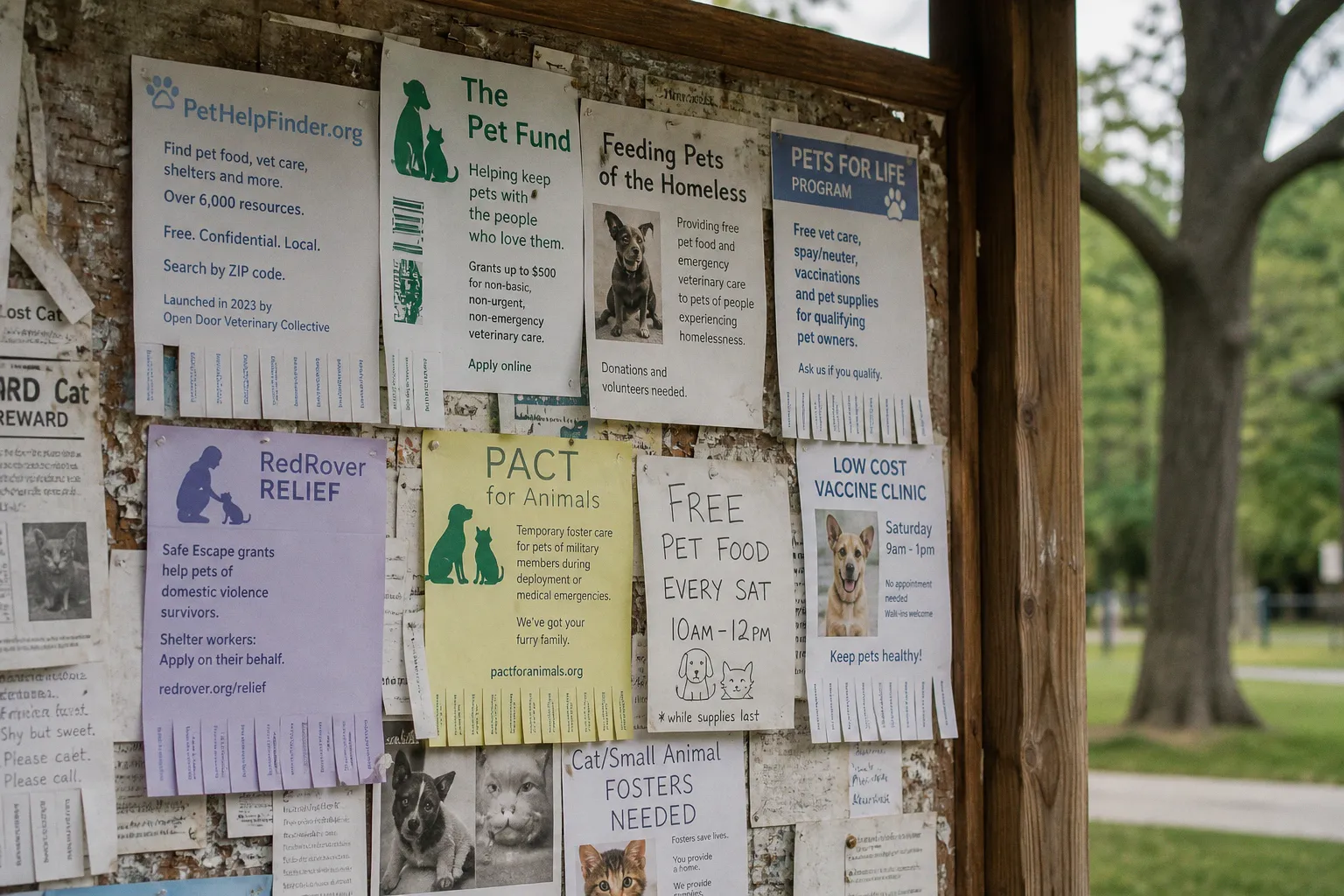
The dog needs the surgery, the cat needs the medication, and the family budget simply does not have a category called "emergency dog." The good news is that there is a real, navigable safety net behind that panic. There are more than 6,000 community pet resources for low-income families in the US and Canada, and they are organized far more logically than most people realize. The trick is knowing which bucket your specific situation belongs in before you start dialing.
Compare car rental deals in United Kingdom
See available offersPartner link — DiscoverCars comparisonThat is the work this guide is built to do. Rather than dumping a list of national hotlines on you, we are going to map the field by type of need: emergency medical, routine wellness, food and supplies, and crisis-driven boarding. Once you know which category you are in, the right resource tends to surface quickly.
The first thirty minutes of any pet-related financial crisis should go into classifying the problem, not into googling pet help. Identify the need, then match the resource.
Navigating the Database: How to Find Local Financial Aid
The single best starting point in 2026 is PetHelpFinder.org, a free searchable database launched in 2023 by the nonprofit Open Door Veterinary Collective. It catalogs over 6,000 financially friendly pet resources across the United States and Canada, including food banks, veterinary clinics, and temporary boarding programs. You can search by ZIP code and filter by service type, which eliminates the most exhausting part of the process: calling organizations one by one only to learn they serve a different region.
Before you open the database, take ten minutes to gather the documents you will almost certainly be asked for later. Most community pet assistance programs run on the same baseline paperwork: proof of income (recent pay stubs, SNAP award letter, Social Security statement, or unemployment documentation), proof of residence (a utility bill or lease), the pet's vaccination history if you have it, and a brief written summary of the specific need. Having these ready in a single folder means that once you find the right program, the application moves quickly rather than stalling for a missing pay stub.
PetHelpFinder is not an application portal. It is a routing tool. It tells you where to apply. The actual intake happens with each individual organization, which is why the eligibility nuance in the sections below matters so much.
Emergency Medical Grants and Veterinary Subsidies
There is an important distinction in this space that families often miss, and missing it costs them the grant. Most nonprofit veterinary grants are explicitly structured to cover non-basic, non-urgent, and non-emergency care. That sounds contradictory at first, so let me unpack it.
The Pet Fund, for example, offers financial assistance of up to $500 per applicant, and that ceiling is real money. But The Pet Fund will not pay for an emergency surgery that has to happen tonight. They will help with the diagnosed cruciate ligament repair that is scheduled three weeks out, the dental extractions that have been on the treatment plan for a month, the long-term oncology consultations. If your dog needs care right now, the more relevant path is usually a low-cost clinic in your area or a payment plan through CareCredit, not a grant program with a multi-week approval window.
Here is the practical split for triaging a veterinary bill:
| Situation | Best Resource Type | Why |
|---|---|---|
| Emergency (today/tonight) | Low-cost emergency clinic, CareCredit, or local humane society clinic | Grants cannot turn around in time |
| Scheduled surgery or specialty care | The Pet Fund ($500 cap), breed-specific rescue grants | Funding matches the timeline |
| Chronic condition management | Open Door Veterinary Collective member clinics | Sliding-scale ongoing care |
| One-time wellness package | PAL+ or Pets for Life (see below) | Bundled, no-cost core services |
The reason this matters is that grant funding is limited and is intentionally directed away from emergencies precisely because emergency funding would exhaust the pool within days. When you apply for the right tier, your odds of approval go up substantially. Submitting a The Pet Fund application for an acute emergency is not just a slow path; it is almost certainly a denial path.
A $500 grant that arrives in three weeks is a terrible match for a blockage that needs surgery tonight. Match the timeline before you match the dollar amount.
If you are in immediate crisis and cannot self-pay for an emergency, the humane society in your county typically runs a low-cost spay/neuter and wellness clinic that also knows the local funding landscape. Call them first. They will triage you into the right resource faster than any cold call list.
Securing Temporary Housing During Personal Crises
Boarding is the category where logistics get most tangled, because eligibility is rarely self-serve. Most crisis boarding programs require a third-party referral, and that detail catches people off guard. If you are about to enter a domestic violence shelter, are being hospitalized for an extended period, or have been displaced by fire or severe weather, the dog cannot be dropped off the way you would board for a vacation.
Several key programs cover these scenarios, each with its own operational scope:
- Denver Animal Shelter's Safe Haven Program is a localized initiative offering two to four weeks of temporary housing for pets of families in crisis. It serves the Denver area specifically and includes support for fire displacement, domestic violence, hospitalization, and severe cold weather under 15°F for individuals experiencing homelessness. Applications require a caseworker referral.
- RedRover Relief provides Safe Escape grants that cover temporary boarding and veterinary care for pets of domestic violence survivors, but the application must be submitted by a shelter worker on the survivor's behalf. Individuals cannot self-apply.
- PACT for Animals arranges temporary foster care for pets of military personnel during deployment and for pet owners facing medical emergencies that require long-term hospitalization.
The process of securing a referral is a significant logistical hurdle for families in the midst of a crisis. They often wait to ask for help until they are in the shelter or the hospital, and by then the pet has already been surrendered to a municipal shelter. The better sequence is: as soon as you know a crisis is coming, contact the shelter or hospital intake, ask specifically for their animal-welfare liaison, and have that person initiate the RedRover or PACT referral. The liaison exists precisely for this handoff.
There is also the cold-weather threshold to know about. In Denver, the Safe Haven program activates for unhoused individuals when temperatures drop below 15°F, which is a hard line, not a guideline. If you are in another city and have no local program, calling the nearest open-admission shelter—a facility that operates with a policy of accepting animals from its jurisdiction, typically including strays and owner surrenders—is often the fastest route to understanding your local options.
If a crisis is on the horizon, the animal-welfare liaison at your shelter or hospital is your single best ally. Their job is the handoff you cannot do yourself.
Accessing Essential Supplies and Routine Wellness Care
Food and routine care are the most common needs, and they are also the most generously resourced. Several programs are designed exactly for the "I can feed my dog but I cannot afford a $90 vaccine visit" profile.
Feeding Pets of the Homeless is a national nonprofit that distributes free pet food and emergency veterinary care specifically to pets of individuals experiencing homelessness. Local distribution partners run the actual hand-offs, so a quick search for the nearest partner site is the right first step.
For the broader low-income population, the Humane Society of the United States' Pets for Life (PFL) program delivers free veterinary care, spay/neuter surgeries, vaccinations, and pet supplies to pet owners in designated underserved and low-income communities. PFL is not available everywhere; it operates in specific service areas. Your ZIP code is the determining factor, not your income alone, which is why PetHelpFinder's geographic filter is so useful for screening.
If you live in Colorado, the Prevent-A-Litter Plus (PAL+) program from Animal Friends Alliance is one of the cleanest bundled offers in the field. It provides a one-time, six-month-long subsidy covering spay/neuter surgery, vaccinations, and microchipping for qualifying low-income pet owners. The six-month window is important: it gives you scheduling flexibility rather than forcing a single appointment date. The spay/neuter clinic that eventually led to the PAL/PAL+ lineage opened in 2007, and the program has matured into a reliable, repeatable pathway.
Here is a quick reference for matching routine needs:
| Need | Program | Window or Limit |
|---|---|---|
| Pet food (homeless clients) | Feeding Pets of the Homeless | Ongoing |
| Free veterinary care in underserved areas | Pets for Life (HSUS) | Designated ZIP codes |
| Spay/neuter + vaccines + microchip bundle | PAL+ (Colorado) | 6-month subsidy window |
| Local food bank for general low-income families | PetHelpFinder.org ZIP search | Varies by partner |
Two cautions worth flagging. First, federal SNAP benefits cannot be used to purchase pet food; this is a regulation, not a temporary restriction, so plan around it rather than waiting for a policy change. Second, the exact income thresholds for PFL service areas are not published centrally, so eligibility has to be confirmed by the local coordinator. Do not assume disqualification based on a guess.
Navigating Eligibility Requirements for National Programs
The most demoralizing part of applying for help is the rejection letter, and most rejections happen for preventable reasons. Eligibility is usually narrower than the program's marketing suggests, and the application process usually requires a specific sequence.
Three patterns show up across virtually every national program:
1. Funding is limited and is not guaranteed. Even when you meet every listed criterion, awards are competitive and cyclical. Apply to more than one program at the same time. The Pet Fund and RedRover operate independently, and applying to both does not disqualify either.
2. Referrals matter. RedRover Safe Escape, Denver Safe Haven, and many local boarding programs cannot accept a self-referral. The handoff has to come from a shelter worker, social worker, case manager, or in some cases a hospital discharge planner. If you do not have one, ask the intake desk directly. Most institutions have a list of on-call social workers for exactly this conversation.
3. Timelines have to align. A grant that pays for next month's surgery will not pay for tonight's emergency. A foster program that requires a deployment order cannot be activated for a one-week business trip. Match the program's stated timeline to your actual timeline before you start the paperwork.
The realistic expectation to set is this: for scheduled medical care, food, and wellness bundles, approval rates are decent if your paperwork is clean. For acute emergencies and same-week boarding, the bottleneck is rarely money; it is logistics. Building the relationship with a caseworker, a shelter liaison, or a low-cost clinic in advance is what unlocks the fast path when you actually need it.
Build the handoff before the crisis. The five-minute introduction to a shelter liaison today is the thing that saves your dog's place in your life six months from now.
Putting It Together
If you take only one thing from this guide, take the routing framework. Identify which category your need belongs in — emergency medical, scheduled medical, food and supplies, or crisis boarding — and match it to the resource type that was designed for that category. Use PetHelpFinder.org as the searchable map; use the national programs (The Pet Fund, RedRover, PACT, Pets for Life, Feeding Pets of the Homeless, PAL+) as the layered funding and housing support; and treat the caseworker relationship as the actual gatekeeper for the fast paths.
The pet care safety net is real and it is broader than most owners ever discover, but it rewards preparation. The families who get through a veterinary or housing crisis with their pet still beside them are almost always the ones who started the paperwork a few days before they thought they had to. That is the baseline comfort of a good plan: not the absence of problems, but a familiar anchor you can reach for when the problem lands.