Prescott Valley Police Launch Dog Walker Watch Program for Neighborhood Safety
The Prescott Valley Police Department will run its quarterly Dog Walker Watch session on August 12, 2026, per a department announcement.
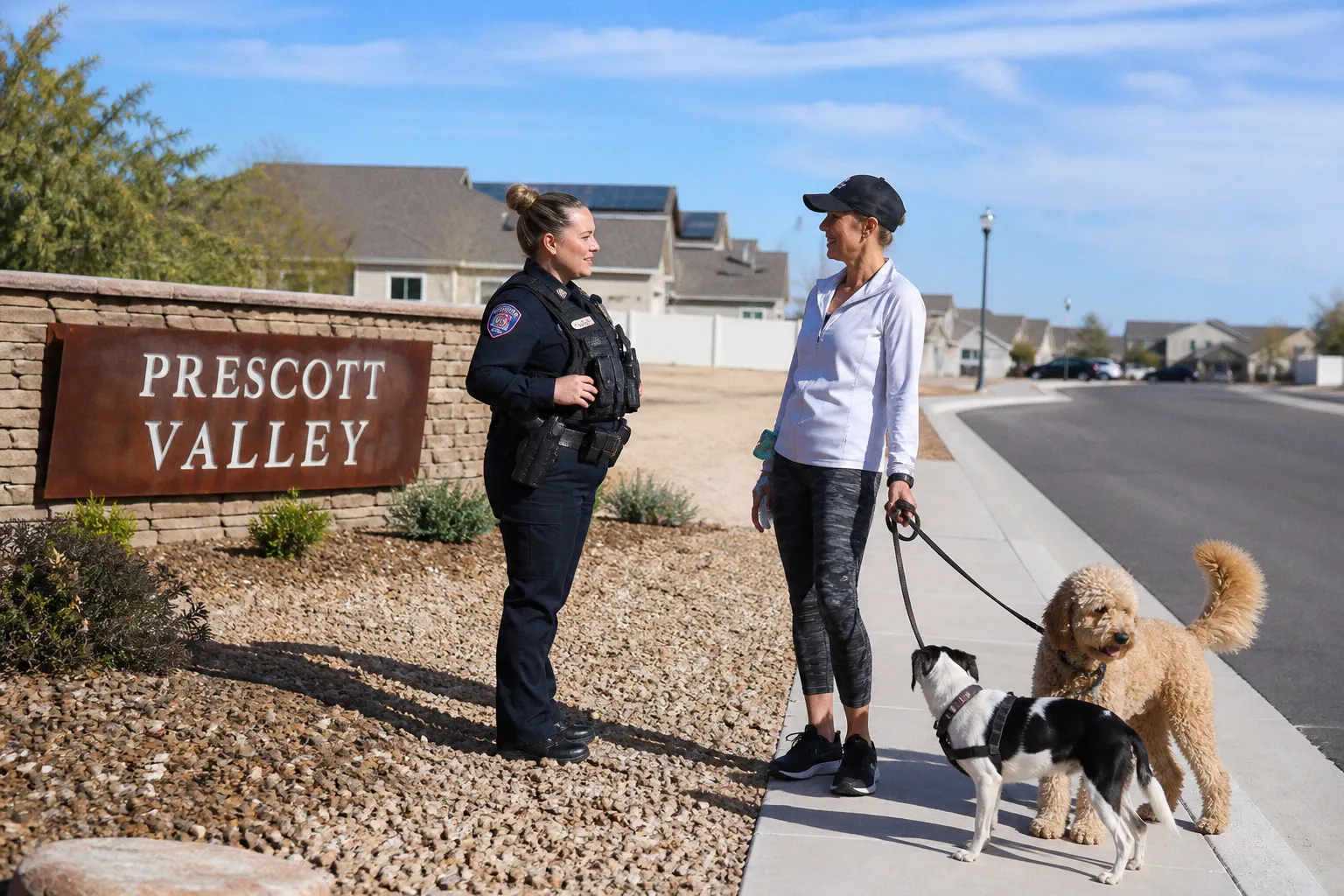
The program converts routine neighborhood routes into a documented observation layer for local law enforcement. For professional walkers, the meeting signals an evolving baseline of what local agencies expect from civilian operators working the public right-of-way.
Training Scope
The curriculum targets civilian walkers operating fixed loops through residential corridors. Instruction covers baseline observation protocols: pattern recognition for unfamiliar vehicles, license plate retention methods, and escalation thresholds for contacting dispatch. Officers walk attendees through reporting templates that capture timestamp, location coordinates, and physical descriptors without subjective interpretation. Body language notes are explicitly excluded from the reportable fields — the program trains observation of environment, not people.
No tactical engagement training is included. The role is witness and reporter, not responder. Walkers are not armed, not uniformed, and not authorized to detain. Their value lies in volume and consistency of observation across hundreds of small transits that patrol vehicles cannot replicate. A single walker covering the same four blocks at 9 a.m. and 5 p.m. produces a data set no cruiser can match.
Route Protocol Adjustments
Walkers who adopt this operating model should adjust three baseline variables on every assigned loop:
- Cadence. Fixed departure times create predictable observation windows. Predictable routes also mean deviations register cleanly — an open side gate that was closed yesterday becomes a data point rather than background noise.
- Documentation. Carry a charged phone with location services active. Note anything displaced from prior visits: yard furniture, vehicle positions, package deliveries, porch lighting status. Time-stamp each note. Voice memos outpace typed notes when the leash hand is occupied.
- Client Communication. Inform clients of the planned route and expected return window in writing. A missed check-in triggers a defined response — call the client, then the agency, then non-emergency dispatch. The sequence is pre-set, not improvised.
Verification Checklist
Before adopting any community-watch protocol on a paid route, confirm the following parameters:
- The program is administered by a sworn law enforcement agency, not a private affinity group or social-media network.
- Reporting channels are documented and tested before the first walk. Know who answers the call and how long they take to respond.
- Insurance coverage for the walking business explicitly includes acts performed under the program. Standard pet-sitting liability policies often exclude auxiliary observation duties.
- Client contracts acknowledge the auxiliary observation role and its limits. Clients must understand that their walker may pause a session to report an incident.
- The walker carries visible agency identification in case a resident or responding officer needs to verify affiliation.
The Prescott Valley session is open to local walkers, with venue and registration details sitting with the department. Operators outside the jurisdiction should query their own municipal channels for equivalent programming before assuming coverage exists. The protocol has limited value without documented agency backing and a tested reporting chain.